controversial Inland Revenue proposals for shareholder loans hit a major roadblock
The Finance and Expenditure Select Committee has reported back on the Taxation (Annual Rates for 2025-2026, Compliance, Simplification and Remedial Matters) Bill. This Bill contained measures in relation to changing the tax treatment of non-resident visitors who are working remotely while visiting New Zealand, introducing the new Revenue Account Method for calculating foreign investment fund income, plus the usual host of other amendments tidying up various issues.
The amendments to the tax treatment of New Zealand visitors are designed to encourage people to work here remotely without triggering too many adverse tax effects. One change proposed relates to disregarding the activities of a non-resident visitor present in New Zealand when determining whether a company is tax resident in New Zealand.
Watties, Heinz, tax and a Lions legend
This is a long-standing point and with Watties being in the news for all the wrong reasons, I recall an interesting point raised way back in the 1990s when Watties was acquired by Heinz, the international food manufacturing giant. Apparently, Tony O’Reilly, the former British Lion and then chairman of Heinz, was in the country at the time the deal was being finalised. Did this mean Heinz had a permanent establishment in New Zealand because key decision makers were here?
Tony O’Reilly in action against the All Blacks in 1959
That was a somewhat mischievous question. But it is an example of where key personnel being in a country may trigger unintended and adverse tax consequences. The Bill tidies up a number of issues relating to this as well as clarifying the treatment of remote working by non-residents.
No major changes to the Revenue Account Method proposal
When the bill was introduced, much fanfare was made of the proposed Foreign Investment Fund (FIF) Revenue Account Method. This allowed an eligible person’s FIFs to be taxed on a realised gains basis with a discount of 30% applied to the gain resulting in an highest effective tax rate of 27.3% (i.e. 70% of 39%).
This was seen as disappointingly high so many submissions on the Bill requested a higher discount to reduce the effective tax rate. These have all been knocked back on the basis that the maximum rate of 27.3% is broadly comparable to the 28% payable under the PIE regime.
But there are some minor mostly technical changes. For example, losses arising under the Revenue Account Method were initially to be ring-fenced and only available against future gains. Any such losses will now be available to offset against dividends from the same interests. So that’s a bit of a win.
And there is the ability also to allow taxpayers to sometimes use other method calculations which are required at present rather than and not lose their eligibility to apply the revenue account method to other interests. In other words, you can sort of split treatment on that. So generally, the rules are a progression, but I think you can read when you get into reading the fine printing, you sort of see the technical minutiae and issues that pop up because of the complexity involved.
There was an interesting, there’s also a proposal for essentially there’s a realisation tax on migration, and a point has now been clarified that If this happens, the calculation of any tax payable, because someone has used the revenue account method and then migrated out of New Zealand, they would use the market value of the interest at the time the person departs New Zealand, not the market value received when the interest is subsequently disposed of.
Quick example, a person leaves New Zealand when the market value of one of these interests is say, $500,000, subsequently sells it and realises the market value of $1,000,000. Any New Zealand tax payable will be based on the 500,000 being the market value at the time they left.
Don’t look the parents are squabbling…
There was a nice little spat between the various parties on the committee over the proposal to repeal the Section 17GB of the Tax Administration Act 1994, which allows the Commissioner to collect information for the purpose relating to the development of policy for the improvement of the tax system. This was the measure introduced under the last Labour government, which was then used as the basis for finding the information for Inland Revenue’s controversial 2023 High Wealth Individual Review. Unsurprisingly Labour and the Greens opposed its repeal as did 202 submissions (including for the record Baucher Consulting, and the Chartered Accountants of Australia and New Zealand). Eight submissions supported the repeal.
Information sharing risks?
Labour was also opposed to the provision expanding the ability to allow Inland Revenue to share information about individual taxpayers with other government agencies more easily by way of Ministerial agreement. The Labour Party MPs made this very valid point,
“While Inland Revenue has strict rules about which employees may access information about individual taxpayers and it polices those rules rigorously, the same protocol may not apply in other agencies.”
Indeed, Inland Revenue, to the best of my recollection, has never had issues where someone has emailed out a spreadsheet full of confidential details which we’ve seen both the Ministry of Social Development and ACC to name a couple of culprits do. The Labour Party also noted “This is a significant change to the rules that protect the privacy of taxpayers’ information. We note the Office of the Privacy Commissioner has concerns about these proposals.” Despite this the provision is to go into effect.
Financial arrangements – three welcome surprises
A big and welcome surprise relates to changes to the financial arrangements regime. Under the financial arrangements regime if certain thresholds are exceeded taxpayers must calculate income and expenditure on an accrual, or unrealised, basis rather than on a cash, or receipts, basis. These thresholds had not been increased since 1999, and the bill proposed to double them.
The regime also has a deferral threshold which means income and expenditure must be calculated on an accrual basis (unrealised) if the difference between calculating income on a cash (receipts) basis and the accrual basis exceeded $40,000 at any point. This applied regardless of whether a taxpayer’s total financial arrangements were under the $1 million threshold. Unsurprisingly, this deferral threshold frequently tripped up taxpayers (I even once saw advice from a Big Four firm which had overlooked its impact). I was one of several submissions recommending repeal of this threshold.
Inland Revenue has accepted our submission noting the deferral threshold
“…imposes a high compliance burden, requiring taxpayers to calculate income and expenditure on an accrual basis to compare it with a cash basis result and ensure that the difference is below a threshold. This is the same compliance burden that being a cash basis person is intended to avoid.”
This is an excellent result.
But wait, it gets better
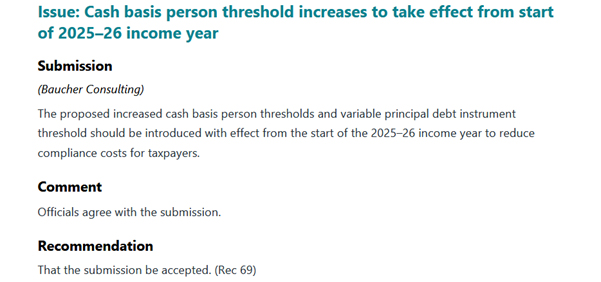
Under the Bill the increased thresholds were due to take effect from the start of the 2026-27 income year (1st April for most people). Adopting the principle of you don’t ask, you don’t get, I also submitted the threshold changes should be effective as of the start of current tax year (i.e. 1st April 2025). This would reduce compliance costs for the taxpayers, one of the key objectives of the Bill.
To my great surprise and delight, that was accepted as well, which is another excellent result.
But wait, there’s more…
KPMG made a very sensible submission that foreign currency loans used as mortgages over property should be removed from the financial arrangements rules and calculations. Exchange rate fluctuations can mean the deferral threshold is breached making any unrealised foreign exchange gains taxable. This once happened to one of my clients resulting in a tax bill of over $100,000.
Although Inland Revenue did not accept KPMG’s submission in full, it proposed instead “limiting the effect of foreign exchange fluctuations for the absolute value threshold”. This would be achieved by testing the absolute value threshold (now $2 million) is tested using the principal amount converted at a set date, for example, the first day of the financial arrangement, and ignoring subsequent foreign exchange fluctuations. If the principal amount changes for non-foreign exchange rate, reasons i.e. increases or decreases in borrowing, the financial arrangement should be reassessed for the threshold.
A bit late for my client perhaps but still a good result. The three change are also good examples of the Generic Tax Policy Process in action resulting in sensible law changes.
Controversial shareholder loan proposal halted
Moving on, late last year, Inland Revenue dropped what I described as a bombshell, with a consultation proposal for significant changes to the treatment of shareholder loans. Inland Revenue proposed that shareholder loans above a certain threshold would instead be treated as dividends, similar to the treatment for Australian and UK taxation purposes.
These proposals have hit a major roadblock with opposition from Winston Peters and New Zealand First together with the ACT Party. The end result is that the proposals as put forward in December will not be proceeding. Instead, Inland Revenue will continue to review the issue of the treatment of outstanding shareholder loans when a company goes into liquidation owing tax.
The proposals were quite controversial but the same time there was something of a tacit acceptance that yes, perhaps something needed to change. Simultaneously, there were concerns that Inland Revenue was perhaps muddling two issues. One of the issues was that companies that went under often sometimes owed substantial sums by shareholders, and in some cases, this meant Inland Revenue was missing out because funds were paid to shareholders instead.
John Cantin, former guest of the podcast, and also the independent advisor to the Finance and Expenditure Committee on the current tax bill has made public his submission to Inland Revenue on the shareholder loan proposals. His view is that more information is needed on the interaction between outstanding shareholder loans and company failures and the composition of the tax debt of such companies. If it is mostly GST and PAYE? Then yes, maybe that is something to be considered. He also thought there was merit in looking at changing the tax treatment of what happens on liquidation.
The upshot is we’ll be going back for round two of consultation. It’ll be interesting to see what comes out of this. Like John I think changes around what happens when a company is put into liquidation are sensible and also around keeping records of what we call available capital distribution amounts and available subscribed capital.
Property flippers – what about the tax impact?
And finally, an interesting story from RNZ about a complaint to the Real Estate Authority about a rise in so-called ‘property flippers’ making six-figure returns from unwitting vendors. Property data firm Cotality has noted a rise in significant rise in what’s called contemporaneous sales, with the number happening last year was almost double the total for 2024.
In a contemporaneous settlement, a property flipper makes a purchase offer with a long settlement period and then finds another buyer to purchase the property on the same day the property flipper has to settle their purchase. If it all goes to plan the property flipper makes a quick gain.
According to iFindProperty co-founder Maree Tassell who has complained to the Real Estate Authority about the practice:
“It’s quite common that there are some deals out there where people are making over $100,000-plus on contemporaneous settlements, getting a property under contract. The poor old vendor, and even often the vendor’s agents will think ‘oh this is a real purchaser’. …It’s quite deceptive to the vendors and quite deceptive sometimes to the agents.”
Although tax isn’t actually discussed in this story, these transactions would be considered a taxable trading activity even if they are not specifically within the bright-line test rules. It’s the sort of activity Inland Revenue should be watching with great interest. Property flippers should therefore beware, you may be making a quick buck, but Inland Revenue will be tracking these transactions. If you are not declaring the income, then you could find yourself with a big please explain somewhere down the line.
And on that note, that’s all for this week. I’m Terry Baucher and thank you for listening. Please send me your feedback and requests for topics or guests. Until next time, kia pai to rā. Have a great day.
We’re racing towards the end of the current tax year. And naturally, at this time of year, tax advisors will be planning ahead and considering what elections we might need to make before 31st March, whether to bring forward taxable income into this year or, if we can, defer taxable income into a later tax year because we are aware that in that new year a lower tax rate will apply.
Right now, I’m discussing these timing options with a number of clients who are thinking about transferring or withdrawing funds from their UK pension schemes. Such transfers/withdrawals are taxable under the foreign superannuation scheme transfer provisions in Section CF3 of the Income Tax Act 2007.
Long-term followers will know that I am not a fan of this regime, but it’s now been in place since 2013. One of my major criticisms with the regime is that it triggers a tax liability for the transferor, even though that person may not be able to access the funds in the scheme to pay the tax. This wasn’t really grasped by most of the industry until after the reforms were put in place.
The Scheme Pays solution
Subsequently, there’s been a long period of consultation between industry specialists and Inland Revenue, and then between Inland Revenue and HM Revenue and Customs (HMRC) to find an answer to this issue. Fortunately, and finally, that answer has now been found and will become effective from 1st April. It’s known as the ‘Scheme Pays’ option, under which the transferring scheme, the receiving scheme (which for UK purposes is known as a qualifying recognised overseas pension scheme or QROPS) will pay the tax on behalf of the transferor, the transfer scheme withdrawal tax.
The benefit of the Scheme Pays option is twofold. Firstly, the tax may be paid from the funds that are transferred. The problem that had existed previously was that HMRC could have treated a withdrawal to pay the tax as an ‘unauthorised withdrawal’ for UK tax purposes, which could come with a 55% tax charge on it. Working through a solution which was mutually acceptable to HMRC and Inland Revenue took some time.
Secondly because a QROPS is a portfolio investment entity the tax rate payable is capped at 28%. The option that now becomes available for people considering a transfer into a QROPS is If they do so, they will pay tax at 28%, which if they’re a higher rate taxpayer – 39% – is a very attractive option.
When to transfer?
The issue now under consideration is whether a person transfers a scheme before 1st April, be taxed at the usual personal tax rates and is therefore responsible for meeting the tax personally. Alternatively, defer the transfer until on or after 1st April and into a QROPS. The deferral will increase the amount of taxable income, but the trade-off is a flat 28% tax charge. There are some clients where that’s an extremely attractive option, and we’re talking about saving tens of thousands of dollars as a result.
There is an argument, in my view, that the tax rate for all transfers like this should have been 28% or linked to the top prescribed investor rate all along, because basically part of the rationale for this regime is countering people getting a benefit from investing offshore.
The transfer scheme withdrawal tax
The individual making the transfer is still liable for determining the taxable amount of the transfer. For example, if it’s $100,000, the receiving QROPS will withhold 28% or $28,000 from the amount transferred and pay it to Inland Revenue. The transferring taxpayer has got 10 working days from the point at which the funds reach the scheme to ask the scheme to pay the tax (‘Transfer Scheme Withdrawal Tax’) on your behalf.
The taxpayer can calculate the taxable amount using either the ‘Schedule Method’, or the ‘Formula method’ if it is available. For many people who are transferring defined benefit schemes, such as UK teachers’ pensions or UK police pensions, they must use the Schedule Method.
It may have taken a long time to resolve but the Scheme Pays option is a good alternative. As I said, it has the potential to save thousands of dollars for some taxpayers. So if you’re considering transferring your UK pension you should get in touch with your local tax advisor.
Changes to banking taxation ahead?
Moving on, in my last podcast I mentioned in passing that the Minister of Finance had made comments about a potential banking review. Subsequently there’s been a couple of stories in the New Zealand Herald and Business Desk on this matter, in particular, Inland Revenue are preparing a consultation document entitled Changes to Tax Rules for Foreign-Owned New Zealand Banking Groups.
the document outlines a series of technical proposals aimed at improving the integrity of the tax system. Apparently, the changes would affect offshore banks that have branches in New Zealand (about 6% of the banking sector by assets according to 2024 figures) rather than locally incorporated banks with which the vast bulk of Kiwi households and businesses engage. While the proposed changes could see banks pay a bit more tax, they aren’t aimed at generating material amounts of additional tax revenue for the Crown.
Although it’s interesting to see this issue under consultation, it represents one of the group of technical issues that Inland Revenue is always mulling over particularly because being the banking sector, there’s possibly quite some large sums involved.
A banking levy surprise in the Budget?
Dileepa Fonseka in Business Desk wondered, whether in fact, there might be some form of banking levy introduced as part of the budget on 28th May. He considered whether such a levy could possibly be tied to the recently established Depositor Compensation Scheme (DCS).
Dileepa notes that in Europe, 17 countries and the United Kingdom have introduced bank levies or financial stability contributions in the years following the Global Financial Crisis. Many were levied on the liabilities banks carry rather than profits and are designed to ensure financial stability and to cover the cost of insuring bank deposits.
It’s possible anything which taxes banks more might be a bit of a vote winner, even if, as experts note, there’s a chance that such levies might ultimately be passed through to customers. Dileepa also makes an interesting comparison with a similar levy which was a surprise sprung by Scott Morrison in 2017 when he was the Australian Treasurer (Finance Minister).
It’s interesting to see the stories circulating in this space. We’ll get more details on the Inland Revenue consultation when it is publicly released, and we’ll discuss it then. Meantime, as I said in the first podcast of the year, we could expect to see a bit of electioneering around a potential bank levy.
Foreign Investment Funds and transitional residents
Finally, this week, there’s an interesting Inland Revenue Technical Decision Summary, TDS 26/01, regarding the opening value of foreign investment funds. It relates to a transitional resident, a person who has either not previously been resident in New Zealand or has been non-resident for at least ten years. Transitional residents generally are eligible for a 48-month exemption from New Zealand income tax on their overseas investment income. But what happens when that exemption period expires?
The taxpayer in the TDS also requested a 31st December balance date, which had been approved by Commissioner. In other words, without saying so specifically, this client is probably an American who must file US tax returns to 31st December. And as the TDS notes, a 31st March balance date means there are high compliance costs because the person has to calculate income for US tax purposes to 31st December and then for our purposes to 31st March.
The taxpayer’s last day of his transitional residence exemption period was actually 31st December 2024. He requested a change of balance date for his tax year from 31st March to 31st December to align with his US filing period. Inland Revenue agreed to the request which means that balance date could be used for calculating hi FIF income. Which is good because that is very handy for many American clients, because of the dual reporting they have to do.
But the other point is that the TDS agreed the opening value for each FIF interest for the purposes of the income year ending 31st December 2025 would be nil, not the value as of 31st December 2024. That means that when applying the fair dividend rate, which is 5% of the opening value and any quick sales adjustments, the opening value would be NIL. Therefore, for the year to 31st December 2025, only the quick sales adjustment calculation will apply in relation to the FIF interests acquired and disposed of during that tax year.
This is an interesting little summary. It confirms a point that some of us had thought was the case, that clients required to file American tax returns could switch to a 31st December year end to help ease compliance. The taxpayer still has to request a change but this TDS indicates Inland Revenue should accept the request.
Still on foreign investment funds, we should hear this week about the final form of the proposed change, allowing taxpayers required to file US tax returns to adopt a quasi-capital gains tax or “revenue account” approach to their foreign investment fund interests, i.e. being taxed on a realisation basis. The Finance and Expenditure Committee is due to report back on 10th March on the Bill and we’ll bring you that news next week.
And on that note, that’s all for this week, I’m Terry Baucher and thank you for listening. Please send me your feedback and requests for topics or guests. Until next time, kia pai to rā. Have a great day.
Welcome to 2026. It’s early in the year, but the main drivers for the tax year seem already set. With $9.3 billion of tax interest and penalties outstanding as of 30th June 2025 Inland Revenue’s crackdown on debt will continue. It will also ramp up its investigation activities, with holders of crypto-assets under particular scrutiny.
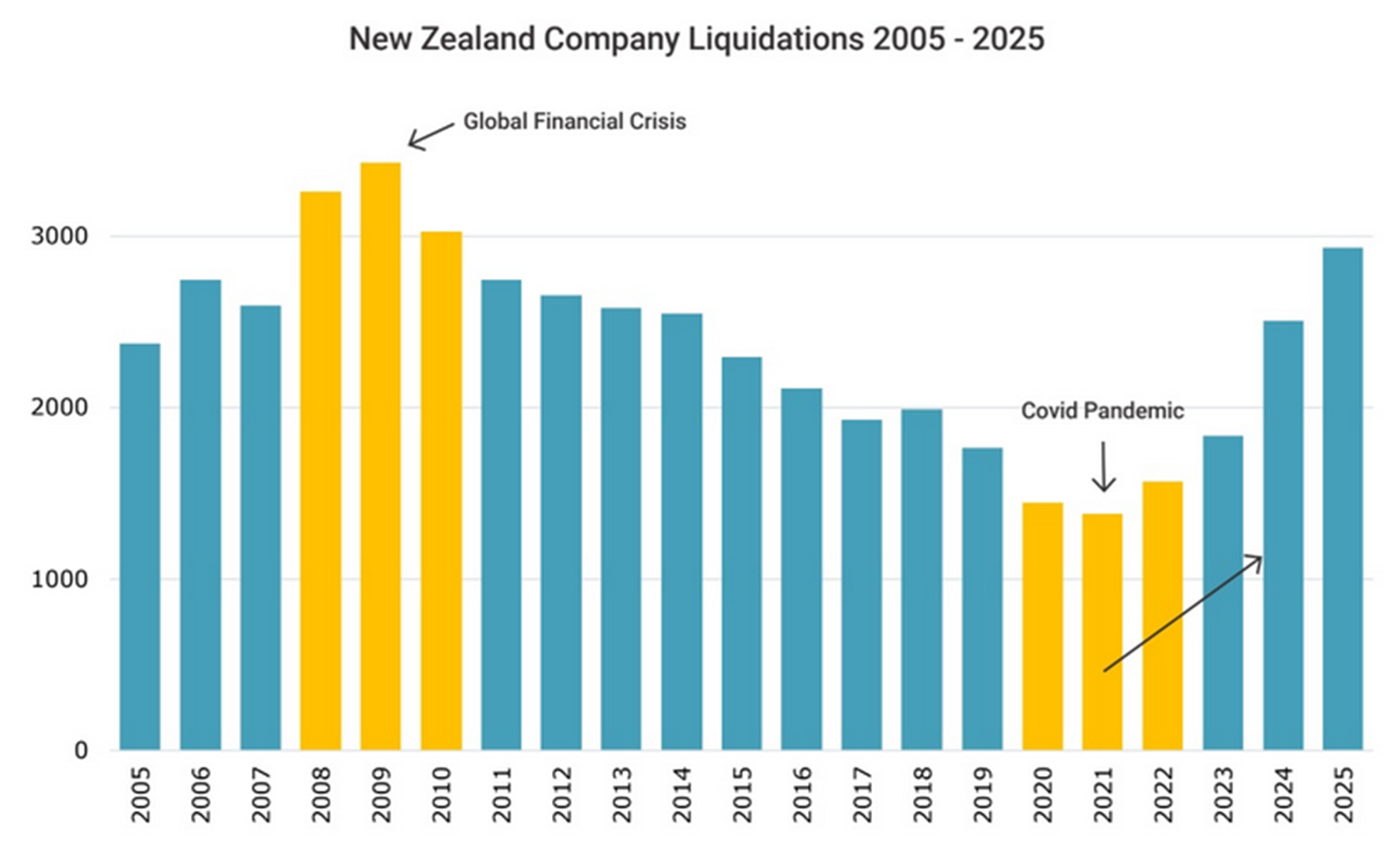
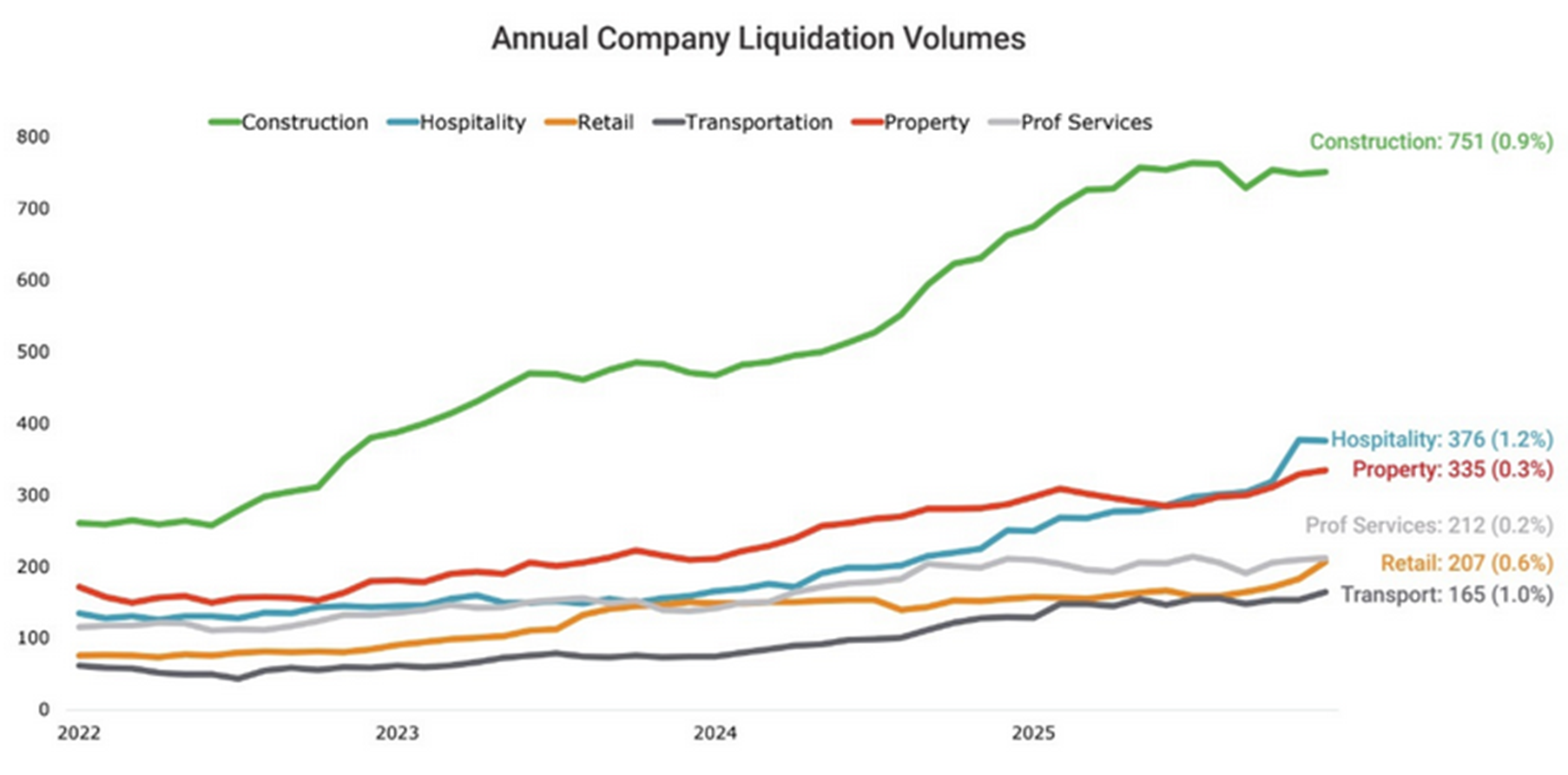
Inland Revenue is working hard to get the overdue tax debt down. However, the economy isn’t in great shape, with a recent story pointing out that liquidations have been the highest since the global financial crisis in 2008-2010. The construction sector in particular is struggling.
If you are behind with tax debt contact Inland Revenue
I cannot stress this enough, if you are in trouble with your tax debt, the first and best thing you should do, is to approach Inland Revenue. So long as you are realistic and open with, you will probably find it is prepared to work with you on an instalment plan. And in some cases where the debt is relatively small, say under $20,000, you can set up your own instalment plan, or your tax agent can help you do it.
The key thing is you have got to make the initial approach because Inland Revenue’s attitude hardens if it feels that a tax debtor is not making realistic attempts to address the scenario.
The 80:20 rule in reverse
An interesting feature about the composition of tax debt is that although the bulk of tax is paid by the very largest companies in the form of PAYE, GST, and company income tax, the majority of tax debt comes from SMEs, micro-businesses and individuals. As of 30th June 2025, over 527,000 taxpayers owed tax. For many of those small businesses, the owners are under enormous stress and it’s difficult to address the issue of tax debt. Perhaps surprisingly, my experience has been that many clients are relieved when they eventually do contact Inland Revenue as it’s often not as bad as feared and a plan is now in place.
Don’t expect the Election to change anything
We can also expect to see Inland Revenue ramping up activities. I would not be surprised if this year’s Budget has more funds for investigation and debt collection activities on top of the $35 million per annum boost it received in last year’s Budget. And by the way, this will be something that will remain the same even if there’s a change in government after the Election. Inland Revenue will still be expected to crank up its enforcement activities.
Cryptoasset investors targeted
On investigations, I’m hearing noises that transfer pricing reviews are increasing, but a key focus area is cryptoassets. Inland Revenue noted in its last annual report that it had several cases going through its dispute process, which involved “tens of millions of dollars”. It seems to be taking a fairly aggressive approach.
A client has shown me a letter where Inland Revenue have said, “if you do not make a voluntary disclosure or contact me directly, I will assume that you have deliberately failed to correctly declare your cryptoasset income.”
The tone of this letter was really quite surprising to me. Generally speaking, when Inland Revenue is considering investigations and audits, it is never as aggressive as that. More often the questions/letters that come in are along the lines of “Are you sure about that? Maybe you might want to check and come back to us.” Whatever Inland Revenue’s tone cryptoasset investors and traders should expect enquiries.
Wrapping, bridging, lending, borrowing and staking cryptoassets
Still on crypto, Inland Revenue has released a 30 pages issues paper for discussion setting out its view on the income tax treatment of wrapping, bridging, lending, borrowing, and staking cryptoassets, or decentralised finance (DeFi) transactions.
The basic position Inland Revenue has adopted with crypto is that it is property, and therefore the general rules apply that the disposals of crypto will be taxable if they were acquired for a main purpose of disposal or as part of a profit-making activity.
The paper refers to increases in crypto arising from DeFi transactions as “rewards”. Inland Revenue’s view is these are money’s worth and usually taxable when received. The analogy would be these rewards are like a dividend or an interest payment and should therefore be taxed. Submissions on the paper are open until 12th March.
Expect some crypto related court decisions
Last November I discussed the Technical Discussion Summary TDS 25/23 on the taxation of cryptoassets. As previously noted, Inland Revenue is currently involved with several similar cases involving “tens of millions of tax” so I expect some cases to appear in the courts this year perhaps either before the Taxation Review Authority, or the High Court.
As an aside it’s worth noting one of the interesting (and I don’t think it’s entirely healthy to be frank) issues with our tax system at present is that we don’t actually get an awful lot of tax cases coming through, partly because the dispute process is designed to try and resolve most issues before they get to court.
But I do wonder if it’s gone too far the other way. Supreme Court Justice Susan Glazebrook has publicly remarked on the decline in tax cases in the courts. Is that entirely healthy, given that tax is a fairly litigious topic? It is a little surprising when you step back and reflect that we don’t see many tax cases coming through. That said, I expect we will see some crypto related cases this year.
International tax – America goes its own way
Moving on, the year has been quite frantic with international developments. One of the features of the new second Trump administration is its withdrawal from many international agreements, and it has also made it very clear that it will view unfavourably what it regards as discriminatory tax practices.
As a result, the international two-pillar agreement that the OECD/G20 been working on for close to a decade now has hit a big speed bump, with the Americans making it very clear they don’t believe or consider that its multinationals (we’re talking particularly the tech companies) should be subject to those rules.
Now the end result of that is that there’s been a development called the side-by-side package which the OECD released in early January. l It’s convoluted as always with international tax, but at the moment, there’s only one country that qualifies for the side-by-side system, and you’ll not be surprised to hear that’s the United States. Basically, the idea is to allow Pillar Two to continue to coexist with the American tax regime and in theory deliver comparable minimum tax outcomes. In theory everyone is still progressing towards the 15% minimum corporate income tax rate globally.
Incidentally, the Pillar Two rules were effective for 2025 from a New Zealand perspective which means some multinationals may be subject to these rules. As I mentioned earlier, there’s been reports coming out from the Big Four that more transfer pricing reviews are happening. Anyway, we’ll keep our eyes on what’s going on in the global tax space. We expect to see more developments in that area. And it’d be interesting to see how Inland Revenue approaches its audit work in relation in this space.
“What’s in a name? That which we call a rose by any other name would smell as sweet”
Finally, it’s an election year and tax seems set to play a major part of the debate this year. So far Labour has proposed a capital gains tax on residential properties (excluding the family home) and commercial properties.
Meanwhile, echoing Juliet’s question in Romeo and Juliet, a sharp debate broke out last week, in relation to the Government’s gas levy to help pay for the proposed LNG facility in New Plymouth. Is it a tax or “just” a levy? We can expect to see more of this verbal jousting in the months ahead of the election.
Last week, the Finance Minister Nicola Willis was one of the speakers at a two-day economic forum at Waikato University. Interestingly, she brought up the question of tax policy, which is often a matter that’s debated at tax conferences although usually it’s the Revenue Minister discussing the topic.
The Finance Minister hasn’t exactly gone outside her lane because tax is a key part of her portfolio, but it is unusual to see her discuss it publicly.
She noted “tax policy certainty needs to span successive governments.” And that’s very true. The issue she was driving was a hope that Labour would support the Investment Boost package that was renounced as part of last year’s budget.
Investment Boost is an interesting initiative, one of what we call accelerated depreciation, which the OECD suggests we should be doing if we want to boost productivity. It’s an interesting mix of reactions to it, mostly positive.
I’ve had clients who are in the business financing sector report that it hasn’t had the booster effect that they were expecting.
So anyway, the Finance Minister was saying she hopes that Labour in the interests of consistent tax policy would keep Investment Boost. That remains to be seen. It’s an election year and to possibly; to borrow a rugby phrase, she’s getting her retaliation in first.
A bank taxation review?
In her speech the Finance Minister also raised the question of whether the four main big Australian-owned banks are paying enough tax. This seems a classic example of Bettridge’s law of headlines, that is, any headline that ends in a question mark can be answered by the word no. There’s a great deal of commentary around how much tax is paid by the big four banks and whether it is appropriate. They seem to have higher margins than their Australian parents and a higher margin compared with many other countries.
Australian introduced its Major Bank Levy in 2017 and there has been a long-running bank levy in the UK. Infamously, as the Green Party pointed out, Margaret Thatcher introduced a bank levy on excessive profits in the early 1980s. Anyway what the Finance Minister has apparently put on the radar is some form of review of the tax treatment or what’s happening with the tax and the big four banks. It will be interesting to see what comes out of the review.
Budget date announced
Finally, this year’s Budget will be on Thursday 28th May, a little later than I anticipated. We’ve been told it won’t be a “lolly scramble”, but being an election year, I expect we may see some surprise announcements.
Meanwhile the main themes for the year are set, more Inland Revenue debt recovery and investigation activity, an international tax picture in flux and finally because of the forthcoming election we’re going to be hearing a lot about tax. Whatever eventuates we will keep you up to date with developments.
And on that note, that’s all for this week, I’m Terry Baucher and thank you for listening. Please send me your feedback and requests for topics or guests. Until next time, kia pai to rā. Have a great day.
Earlier last year, Inland Revenue conducted a policy consultation on tax matters relating to charities and not-for-profit sector. At the time, there was a fair bit of speculation that there would be changes announced in the May budget in relation to the taxation of charities and in particular what was seen perceived to be the unfair tax advantage given to charities which owned businesses.
That actually didn’t play out, but instead Inland Revenue pushed forward with consultation on the taxation of mutual transactions of associations or not-for-profits, including clubs and societies. Behind the scenes it began targeted consultation in November with around 50 persons and organisations who had provided feedback on the previous consultations. This consultation covered donor-controlled charities, membership subscriptions, and other matters.
A Christmas surprise?
On 15th December, just before Christmas, Inland Revenue then released what it called a ‘Targeted policy consultation’. This explained what had happened in November and that it was now seeking more feedback because of wider public interest in the issue. The thing was, though, the initial deadline for submissions was 24th December. However, Inland Revenue added it would be prepared to extend this submission deadline on request, but it plans to review all submissions by late January.
The surprise part of the consultation is in relation to membership subscriptions and related matters. The consultation makes clear that membership subscriptions charged by tax-exempt not-for-profits, such as the 29,000 registered charities and 19,000 amateur sports clubs, are not taxable currently and will not be taxed under the proposals out for consultation.
Are membership subscriptions taxable?
But the question under consideration is around membership subscriptions for most not-for-profit organisations. Currently, the accepted treatment is that trading with members, such as conferences and sales of merchandise, are considered taxable income, but membership subscriptions were not as they were covered by the ‘mutuality principle’. However, Inland Revenue has drafted an operational statement “…indicating that it is likely to formally change its view and state that under current law many membership subscriptions would be taxable.” Needless to say, this would be an unwelcome surprise for quite a lot of groups. Although there may be a trade-off in that some other expenses which are currently not deductible may become deductible.
The consultation also suggests the current annual tax-free threshold of $1000 could be raised to $10,000. There are also suggestions to simplify the income tax filing requirements for taxable not-for-profits, but Inland Revenue also wants to require banks and other financial institutions to provide it with financial information for those not-for-profits who use the tax-free threshold.
This is a surprising and for many organisations unwelcome development estimated to raise perhaps $50 million annually. From what I’ve seen there’s no clear explanation given as to why Inland Revenue thinks the mutuality principle no longer applies in relation to the subscriptions. I imagine there will be quite some pushback on the membership subscription issue. It will be interesting to see how this plays out and what changes are announced in the 2026 Budget.
“Don’t look back in anger” – 2025 in review
Talking of Budgets, the 2025 budget on 22nd May contained a pleasant surprise with the announcement of the Investment Boost allowance. This enables businesses of any size to fully deduct 20% of the value of any new assets in the year of purchase. Interestingly, it also includes new commercial and industrial buildings and would also cover earthquake strengthening in some cases. Perhaps surprisingly, there was no cap put on the amount which could be claimed by a business.
The Investment Boost initiative is designed to boost investment and productivity, a theme in common with other tax initiatives, for example, proposals for digital nomads and changes to the Foreign Investment Fund regime included in the Taxation (Annual Rates for 2025−26, Compliance Simplification, and Remedial Measures) Bill currently before Parliament. It’s actually a on long-standing principle of our tax policy to enable investment in New Zealand and remove barriers to doing so.
The investment boost was a big surprise. Whether it’s had the hoped for impact is not clear yet. As everyone is well aware, economic activity was bumpy in 2025, but it could be that the groundwork has been laid for a stronger recovery this year.
Boosting Inland Revenue’s compliance activities
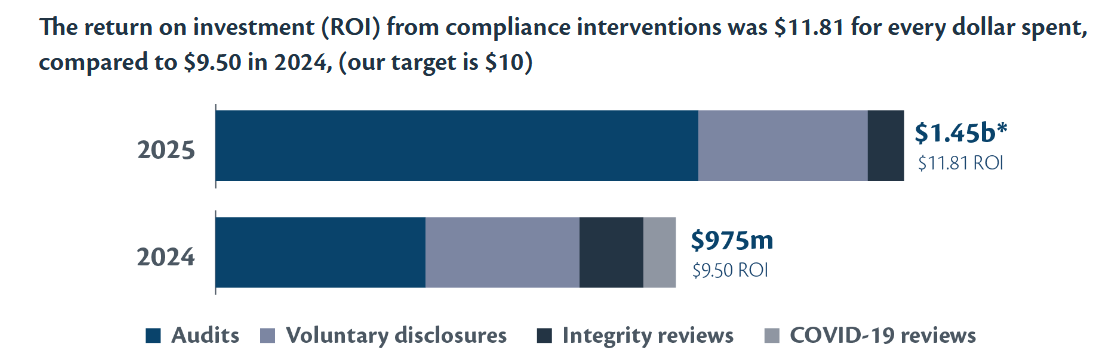
Another constant theme for the year, was more money in the 2025 Budget for Inland Revenue to boost its compliance activities. On top of the $116 million it was given over 4 years in the 2024 Budget it got another $35 million in the 2025 Budget. Consequently, 2025 saw great degree of investigative work by Inland Revenue. According to Inland Revenue’s 2025 Annual Report, it has achieved great returns from its increased compliance activities.
In addition to investigation and review work, Inland Revenue is also trying to close off what it considers loopholes and areas where there appears to be seepage in the tax system. The not-for-profits consultation we discussed earlier is one such example. However, arguably the biggest single example, and which was such a bolt from the blue, I called it a bombshell, was the recently announced consultation on the taxation of shareholder advances. It’s one of the most significant changes to the taxation of small businesses in recent years, potentially worth several hundred million of additional tax revenue annually. We’re therefore going to see a fair bit of lobbying and feedback about the proposals which are almost certain to be as part of the 2026 Budget and the annual tax bill. Watch that space.
Targeting crypto-assets
The taxation of crypt-assets is one specific area where Inland Revenue is currently very active. In November I discussed Technical Decision Summary TDS 25/23 where investors in crypto-assets lost the argument that gains were on capital account and therefore non-taxable. This case is probably the tip of the iceberg as according to Inland Revenue’s 2025 Annual Report “As at 30 June 2025, more than 150 customers were under review, with total tax at risk in the tens of millions.”
We’ll also see ongoing activity from Inland Revenue reviewing property transactions. Everyone tends to underestimate how much access to data Inland Revenue has and the information sharing which goes on with other Government agencies and tax authorities around the world. I’m sure I’m not the only tax agent seeing increasing numbers of inquiries from clients and Inland Revenue relating to investigations or reviews covering overseas income which may or may not have been declared properly.
Tax debt – a $9.3 billion problem
The other big area for Inland Revenue is managing the debt book, in late November I had a very interesting discussion with Tony Morris from Inland Revenue about how it is approaching the management of its debt book, which is over $9.3 billion and what steps are being taken to reduce this.
I’m seeing a much more forceful attitude from Inland Revenue around earlier interventions and debt collection. In some cases, that’s well merited. Other cases, I think it’s been a little ham-fisted. There’s also work to be done in managing companies which fall behind on GST and PAYE. Much earlier intervention is needed there. But one hopes that the extra money that Inland Revenue has received from the government will aid that. Getting the debt book under control is obviously very important for Inland Revenue and for the Government.
One area I think actually needs a fundamental redesign, is the question of student loans where only 30% of overseas-based debtors are making repayments at this point. Now, Inland Revenue does have the power in many double tax agreements to ask overseas authorities to intervene on its behalf, but it seems to have been a bit reluctant to do so. 2026 may see a change in this approach.
Overall, we can expect to see Inland Revenue gathering using all its available tools to collect the maximum amount of overdue debt and bring the debt book under control. That’s been a big theme in 2025 and it’s going to be a continuing theme this year.
The Trump effect
Internationally, the second Trump administration has caused all sorts of upheaval across the world order geopolitically, but also in the tax space where progress on the already grindingly slow Organisation for Economic Cooperation and Development/G20 multilateral tax proposals, the so-called Pillar 1 and Pillar 2 proposals, has basically ground to a halt.
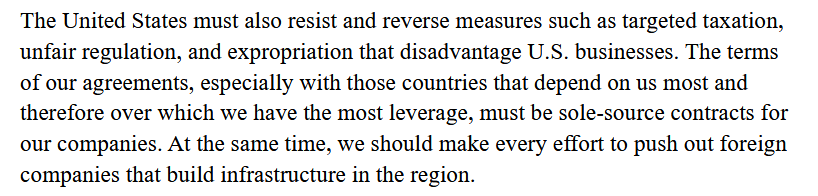
The Trump administration made it clear early on it is hostile to what it considers unfair taxation and regulation. Its National Security Strategy released in November spelled it out bluntly.
(National Security Strategy of the United States of America, page 19)
Against this background it’s hardly surprising the Government in May decided to withdraw (“discharge”) the Digital Services Tax Bill.
Big Tech, Little Tax
The multilateral Pillar 1 and Pillar 2 deals seem dead in the water, but as the Tax Justice Aotearoa noted in their report, Big Tech, Little Tax that still leaves the problem of the tech companies’ apparently extensive use of transfer pricing methodologies to minimise their tax bills.
One of the examples the Tax Justice Aotearoa report considered was Oracle New Zealand, which according to its 2024 financials, earned revenue of $172.7 million, but paid licensing fees of $105.3 million to an Irish-related party company. It ultimately finished up with taxable income of just $5.3 million. It’s apparently paid royalties representing between one third and three-fifths of its total revenue. Oracle, incidentally, is currently undergoing an audit in Australia and there’s a related tax case going through the courts, which I expect Inland Revenue will be watching very closely.
And then there’s Microsoft, which earned revenue of $1.32 billion, but then paid over a billion dollars in purchases to another Irish located related party company.
The Digital Services Tax might have had some impact on this, but a more likely tool to try and recover additional tax would be to start applying non-resident withholding tax on the royalty element of any cross-border payment. The payments should remain deductible, but subject to a (typically) 5% withholding tax. Such an approach should be acceptable under most long-standing international agreements, but it will be interesting to see what pushback emerges if Inland Revenue adopts this approach.
Tax policy highlights the rising cost of demographic change
In the tax policy space in general, it’s been an interesting year with the Inland Revenue’s long-term insights briefing somewhat controversially looking at the question of the tax base. This was alongside Treasury’s He Tirohanga Mokopuna, statement on the long-term fiscal position which took a 40-year view of the Government’s fiscal position. A common theme was the demographic pressures on pension funding. Unsurprisingly that, together with the rising costs of climate change, was also a major theme the OECD’s review of tax policy in 2024.
Capital Gains Tax – a never-ending story?
The seemingly endless debate about capital gains tax continued through 2025. The International Monetary Fund paid its regular Article IV visit and suggested it might not be the worst thing in the world. The more interesting IMF report to me was about New Zealand productivity, where it directly suggested that the lack of a capital gains tax has meant excess capital has been gone into property rather than into productive investment, and it could be a factor in our low productivity. That’s not an unreasonable conclusion in my view.
Then we had the Labour Party finally announcing its somewhat limited capital gains tax proposal, which will apply to all residential investment and commercial property. That’s a little less bold than what Labour Party members wanted, but on the other hand is in line with our practice of incremental changes. It’s also pretty much in line with what the minority group on the last tax working group suggested, a comprehensive capital gains tax wasn’t needed, but expanding it into the taxation of residential property was certainly recommended.
The Tax Policy Charitable Trust brought down former IMF Deputy Director Professor Michael (Mick) Keane for a couple of lectures, one of which was in Wellington at Treasury. He made the interesting observation that most tax jurisdictions which do have a capital gains tax, and remember we’re in the minority, approach it from the basis that everything is in unless it’s out. Presently, our approach is the flip side, everything is out unless it’s in but the problem is there’s a lot more in than people realise and so there’s seepage of potential review. In terms of conceptuality, I think his approach is to be preferred. Include everything and then carve out exemptions (such as the family home). That is what we see around the world as he noted.
Looking ahead as always, there will be a huge debate going on around what are the best tax settings for New Zealand as we head into the second half of this decade. With 2026 being an election year, we’re going to hear a lot about capital gains tax. I’m afraid non-tax geeks will probably be heartily sick of it by the end of the year.
Thank you
Finally, I’ve been very fortunate with the guests I’ve had this year, so thank you all, you’ve been most interesting and generous with your time. A special shout-out to Tony Morris of Inland Revenue for a fascinating discussion on where Inland Revenue is working in the debt space. (Transcript coming soon).
And on that note, that’s all for 2025, we’ll be back in late January to cover all the latest developments in tax as always. I’m Terry Baucher and thank you for reading and commenting. Please send me your feedback and requests for topics or guests. In the meantime, best wishes for 2026!