The Government’s “targeted, timely and temporary” fuel relief package does as I thought it would, make use of the Working for Families tax system, but not to the extent that I had hoped. The proposal is to increase the In-Work Tax Credit (IWTC) by $50 a week. That will last for up to 12 months or sooner if until 91 octane falls below $3 a litre for four consecutive weeks.
The package will benefit 143,000 working families with children who will get receive the full $50 a week, with another 14,000 additional families getting a reduced payment, thanks to the impact of the abatement thresholds. First payments will be made on 7th April if people receive IWTC and Working for Families weekly, or 14th April if they’re paid fortnightly. The package is expected to cost $373 million if it runs for a full year will be counted against the Government’s operating balance for Budget 2026, which is coming up next month on 28th of May.
Whether it’s why broad enough is obviously a concern because prices are racing up particularly that of diesel which at my local Gull petrol station has risen 30 cents per litre this month alone to overtake 91 Octane petrol. There’s a lot of pressure on families out there.
The Lord giveth…and taketh
The start of the new tax year on 1st April also means a number of other changes took effect, some of which will take funds away from families. One of the more noticeable changes will be the increase in KiwiSaver contribution rates, which rise from 3% to 3.5% for both employers and employees. This happens automatically unless the employee applies for a temporary reduction to stay at 3% which can be for between 3 and 12 months. An employer is not required to increase their contributions if an employee requests a temporary reduction. According to an ASB survey perhaps 15% of employees planned to request a temporary pause on the increase to 3.5%.
ACC rates have also increased with the earner’s levy rising from 1.67% to 1.75% per $100 earned up to the maximum of $156,641 per annum. The minimum wage increases from $23.50 an hour to $23.95 an hour. But Best Start payments for babies born after 1st April will now be subject to abatement on annual family income over $79,000.
In my last podcast prior to the announcement of the fuel relief package, I suggested one option could be to increase abatement thresholds. It so happens the abatement threshold for Working for Families was increased, with effect from 1st April, from $42,700 to $44,900, the first increase since June 2018. However, in keeping with the theme of giving with one hand and taking with the other, the abatement rate also increased from 27 cents per dollar to 27.5 cents per dollar.
Relief package highlights abatement issue
The $44,900 income threshold is for a FAMILY’s income. Also keep in mind that someone working 40 hours at the new minimum wage of $23.95 per hour, has a total annual income of $49,816, which is nearly $5,000 above the new threshold.
The Government’s package here highlights an issue we’ve raised repeatedly now for several years about the interaction between low abatement thresholds leading to high effective marginal tax rates for persons on average and sometimes below average income.
The Government finds itself, giving with one hand, and then taking with the other. And the taking bit isn’t always noticed by the general public. The announcement of a $50 boost will go down well for those 143,000 families that are going to get it, very welcome indeed. But there’s the other 14,000 families who won’t be getting the full benefit, and a whole group that never got anything at all but still have increased transport costs.
The Working for Families abatement threshold is far too low which results in clawing back family income at a time when families need every cent possible, because this fuel shock is going to feed through to transport costs, obviously, and from there into the price of food.
An incredibly complicated system in need of reform
Over the past 30-odd years New Zealand has developed an incredibly complicated system of benefits where we’re giving with one hand, clawing back with another hand, and not looking at the overall impact of what we’re trying to achieve. I understand the question of abatement thresholds and its impact was actually discussed at the recent International Fiscal Association conference and my thanks to Robyn Walker of Deloitte for raising the issue for discussion.
But this is something I’m going to continue to raise. It would good to be hopeful we might see something in the coming Budget, but I wouldn’t hold out much hope for that because if something in this area was under serious consideration, it might have been included as part of this temporary package. But clearly, that’s not likely to happen, particularly since the threshold has just been increased.
Changes to thin capitalisation
The necessary legislation for the fuel relief package was included in the Taxation (Annual Rates for 2025–26, Compliance Simplification, and Remedial Measures) Bill we’ve been discussing in the past couple of podcasts. A number of other late amendments were also included in the Bill prior to it finally passing into law. A major change was in relation to the thin capitalisation regime in relation to infrastructure projects.
By way of background, overseas investors can choose to fund their New Zealand investments with equity or debt. If the investment is made via equity there’s no deduction available. However, if the investment is debt funded a deduction is normally available for any interest payable on the debt. Consequently, from a tax perspective debt financing is obviously preferable.
Back in 1995, New Zealand introduced some thin capitalisation (or thin cap) rules, which basically said for foreign-controlled home subsidiaries, the amount of tax-deductible debt would be limited to 60% of the net debt asset ratio for the New Zealand entity. (There’s some fluctuation allowed to this threshold depending on the worldwide group tax percentage for the total group of companies).
Thin cap rules are very common worldwide as a counter to excessive interest deductions, but it’s been recognised they can be a potential hindrance on infrastructure projects.
A targeted exemption
I understand discussions have been going on for some time with interested parties with suggestions that New Zealand follows Australia in introducing a specific thin cap exemption for infrastructure. The Government has therefore
“Agreed to a targeted exemption to the thin capitalisation rules specifically for infrastructure investment (including new infrastructure projects as well as existing infrastructure businesses), that aims to mitigate a potential impediment to foreign investments in New Zealand’s infrastructure under the existing rules.”
Under the amendment effective from the start of the 2026-27 tax year, any entity now electing into it will be able to deduct interest expenses on its full amount of debt, without a thin capitalisation adjustment so long as the debt is applied to the eligible infrastructure entity’s business or project, is from a genuine third party and does not have any equity-like features. The lender must only have recourse to the assets and income of the entity. Furthermore, the New Zealand entity still has to be capable of supporting the debt on a standalone basis without any further support from its investors.
This is a step forward and ties in with the Government’s overall plan to develop infrastructure and assist infrastructure projects. There’s been some discussion about the revenue loss risk on such an initiative, but equally we’re experiencing the risk of not building enough infrastructure in the first place. So maybe accepting there may be a risk around tax seepage is the right way forward.
Tax change for the New Zealand Superannuation Fund
The Bill also enables the New Zealand Superannuation Fund to pay its tax payments annually rather than through the provisional tax regime, as it currently does. This is designed to help its cash flow because as the country’s largest investor and taxpayer, it locks up a lot of capital in provisional tax payments, which if it gets wrong, can have quite severe use of money interest implications.
Using tax pooling to collect tax debt – another band-aid solution?
One other interesting change is a pilot extending the time limit to use tax pooling to satisfy income tax debt for the 2022-23 and 2023-24 income years. At present if you have not paid your tax in full for those years use of money interest (8.97% from 16th January this year) will be charged.
The proposal is to allow payments to be made using tax pooling (which has a lower effective interest rate) for those outstanding years until 1st of October 2027. This option is not allowable if the applicant has been bankrupted or is the subject of recovery proceedings for unpaid tax. The debtor must be up to date with their income tax and GST returns and with your GST and PAYE payments. (Inland Revenue does have some discretion to allow tax pooling if it considers it’s a one-off scenario, and it has accepted an application for financial relief under the Tax Administration Act).
This is an interesting idea to try, which could help with the over $9 billion of tax debt currently outstanding. However, I think it’s another example of perhaps putting a patch on or a Band-Aid on instead of rethinking the whole issue. At the moment late payment penalties AND use of money interest apply to late paid tax. In my view it should be either late payment penalties or use of money interest, but the combination of the two is a double whammy, which I don’t think is particularly effective and just aggravates clients.
Use of money interest is a vital tool, and I have no issues with it. We could argue that the rate is very high, but then it has to be because the Government doesn’t want to be treated as a banker of last resort. Nevertheless, I think reviewing the whole issue of late payment penalties, use of money interest, and how much of a factor they are with companies and individuals defaulting on their tax, would be a worthwhile exercise.
Inland Revenue myIR accounts under cyber-attack
Finally, Inland Revenue is always on the watch out for cyber security risks and so it’s introduced two-step verification when people are accessing their My IR accounts. This is to counter attempts by cyber criminals to hack into people’s My IR accounts.
Last month Inland Revenue noticed a significant increase in malicious attempts to log on with over 500,000 attempts made.
Unfortunately, around 300 MyIR accounts, which did not have two-step verification set up, were accessed. Inland Revenue has closed these accounts and they’re also monitoring another 900 accounts where a correct password was entered, but the two-factor authentication prevented access.
Always be alert that your My IR account contains highly sensitive data. This includes, dates of birth, addresses, details of your bank account, and your earnings. It’s good to know that Inland Revenue is watching closing. Sometimes two-step verification can seem like a pain in the backside, but it’s a vital tool. And with over 500,000 attempts to hack in one month, there’s a serious issue that Inland Revenue has to guard against.
And on that note, that’s all for this week. I’m Terry Baucher and thank you for listening. Please send me your feedback and requests for topics of guests. Until next time, kia pai tō rā. Have a great day.
(This is an amalgamated transcript of the 23rd March and 3rd April podcast episodes. It has been edited for brevity and clarity).
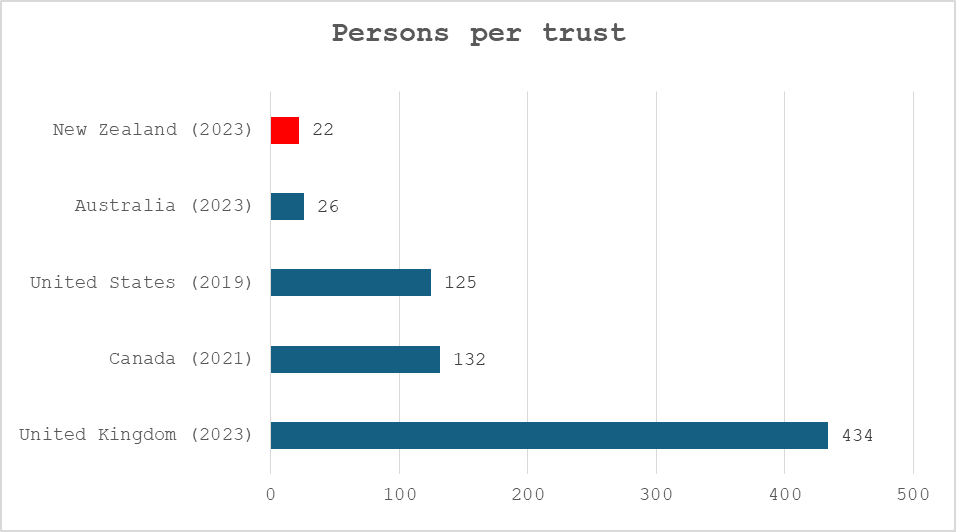
New Zealand has an extraordinarily high number of trusts relative to its population. We don’t actually have official numbers on the number of trusts in the country but estimates range as high as 600,000. Inland Revenue’s recent trust disclosures data notes that as of 31st March 2023 it had 412,000 trusts with IRD numbers. Not all of them have to file tax returns but to put it in context that number of 412,000 represents one trust for every 12 people in the country. By comparison, based on UK tax return filing statistics filed for the same period, there is one trust in the UK for every 434 people.
(Prepared by author using latest available official tax return statistics)
So, there are a significant number of trusts in New Zealand. And that means unintended consequences are lurking for the settlors, trustees and beneficiaries of these trusts. One I would consider is a well-known issue is that for Australian tax purposes, a trust is deemed resident if any trustee is tax resident in Australia. A common pre-migration planning tactic for people moving from here to Australia is to ensure that they resign any trusteeships.
Watch out for Australian resident executors
By the way, this trust residency rule also applies to executors. I’ve frequently advised clients that they need to update their wills and if they have an Australian executor, they need to remove that person or consider alternatives.
Got an Australian resident trustee? Get ready to pay Australian capital gains tax even if it is your main home.
The implications of having an Australian resident trustee are frankly messy, to put it mildly. For Australian tax purposes a trust is deemed tax resident in Australia if ANY trustee is tax resident in Australia. This potentially makes the trust subject to Australian capital gains tax with the Australian resident trustee responsible for collecting the tax on any capital gain derived by the trust.
As an Australian resident trust any capital gain will be calculated under Australian tax law. This applies regardless of the fact that we don’t have a general capital gains tax. The issue that’s emerged in several cases that I’m dealing with relates to property has been sold by a trust and the disposal was not taxable for New Zealand because either the bright-line test didn’t apply or in some cases the property was actually the main home of one of the trust beneficiaries.
Australia has an exemption from capital gains tax for the main home, but and this is a huge but, this exemption does NOT apply to main homes held in trust.
The danger scenario
The danger scenario is a typical New Zealand complying trust with an Australian resident trustee. The trust sells a New Zealand situated property and then looks to distribute the gain. Even if that gain is distributed only to New Zealand resident beneficiaries, under Australian legislation, the Australian trustee is liable for the tax on that gain. Conceptually, it seems inconceivable that the sale of a New Zealand property distributed to New Zealand residents is taxable in Australia but it’s the interpretation the Australian Tax Office has adopted because at least one trustee is an Australian tax resident.
Well, what about the double tax agreement?
What can be done about this? Well in some cases, if there are only Australian resident trustees, then to use a technical term you are frankly stuffed. But more often than not, the majority of trustees are New Zealand tax residents. In this case you might be able to apply the clauses within the double tax agreement between Australia and New Zealand (the DTA) dealing with residency.
The problem is that the current DTA following the modifications made in 2017 to adopt the Multilateral Convention to Implement Tax Treaty Related Measures to Prevent BEPS (the MLI), doesn’t have an easy process for resolving this matter. Generally, you can apply the relevant double tax agreement to determine the place of effective management for non-individuals.
For example, a trust might have five trustees with only one in Australia and the remaining four trustees plus the settlor and this is the group which carries out the management of the trust. Accordingly, the place of effective management is in New Zealand. Australia therefore gets no taxing rights in relation to any disposals of non-Australian situated property. (Keep in mind that even if this scenario plays out, if a distribution is made to an Australian resident beneficiary who does not qualify for the Australian temporary resident exemption, the distribution is still taxable in Australia).
However, at present under the modified DTA, trustees wanting certainly will actually have to make an application to Inland Revenue through the mutual agreement process to ask them to consult with the Australian Tax Office and resolve the matter of residency.
A helpful United Kingdom court case?
Coincidentally, Howarth v HMRC [2025] EWCA Civ 822 an interesting UK Court of Appeal decision on the issue of place of effective management for a trust has just been released. The case involved a widely marketed tax avoidance scheme known as a “round the world” scheme, which was designed to avoid UK capital gains tax (CGT).
Under the scheme the trust’s Jersey based trustees held shares in a UK incorporated company. The Jersey trustees resigned in favour of a Mauritius resident trustee company who then sold the shares. Following the sale the Mauritian trustees resigned in favour of UK resident trustees. At the time the shares were sold, the trust would be deemed tax resident in Mauritius, a jurisdiction which, very conveniently, does not tax capital gains.
When the Court of Appeal considered the issue of the trust’s place of effective management it concluded the trustees in Mauritius were following a predetermined single plan set out by the UK settlors of the trust. The Mauritian trustees were “playing their parts in a script which had been written by others”. The Court of Appeal therefore upheld two lower court decisions (the equivalents of the Taxation Review Authority) that the place of effective management of the corporate trustee was in the UK.
It’s quite useful to see courts talking about the residency of trusts because double tax agreements don’t specifically refer to trusts but “non-individuals”. As a UK Court of Appeal decision, it represents a good precedent. Incidentally it’s expected if the case goes up to the UK Supreme Court, it will probably still rule the same way.
I think Haworth v HMRC could be useful for any trustees who find themselves dealing with the complications of an Australian resident trustee and they wish to ensure any Australian tax is limited only to gains actually distributed to an Australian resident.
CPA Australia calls for a capital gains tax
Still in relation to capital gains tax, as previously discussed Inland Revenue has a long-term insights briefing currently out for consultation. (Submissions are open until 1st September). The briefing discusses how we need to look at ways we could expand the base tax base to meet coming financial demands mostly around superannuation, health and in my view, climate change.
This week CPA Australia, the accountancy body which represents over 3000 accountants here in New Zealand, has called for a rethink of the tax system, including consideration of an introduction of capital gains tax (CGT). The organisation agreed with Inland Revenue; there are many pressures on the New Zealand tax system particularly around ageing demographics. CPA Australia felt the absence of a capital gains tax puts pressure on other taxes. I agree with that analysis, and I also think that’s tied to the question of productivity and diversion of our scarce capital into lower return assets, mainly residential property investment.
It’s interesting to see the CPA Australia come out in favour of a CGT. It suggests that a CGT should only apply to assets acquired after a certain date. In other words, assets held prior to the introduction of that date would be exempt. This is what Australia did when it introduced CGT, coming up 40 years ago next month.
Follow Australia? “Yeah, nah.”
Interestingly, when the last Tax Working Group considered CGT, it got advice from Australia which recommended not to follow the Australian approach and instead go for what’s sometimes known as the valuation day approach. This would base CGT on the valuation of assets on the date of introduction. CPA Australia rightly point out there are compliance problems with that approach but like so much of the stuff we encounter in the tax world, other countries have met and dealt with these issues, so they are not unique or insurmountable.
More on the abatement web
Last week I discussed a substack from Ganesh Ahirao, former head of the Productivity Commission analysing what I called The Dirty Secret of the New Zealand tax system – that very high effective marginal tax rates apply, sometimes over 70%, to people on very modest incomes.
Ganesh has written a follow up this week providing further examples illustrating how people trapped on low-income or benefits, who are trying to work their way out of the system, as they are encouraged to do so, are hit very quickly by very high marginal tax rates.
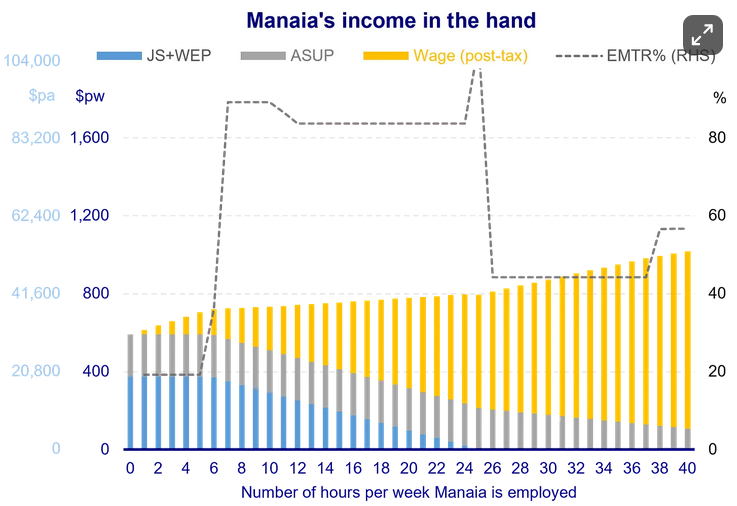
For example, Manaia is single with no children, no student loan, paying immediate rent of $415 a week for a one-bedroom flat. Manaia is eligible for Jobseeker Support alongside the Winter Energy Payment and Accommodation supplement for a total of $592 per week before tax. Six hours employment at the living wage will raise her weekly pre-tax income to $700 but above that threshold, she starts losing her Jobseeker Support at a rate of $0.70 on the dollar. Her effective marginal tax rate jumps above 80% plus.
As Ganesh details, many low-income earners seeking support even one as widespread as Working for Families face similar situations.
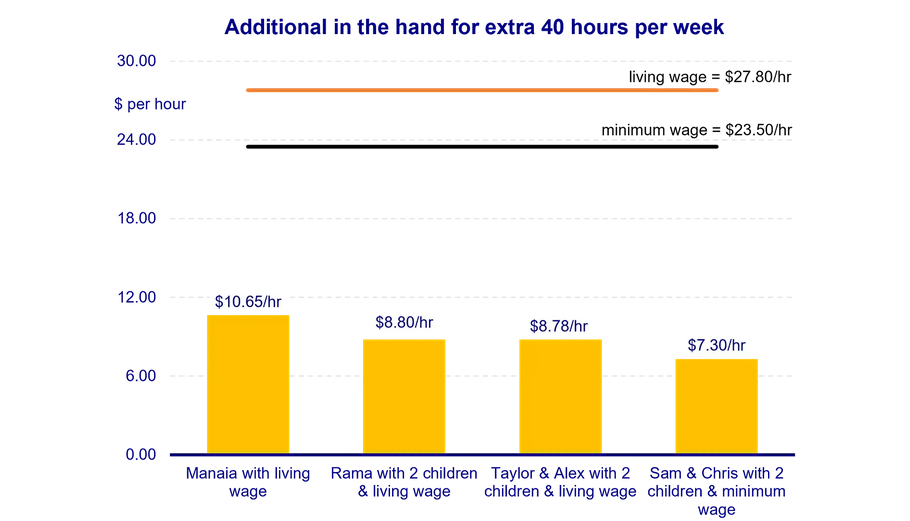
These graphs illustrate Ganesh’s argument which I fully endorse, is we have allowed a huge problem to develop over the last 30-40 years through constant tinkering with the benefits system and swapping universality for a more “targeted” approach. The result is a horrendously complex position which really needs cut through and reform.
I support that and make no apologies for bringing the story up. It is something we should be discussing more frequently and asking our politicians to fix. We can’t be saying to people we need you to work if you’re a beneficiary and then promptly hitting them with 80% marginal tax rates. That is unrealistic and unfair.
The meaning of ‘payment’ for GST purposes
And finally, this week, Inland Revenue has released a valuable draft interpretation statement for consultation on the meaning of payment for GST purposes. When a payment is made is crucial for determining the GST time of supply, the tax period for which you may return output tax. It’s also relevant when an input tax deduction can be claimed and particularly in relation to secondhand goods input tax deductions which are only available when a payment is made.
This draft interpretation statement (only 22 pages) will replace a couple of previous Inland Revenue guidance items, which are actually over 30 years old. The principles involved haven’t changed, but it’s still useful to see the advice consolidated in an updated interpretation statement.
The draft considers typical examples of what constitutes payment. Obviously, cash or bank transfers are payments, but what about if there is an offset or some vendor finance. For example, payment could be made by setting off against an existing debt owed by the supplier to the recipient. Accounting entries can count, but you have to have the evidence to support them, and obviously payment of a deposit represents a payment (and can trigger some GST time of supply issues in relation to the sale and purchase of a property), Overall a very useful guidance.
And on that note, that’s all for this week, I’m Terry Baucher and you can find this podcast on my website www.baucher.tax or wherever you get your podcasts. Thank you for listening and please send me your feedback and tell your friends and clients. Until next time, kia pai to rā. Have a great day.
Every industry has a dirty secret which is known to its practitioners but is not generally known by a wider audience. In my view the New Zealand tax system’s dirty secret is how high effective marginal tax rates most impact our lowest earners.
The effective marginal tax rate (EMTR) is the highest rate of tax that is applied to the very last dollar that you earn. This also takes into consideration abatements or clawbacks which apply. Now for most persons, the natural assumption would be if the highest income tax rate is 39%, then the highest EMTR would be 39%. That’s a fairly logical, quite understandable and mostly correct approach.
How your EMTR can be above the maximum income tax rate
But, “mostly” is doing a lot of lifting because in certain instances a person’s EMTR can be above the highest tax rate. This is usually where a tax relief is withdrawn, or abatements apply. One example of where tax reliefs will be withdrawn is the Independent Earner Tax Credit, which is available to taxpayers who are not receiving New Zealand superannuation or Working for Families and have annual income between $24,000 and $70,000.
However, between $66,000 and the upper $70,000 threshold, it starts to get clawed back at a rate of 13%. This means that although the personal income tax rate for income between $66,000 and $70,000 is 30%, the effect of the clawback means a person’s EMTR within that income range is actually 43%.
The most common example that impacts most people are the interlocking layers of abatements that apply when someone is claiming a tax credit or benefit. The most notable example, which we’ve discussed quite frequently, is Working for Families. These tax credits are abated at a rate of 27.5 cents on the dollar, where a family’s income exceeds $42,700. (Respectively 28 cents and $44,900 from 1st April 2026).
Abatements also apply in relation to Accommodation Supplement and Jobseeker and the combination of all these results in people on modest incomes having extremely high EMTRs.
Working 40 hours a week for an additional $6.07 per hour
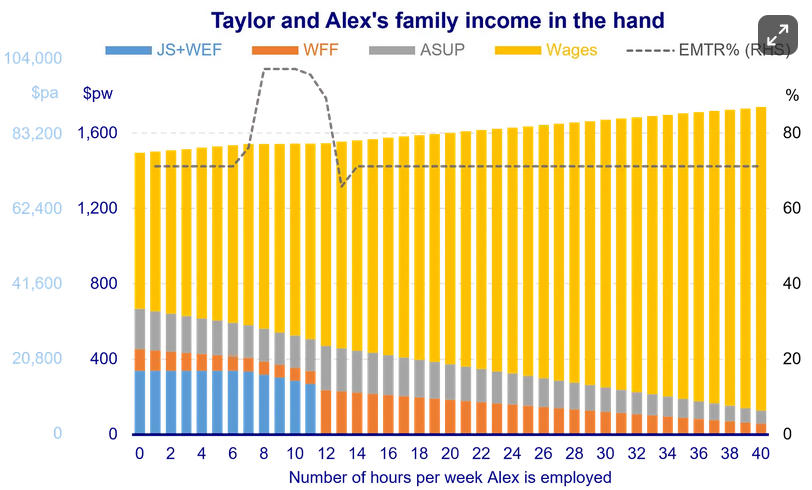
Ganesh Ahirao (Ganesh Nana), the last head of the recently disestablished Productivity Commission, has put together an illustration of how this Gordian Knot of abatements and benefits affects the family of Alex and Taylor and their two children.
The relevant facts are that Taylor is employed full-time at $25 per hour. So the family income is $1000 gross per week which, after deductions for income tax and ACC, is $829 per week net.
The family rent a two-bedroom house in Island Bay, paying the median rent for the suburb of $625 per week. This means that, after rent, the family has $204.30 per week to meet all other non-rent living costs and expenses. They’re therefore claiming additional assistance. Alex can claim Jobseeker Support there’s also Working for Families credits and Accommodation Supplement available.
However, as Ganesh illustrates, if Alex and Taylor do make a claim, they can find themselves trapped in nightmarish web of overlapping, interlocking benefits where the level of abatements can be dependent on what other assistance they’re receiving. Complicating matters is the requirement for anyone like Alex claiming Jobseeker Support to accept employment.
How to lose 71.2% in tax and abatements on the minimum wage
If Alex takes five hours at the minimum wage of $23.50 per hour (i.e. $117.50 per week) this won’t affect his Jobseeker Support because he’s allowed to earn up to $160 per week before abatement. His earnings will be subject to tax and ACC but crucially they also have an impact on the Working for Families and Accommodation Supplement because the family income is above the abatement thresholds.
The abatements and tax on $117.50 total $83.62 leaving net cash in hand of $33.88, or an EMTR of 71.2% – more than double the official income tax rate of 30% (31.67% once 1.67% ACC earner levy is added).
Remember this 71.2% EMTR is for a family earning a little bit under $60,000 a year, $1200 a week. As Ganesh’s analysis illustrates their EMTR can get even higher.
A well-known problem, at least amongst the experts
Earlier this year I discussed a paper prepared by Treasury which examined this issue of how the tax and transfer system affects financial incentives to work. In the paper Treasury noted that most New Zealanders have EMTRs below 50% with only 6% experiencing EMTRs over 50%.
The Treasury paper noted families with children are more likely to face higher EMTRs. Single parent families are particularly hard hit, with 30% of single parent families having EMTRs greater than 50%, and in some cases higher than 100%.
The lesson from the Treasury paper, and Ganesha’s substack, is that over time we have built a complicated, interlocking and confused system of means tested benefits.
We also have a not unreasonable expectation that people receiving benefits should attempt to work. However, the EMTRs of 70% or even more resulting from the abatements applied by means testing may make the actual return for any additional hours minimal.
In such situations, and faced with such disincentives, why would people work extra hours? What Ganesh’s substack hammers home is the need to be step back and have a real think about what we are trying to do with our work and benefits system and the interaction between tax and benefits.
Inconsistent approach
This problem has also been recently highlighted by the changes to the FamilyBoost initiative where the Government is reducing the abatement rates and increasing the abatement thresholds with effect from 1st October because the initiative – a key election promise – wasn’t reaching as many people as expected.
FamilyBoost is now available for families earning up to $229,100, well above the low threshold impacting families like Alex and Taylor. Understandably this has led to questions as to whether such families should be receiving assistance. Which is perhaps a bit rough, because raising children is not cheap.
A long-standing issue ignored for too long
In my view the Government is sending wildly opposite messages here. In many cases, the abatement thresholds have not been increased with inflation for some time. Therefore, with the rise in cost of living and rent in particular, people on lower incomes are struggling to keep up.
This is leading to more applications for supplementary assistance, which then feeds this spiral of higher EMTRs applying. It’s time for someone to grasp the nettle and say, “Well, this is really not achieving very much. Let’s go away and rethink it.”
Strange bedfellows?
Now, in the strange story basket this week is one where the Green Party and the Taxpayers Union have found common ground.
This curious tale is a byproduct of the local government election in Wellington. Two Green Party candidates running there are proposing a change to the taxation rating system. Instead of taxing properties on their total value, including improvements, the Green party candidates want to base rates solely on the value of the underlying land.
Jordan Williams, the executive director of the Taxpayers Union, came out and endorsed this approach on the basis that the current system effectively penalises developments by taxing improvements.
Meanwhile the Green Party candidates are looking to target what they see as land banking, where people are just simply sitting on land, not paying rates. The move is intended to encourage the land to be used for productive purposes, whether it’s more housing or alternative commercial developments.
It’s interesting to see very opposite political bedfellows come together on this point. It’s probably a once in a Blue (or Green) Moon but certainly it’s an example where a principled tax approach can result in a common approach from what appear at first sight to be some unlikely bedfellows.
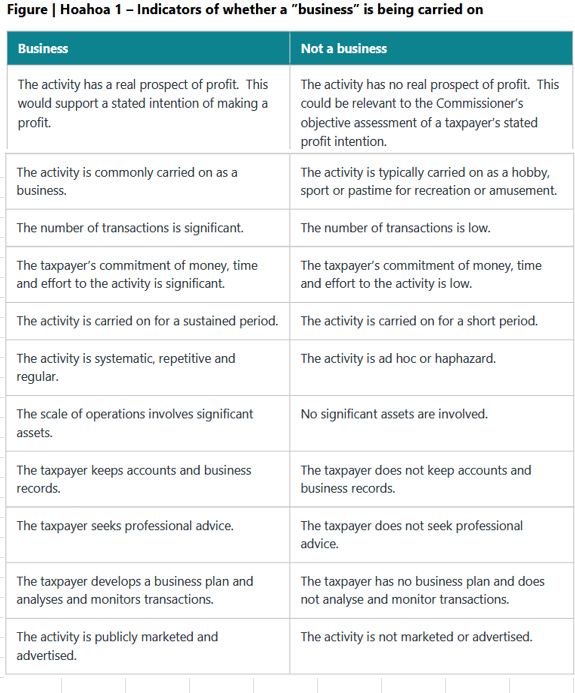
Is that a business you’re carrying on? New Inland Revenue guidance
Inland Revenue has released a draft interpretation statement for consultation on the important issue of when and whether a taxpayer is carrying on a “business” for income tax purposes.
As the draft interpretation statement notes:
“It is important to understand if you are carrying on a business, and when that business is being carried on, because carrying on a business is a requirement of many provisions in the Income Tax Act 2007. In particular, an amount that a person derives from a business is included in a person’s income for tax purposes and the person is allowed a deduction for expenditure incurred in carrying on that business.”
This draft statement is part of a project whereby Inland Revenue is modernising and updating its previous guidance, which in this particular case goes back to 1971. Unless otherwise stated these updates are not changing any previous interpretation.
The leading decision in this area is Grieve v CIR (1984) 6 NZTC 61,682 (CA). In Grieve the court ruled that deciding whether a taxpayer is in business involves a two-fold inquiry as to the nature of the activities carried on and the intention of the taxpayer in engaging in those activities.
The draft statement (which runs to 46 pages including references) discusses these relevant factors in depth but it also has a useful summary.
Overall, this is a useful guide to a commonly asked question.
And on that note, that’s all for this week, I’m Terry Baucher and you can find this podcast on my website www.baucher.tax or wherever you get your podcasts. Thank you for listening and please send me your feedback and tell your friends and clients. Until next time, kia pai to rā. Have a great day.