

Inland Revenue’s bombshell proposal to change taxation of shareholder advances

Inland Revenue’s bombshell proposal to change taxation of shareholder advances

It’s not often in tax that you can genuinely say a bombshell has dropped, but last Thursday at 4:00pm Inland Revenue released one such bombshell for consultation, the somewhat innocuous sounding Improving taxation of loans made by companies to shareholders. “Improving” is doing a lot of heavy lifting there.

The basic position is Inland Revenue plans to completely change the current tax treatment because, as a handy information sheet released alongside the main issues paper points out:

Our current rules mean shareholders who borrow from their company can pay less tax compared with other taxpayers who are fully taxed on their salary, wages and dividends or profits they earn as a sole trader or partnership.

The problem

The current position is this; if a shareholder borrows money from a company, it’s not treated as a dividend or income but is subject to interest. The company can either charge interest at an agreed market rate, or if the loan (or shareholder current account) is either below market rate or is interest free, the company is liable to pay interest calculated using the fringe benefit tax prescribed rate of interest, currently 6.67%.

What has happened is that the amount owed by shareholders has built up over time, and the numbers are quite surprising. According to chapter 3 of the issues paper – paragraph 3.3 onwards – for the year ended 31 March 2024, approximately 119,000 companies (that’s about 16% of the 730,000 total companies in New Zealand) were owed a total of nearly $29 billion by about 165,000 shareholders who are either natural persons or trustees. As the paper notes:

For context, these companies reported $8 billion of taxable income in that same period, so the loan balances were over 3.5 times their annual income.

The average amount loaned by these companies to the shareholders was over $245,000 per company, or over $177,000 per shareholders.

A $19 billion impact of the increase in the trustee tax rate?

In fact, the amounts owed were even larger. According to Inland Revenue the amount of shareholder loans made to natural person and trustee shareholders peaked in the year end 31 March 2022, when about 182,000 companies recorded loans totalling $48.8 billion. The drop in nearly $19 billion between 2022 and 2024 appears mainly due to the increase in the trustee tax rate to 39% from 1st April 2024. Companies took the opportunity to pay dividends to trustee shareholders prior to the increase in the tax rate.

Large numbers are involved here.
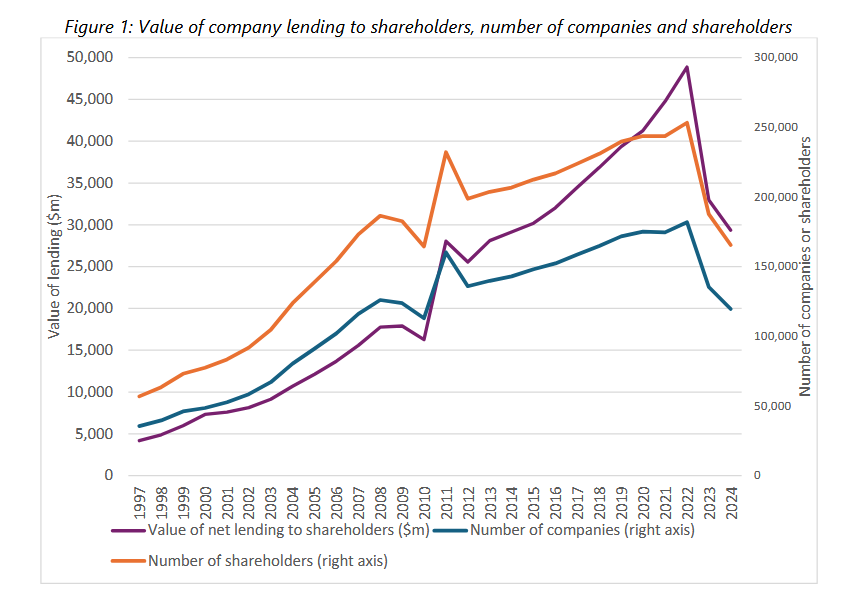
A $12 billion problem

The sheer volume of the loans is staggering. If you want to get an idea of how big a potential loss of revenue the present rules represent, if the total of outstanding loans at 31st March 2024 had instead represented income paid to a shareholder or a shareholder employee (that is, someone who’s an employee and a shareholder in the company) and had been taxed at the highest marginal rate of 39%, about $12 billion of tax would have been payable.

A long-standing and fast-growing problem

The volume of outstanding shareholder loans is a considerable headache that has built up over time. Paragraph 3.7 of the paper notes that the annual growth in loans to shareholders has been approximately 8.7% per annum over the period 1997 to 2023. That surpasses the average growth in economic activity over the same period when nominal GDP growth on average was 5.4% per annum. 

So which companies are lending?

There’s an interesting analysis of what type of companies have been doing the lending. The biggest single group is the rental, hiring and real estate services sector who are responsible for about $7.5 billion of of that $29 billion. Then they’re closely followed by agriculture, forestry and fishing, which is about $5.2 billion, and then construction, which is just over $3.1 billion. These three sectors between them have nearly 55% of all total borrowing outstanding at 31st of March 2024.
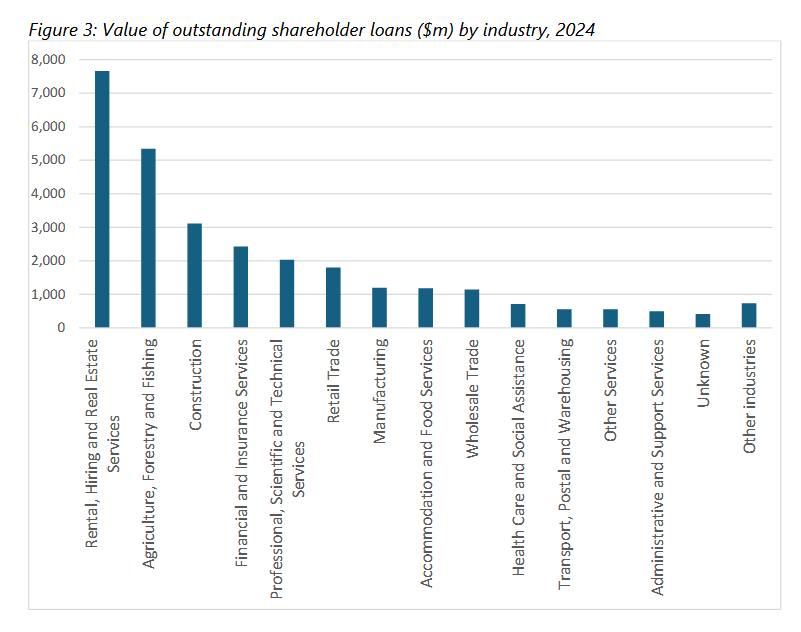
Liquidations and other removals

There’s also another group of companies which I think would be of extremely great concern to Inland Revenue, and that’s companies with outstanding shareholder loans that have been liquidated or otherwise removed from the Companies Register.

Inland Revenue has analysed the approximately 184,000 such companies that were removed from the Companies Register between 1st April 2019 through to early 2025. The data suggests about 27,000 of those companies, nearly 15%, were owed money by their shareholders at the time they were removed based on the assumption that the shareholders at the time of removal were either individuals or trustees. In total those companies were owed approximately $2.3 billion, or about $85,000 per company. Further analysis shows about 15,000 of that group that were removed, were just simply struck off because they hadn’t filed their annual returns. This group was owed nearly $935 million or $55,000 per company.

Another 10,000 companies with shareholder loans went through the formal request for removal process. At the time of formal removal this group was owed $923 million or $92,300 per company.

Finally, 2,000 of companies with shareholder advances were put into liquidation process, and they owed over $426 million or $213,000 per company.  For this group it’s quite possible the liquidator would have attempted to make a claim against shareholders with debts.

This group is of particular interest to Inland Revenue because it’s reasonably likely they had outstanding GST and PAYE debts.  The shareholders in this group probably drew out loans for personal use which were effectively not taxed but the company later was liquidated owing GST and PAYE.

Bringing New Zealand into line with other countries

Inland Revenue’s main proposal is that as of 4th December, when the paper was released, if a shareholder loan has not been repaid within a set period, any outstanding balance above a threshold at the end of that period will be treated as a dividend and taxed accordingly. The repayment period will probably be 12 months which is the maximum time allowed for filing the company’s tax return if it is linked to a tax agent. The suggested threshold is $50,000, subject to consultation. With some reservations, Inland Revenue would permit imputation credits to be attached to any dividends deemed to arise under the proposal.
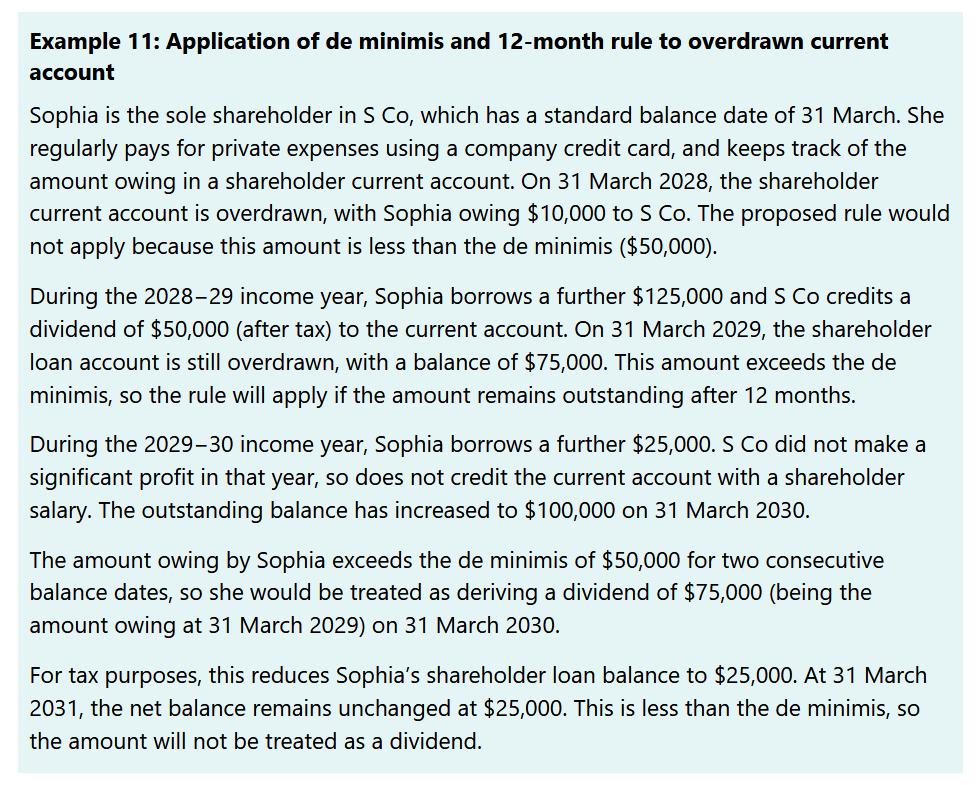
As the paper notes this change would bring New Zealand into line with most of our comparable jurisdictions. If you look at the treatment of shareholder advances across Canada, Australia, the UK and Norway, all take the approach that shareholder advances will be treated as income unless they’re repaid within a certain period. Inland Revenue’s proposed regime would be closest to that of Canada.

This proposal represents a huge change and one which is likely to have significant revenue effect. Exactly how much isn’t specified. At a guess it’s probably going to run to hundreds of millions, perhaps. It will be interesting to see exactly what happens because there’s going to be a displacement activity. Companies will either start paying out higher dividends or increased salaries to avoid the charge. Either way the Government’s tax take will increase.

Not yet enacted but effectively in force

It’s important to remember that Inland Revenue is open to consultation on its proposal so there’s going to be some fine tuning. Whatever the final form agreed, it will apply to all loans to shareholders made on or after 4th December. In other words, although the legislation is not yet in place, it is now in force. Accordingly, I recommend companies should create new accounting ledgers to record all activity from 4th December 2025 separately from any existing shareholder loans as only “new” loans will be subject to the new rules.

What about existing loans?

Inland Revenue proposes the outstanding loan balances, an estimated $29 billion as of 31st March 2024, will not be required to be repaid.  This is a pretty good outcome because requiring loan repayments would be a huge shock to the economy particularly for small and medium enterprises, where shareholder advances are commonly in place.

Treatment of capital gains

Shareholder advances often arise after a company realises a substantial capital gain and shareholders therefore want to access the proceeds. I’ve seen examples where the shareholders have withdrawn the tax-free gains from the sale of an investment property for example often before the accountant even knows what’s going on. (This probably explains why the rental, hiring and real estate services sector has such a large amount of shareholder advances).

The problem is that capital gains even if they are tax-free, can only be distributed when the company is being liquidated. It may be interesting to see if Inland Revenue decides to allow some leniency in calculation of the loans for such advances on the basis that they would not be taxable if those gains had arisen in the hands of the shareholders directly. Inland Revenue’s starting position is that it “does not consider that an exception should be included for loans funded out of capital gain amounts” but it’s open to submissions on this point.

Treatment of shareholder loans on company’s cessation

In relation to companies which are removed from the Companies Register with outstanding loans to shareholders, the paper proposes that the amount of the outstanding loan is deemed to be income of the borrower. This will apply regardless of the reason for removal from the Companies Register. It would therefore apply if the company is struck off for not filing its annual Companies Office return (a fairly frequent event).

Furthermore, this measure would also apply from 4th December 2025. This is considered “necessary to minimise integrity concerns and structuring opportunities that could otherwise arise.” Although any legislation would effectively be retrospective Inland Revenue notes the proposal “does not result in an amount being subject to tax that would not be income under the current law.”  It’s very hard to disagree with this proposal, given that some companies may have accumulated PAYE and GST debts.

Time for a closer look? When 5% of companies are owed 55% of all debt

A group of companies which might find themselves under future scrutiny are those that have substantial amounts of loans. This is arguably one of the most interesting and perhaps surprising part of the paper. According to Inland Revenue there were about 5,500 companies that had outstanding loan balances of more than $1million. Approximately 55% of the total value of outstanding loans, or nearly $16 billion was owed to those companies. In sum 5% of all companies with shareholder advances were owed 55% of the total outstanding debt.

Then within that group, there’s 540 companies that had outstanding loan balances of more than $5 million. In fact, that group alone had 22% of the value of all shareholder loans, roughly about $7 billion, even though they represented just 0.5% of all companies.

The present proposal is that there will be no requirement to repay those loans. However, I still think that Inland Review might take a closer look as to exactly what’s going on with these companies because, as the paper notes, there does seem to have been some substitution of loans for income using the prescribed rate of interest rules to sort of bypass or to minimise the tax payable on the withdrawals.

Incidentally, there was a proposal in a draft I saw that the prescribed rate of interest, currently 6.67%, would be increased substantially to nearer credit card rates, i.e. nearly 20%. That has been dropped presumably after a fair amount of pushback.

A significant but logical change

In conclusion these proposals will significantly impact the small-medium enterprise sector. As Bernard Hickey pointed out, when we discussed the proposals on the Hoon just after the paper’s release, this group is very much part of the Government’s current voting base. It will therefore be interesting to see what happens during consultation.

The Organisation for Economic Cooperation and Development (OECD)had a paper in 2024 which looked at the question of small/medium enterprises and tax arbitrage in the sector. The proposals represent a significant change. But they are also logical when you look at what happens in comparative countries.

As previously noted affected companies need to take action now because whatever the final shape or form of the proposal comes out, it’s effective from 4th December. The paper’s open for consultation until 5th February.  Sharpen up your pens and get your thinking caps on as to how you see this will work and what you want to see in terms of repayment period and a threshold. Inland Revenue has proposed $50,000, but they may be open to suggestions on that.

And on that note, that’s all for this week, I’m Terry Baucher and you can find this podcast on my website www.baucher.tax or wherever you get your podcasts. Thank you for listening and please send me your feedback and tell your friends and clients. Until next time, kia pai to rā. Have a great day.


A deep(ish) dive into the recently released tax bill.

A deep(ish) dive into the recently released tax bill.

  • Highlights from the 2025 NZLS Tax Conference

This year’s annual tax bill, the Taxation (Annual Rates for 2025–26, Compliance Simplification, and Remedial Measures) Bill (“the Bill”) was released at the tail end of August. The Bill’s release coincided with the New Zealand Law Society’s 2025 Tax Conference, which was a happy coincidence – unless you were one of the presenters affected and had to frantically rewrite your paper.

The Conference began with a short message from Minister of Revenue Simon Watts who highlighted the key measures in the Bill such as those relating to the Foreign Investment Fund regime, digital nomads, employee share schemes as well as the exemption for households selling electricity into the grid.

FBT reforms delayed

On the other hand, the Bill was also noteworthy for what it didn’t include.  In particular there are no proposals for Fringe Benefit Tax reform, which had been highly anticipated. According to the Minister, “FBT reforms are going to need more time.” This appears to have been in response to fierce lobbying from Federated Farmers over the very vexed question of the application of FBT to twin cab utes and vehicles generally.

The other area not included was the taxation of charities and not-for-profits and in particular the question of donor-controlled charities. This was less of a surprise because the Government backed away from changes earlier this year.

Digital Nomads

The Bill includes measures to improve or clarify the tax of New Zealand visitors and in particular so-called digital nomads. These follow on from announcements made in January allowing visitors on non-work visas to work remotely. The tax changes are designed to

“…address issues that may be discouraging visitors from staying in New Zealand for longer periods of time while maintaining the integrity of the underlying international tax rules.” 

Effective 1st April 2026 the Bill will allow certain visitors to New Zealand, called non-resident visitors, to be present in New Zealand for up to 275 days in a given 18-month period without becoming a New Zealand tax resident.  They have to be here lawfully and not undertake work for a New Zealand employer or client.

The proposals would also deal with the questions around exempting the non-resident employer from New Zealand employment related obligations, such as PAYE and FBT. Crucially, because this has become a very important question in this area, Also, and this is pretty important because of the greater ease of working remotely, the activities of a non-resident visitor are disregarded when determining whether a foreign entity has established a permanent establishment in New Zealand.

Similarly, if the visiting person is a director of a non-resident company, then as long as they meet the other conditions, the centre of management of or direct control of the non-resident company will not be considered to have moved to New Zealand for tax residence purposes.

These are welcome proposals which clarifies a grey area. That said I think it’s time that Income Tax Act had a specific clause which gave the Commissioner of Inland Revenue discretion to exclude from the “days present” count days where a person has been unavoidably detained in New Zealand due to sickness or, for example, another pandemic.

Inland Revenue granted itself that discretion during COVID back in 2020, but actually there was no such provision in the Income Tax Act, which would have allowed it to do so. My view is it should have that discretion so it can deal with unique circumstances.

Foreign Investment Fund regime changes

The Bill includes the final details around the changes to the Foreign Investment Fund (“FIF”) regime which have been foreshadowed for some time. Under the Bill eligible migrants can elect into the “Revenue Account Method” which will tax FIF interests on a realisation basis.

The main person eligible will be those who are in overseas companies’ employment share schemes where the regular valuations required under the FIF regime aren’t easily obtainable because the company is unlisted. The other main group are American citizens who continue to be subject to US taxes, even though they are no longer resident in the USA.

Under the Revenue Account Method eligible FIF interests together with any dividends received would be taxable on a realisation basis. However, only 70% of any gains or losses will be reported and subject to tax. Assuming a taxpayer’s marginal tax rate is 39% this works out to be an effective 27.3% tax rate.  I thought the Government might go with the highest prescribed investor rate, which would have been 28%.

This measure takes effect retrospectively from 1st April 2025. On the whole I think it’s a welcome move although there will be grumblings that the capital gains discount should have been higher.

Employee share scheme changes

The Bill allows unlisted companies to elect into a regime where the tax liability for employees who receive shares or share options as part of an employee share scheme can generally be deferred until a liquidity event, such as the sale of shares.

That obviously makes sense in terms of the point at which you can value the shares and the employee who is doing a lot of work there will have the ability to raise the funds to cover their tax liability.

Controversial provision repealed

The Bill repeals the controversial section 17GB of the Tax Administration Act 1994 introduced in 2020 by the last Labour government. Section 17GB allowed the Commissioner of Inland Revenue to collect information for purposes relating to the development of policy for the improvement or reform of the tax system. This section was then used to carry out the high wealth individual research project, which was highly controversial.

The section’s repeal isn’t universally applauded. John Cuthbertson, the head of tax for Chartered Accountants Australia and New Zealand (“CAANZ”) suggested it was useful for Inland Revenue to have such data gathering powers to help develop tax policy.so long as the powers are judiciously used and managed. I sparked a lively LinkedIn discussion after I commented in support of John’s comments as I don’t believe we get enough data and information on our tax system, certainly compared with other jurisdictions.

In the discussion it emerged that according to the accompanying Regulatory Impact Statement (“RIS”) Inland Revenue undertook targeted consultation with eight key stakeholders in September 2024. This consultation included “stakeholders from the private sector, public interest groups, as well as academics.” This is pretty standard as part of the Generic Tax Policy Process. However, John Cuthbertson revealed CAANZ was NOT part of that consultation, which is very surprising. I’m now quite intrigued to know who exactly was consulted in that group. (Interestingly, according to the RIS Inland Revenue’s preference was for retention of section 17GB but restrict the use of information collected to the development of policy.)

Privacy Commissioner disapproves of proposed ministerial-level information sharing agreements

One of the counterpoints to section 17GB was the potential invasion of privacy, which is fair enough.  It’s therefore ironic to see the Bill’s proposal to enable the Commissioner of Inland Revenue to disclose information to another government agency pursuant to a ministerial-level agreement. These would by-pass the existing Approved Information Sharing Agreements.

The new ministerial-level agreements enable the Minister of Revenue and the Minister in charge of the other agency the power to agree to the disclosure of information to determine entitlement or eligibility for government assistance, for the detection, investigation, prosecution or punishment, or suspected or actual crimes punishable by terms of imprisonment or two years or more, or to remove the financial benefit of crime.

On the face of it this seems reasonable, but according to the accompanying RIS the Privacy Commissioner raised the following concerns:

“The Privacy Commissioner has concerns as it relates to the proposed changes to enable and earn revenue to disclose tax information to other government agencies. He believes the disapplication of principles 10 and 11 of the Privacy Act in the proposal is unjustified. The privacy commissioner is. Is of the view that there are existing mechanisms to facilitate the sharing of the types of information Inland Revenue are proposing, including Approved Information Sharing Agreements under the Privacy Act 2020 and the board information sharing provisions available under section 18F of the Tax Administration Act 1994.”

The measure will probably go through as proposed but it will be interesting to see if any amendments are made following submissions on the Bill (which are now open until 23rd October).

Do we really need a Capital Gains Tax?

At the NZLS Tax Conference there was a very entertaining session on the issue of a capital gains tax (“CGT”) presented by Joanne Hodge and Geof Nightingale. Joanne and Geof were both members of the last Tax Working Group the big controversy of which was its recommendation for “a broad extension of the taxation of capital gains“. However, Joanne was of part a minority group alongside Robin Oliver and Kirk Hope of Business New Zealand, who did not support the recommendation.

Joanne and Geof’s opposing positions made for a very lively session. Geof remains of the view that it is needed not only as a revenue raiser but for addressing inequality and the question of economic efficiency. Joanne is more of a sceptic about CGT. She’s concerned in part mainly about the economic inefficiencies that can result from a CGT and also considers that the costs of doing so relative to the revenue raised means that perhaps it’s not really worthwhile.

This was a key factor for Joanne together with Robin Oliver and Kirk Hope to that was what drove her, and the other two minority opinions to dissent from the proposal for a comprehensive CGT. But always keep in mind that the entire Tax Working Group agreed “that there should be an extension of the taxation of capital gains from residential rental investment properties.”

Addressing the fiscal shortfall

In making the argument for a CGT Geof picked up matters we’ve raised in previous podcasts (and in Inland Revenue’s draft Long-Term Insight Briefing) about the coming fiscal shortfall which needs to be addressed. He described the outlook as “dire” and that we cannot outgrow these fiscal projections.

Joanne took a different approach. In her view the correct question is really “how comprehensively should we tax capital gains?”  Although she’s opposed to a comprehensive capital gains tax because of the complexity involved, she’s NOT opposed to broadening the net. For example, she raised a question about private equity venture capital and how many people involved in capital raises are treating shares on non-taxable capital account when in fact they should be taxed on sale because they acquired the shares with a purpose or intent of sale. In Joanne’s view better enforcement will deal with a lot of issues and raise tax revenue.

She made a very interesting point that all blocks of land should have their own IRD number which would help with better enforcement. I think it’s a really good idea.

A matter of faith?

Joanne does raise valid concerns about the complexities that are involved in a CGT. Amusingly she and Geof also referred to an informal comment from Professor Len Burman an American CGT specialist to the 2010 Tax Working Group (of which Geof was also a member). Professor Burman suggested that you can do all the analysis on capital gains tax that you want, but in the end, whether you support it or not becomes analogous to religion, a matter of faith.

It’s an interesting proposition; I worked for 10 years in a system with CGT prior to arriving in New Zealand so the arguments around whether or not it should exist simply never arose in my professional career until I came here. So perhaps I am a believer in that regard, but it’s worth noting this year is 60 years since the UK introduced capital gains tax, 40 years since Australia introduced its CGT, Canada has had one since 1972 and South Africa since 2001. As is well known, the absence of a CGT makes New Zealand an outlier. The debate over a CGT will continue to rage, and no doubt we will bring you more commentary on future developments.

And on that note, that’s all for this week, I’m Terry Baucher and you can find this podcast on my website www.baucher.tax or wherever you get your podcasts. Thank you for listening and please send me your feedback and tell your friends and clients. Until next time, kia pai to rā. Have a great day.

18 April 2019 Podcast

The Government announces its decision not to introduce a Capital Gains Tax in this parliament.  Terry runs through the TWG proposals and the implications for New Zealand.

11 recommendations are likely to be implemented by the Inland Revenue. Others such as Environmental, Water and Maori related taxes are not.

My articles on the topic published elsewhere:

17 April on Interest.co.nz predicting a CGT – Will there be one CGT to rule them all? https://www.interest.co.nz/opinion/99191/terry-baucher-ponders-whether-there-will-be-one-capital-gains-tax-rule-them-all

18 April on Interest.co.nz admitting I got the prediction wrong – I am surprised the environmental tax proposals aren’t prioritised https://www.interest.co.nz/opinion/99212/terry-baucher-surprised-govt-wont-prioritise-any-tax-working-group-environmental-tax

18 April on The Spinoff – The other tax recommendations the Government ignored https://thespinoff.co.nz/business/18-04-2019/the-other-tax-recommendations-the-government-ignored/

Podcast Transcript

(more…)