
16 Aug, 2021 | The Week in Tax
- Inland Revenue guidance on the tax implications of the Clean Car Discount
- Latest on Inland Revenue’s audit activity
- Insights from the OECD’s latest report on Corporate Tax Statistics
Transcript
In the week that the Intergovernmental Panel on Climate Change report declared that climate change is “unequivocally caused by human activities” it is rather opportune of Inland Revenue to release its guidance on the tax implications of the Government’s Clean Car Discount Scheme.
To recap, the Clean Car Discount Scheme has been introduced to make it more affordable to buy low emission vehicles. Between 1st July 2021 and 31st December 2021, a rebate will be paid to the first registered person of an eligible vehicle or to a lessor where that person is a lessee.
Starting 1st January 2022, it’s proposed that the Clean Car Discount will be based on vehicle’s CO2 emissions and vehicles with low or zero or low emissions will qualify for a rebate and those with high emissions will incur a fee (subject to enactment of the relevant legislation).
Now obviously, if you’re in business, you need to be aware of the tax consequences if you receive a rebate or pay a fee under the Clean Car Discount Scheme, or lease a vehicle that comes under the Clean Car Discount Scheme. And obviously the outcome varies depending on what you use a vehicle for.
If you get a rebate under the scheme, you will not have to pay income tax on the rebate. It’ll either be treated as excluded income under the rules for government grants if you’re claiming depreciation on the vehicle or a capital receipt. Conversely, if a fee is paid under the Clean Car Discount Scheme, it will be treated as a capital expense and so no deduction will be available. And that’s obviously going to be something which should be watched carefully.
Now, if you’re using the vehicle in your business, and seeking to claim depreciation, then the base cost for these purposes will be either reduced by any rebate received or increased by the amount of any fee. That’s again something to watch out for.
When it comes on to FBT, and this is going to be quite critical, I would say given that we suspect there’s a fair bit of under compliance in this area, FBT will be payable if the car is made available for private use. FBT will be calculated on the cost of the car when purchased or its value if being leased. The cost will either be reduced by the amount of any rebate or increased by the amount of any fee.
For GST purposes, if you get a rebate under the Clean Car Discount Scheme for a vehicle that you use in your taxable activity, the rebate will be treated as consideration for a deemed supply under the rules relating to government grants. So that means you must the return the GST in your next GST return. Conversely, if a fee is payable, then the GST component of that may be claimed as input tax if you’re carrying on a taxable activity.
Overall, this guidance is useful. Inland Revenue have included some examples as well. As I said, it is quite opportune that it arrived at this time when there’s going to be increasing focus on the question of environmental taxation and the role it may have in enabling us to meet our targets under the Paris Accords.
Tracking Inland Revenue audit activity
Moving on, as I mentioned just now there is a suspicion that there’s perhaps non-compliance with FBT going on at the moment. And so it’s quite interesting to see the latest statistics on Inland Revenue audit activity from Accountancy Insurance.
This is the company that provides insurance against Inland Revenue audits and reviews.
For the period to 31 March 2021, they saw the total number of claims increased by 31% compared with the year ended 31 March 2020. So even though it was in the middle of a pandemic, Inland Revenue is still active in reviewing taxpayers. What is interesting to note here is that GST verification claim activity increased by 48% and that for income tax return related activity increased by 67% over the 12 months to 31 March 2021.
Now, this apparently includes two projects Inland Revenue began last year, the bright-line property rules and also the automatic exchange of financial account information programme relating to the Common Reporting Standards.
GST verification activity actually accounted for 90% or more of all claim values in New Zealand, even though actually only 55% of all claims related to GST verification. So that’s a timely reminder that Inland Revenue is still keeping a watchful eye on matters.
It’s actually a little encouraging to hear that Inland Revenue is still actively reviewing GST returns. I’ve seen one or two instances where I’ve wondered how claims got through including one warranty case going on right now where I am really surprised why Inland Revenue was not onto what was happening much, much sooner.
But the fact is, despite the pandemic and the impact it had on general operations for Inland Revenue last year, GST activity has still been maintained. You have been warned
Interntional benchmarking
The OECD recently released its third edition of its corporate tax statistics. It’s a treasure trove of information relating to corporate tax around the world and with the topics covered and statistics reported being steadily expanded. And there’s some very interesting insights in the report which is based on 2018 numbers.
For that year, the average corporate tax revenue as a share of total tax revenues, was 15.3%. New Zealand was just above that at about 15.5%.
Interestingly, that the percentage of corporate tax revenues has risen since 2000 from an average of 12.3% then to 15.3% in 2018. Similarly, you see a rise in the average corporate tax revenues as a percentage of GDP from 2.7% in the year 2000 to an average of 3.2% in 2018. New Zealand by the by at 5.2%. is well above that average for 2018.
This is an interesting statistic because over that same time period since 2000, the average statutory tax rate has fallen by 8.3 percentage points from 28.3% in year 2000 to 20% in the year 2021. Over that time the rate has fallen in 94 jurisdictions, stayed the same in another 13, but increased in only four jurisdictions. And that supports the argument that was made that lowering the statutory tax rate and broadening the base would lead to higher revenues.
I do think that we probably now plateaued out with tax cuts. I don’t see corporate tax rates continuing to fall. Over in the United States, they’ve signaled that they will rise.
The report drills down into the statistics by considering effective marginal tax rates as well. And that’s where it gets interesting from New Zealand’s perspective, again, because we adopted more thoroughly than most and the broad-based low-rate approach to corporate taxation by stripping away a lot of preferential regimes, our effective marginal tax rate is at just over 20% is amongst the highest in the OECD. Apparently, that is because we have less general fiscal depreciation rules than other most other jurisdictions, although the report notes that we are now more generous after increasing rates in 2020 in the wake of the arrival of the pandemic.
The report also has details of the impact of the implementation of BEPS and statistics relating to anonymised and aggregated country by country reporting although New Zealand doesn’t feature in this part of the report.
But it also has something that I think policymakers here would want to perhaps think hard on, and that is the question of tax incentives for research and development.
What the report notes is that R&D tax incentives are increasingly used to promote business, with 33 of the 37 OECD jurisdictions offering tax relief and R&D expenditure in 2020, compared with just 20 in 2000. New Zealand is one of those countries now doing that.
And perhaps we need to think very hard about that because in the statistics showing what the direct government funding and tax support for business R&D as a percentage of GDP in 2018, New Zealand is way down the list at just over 0.1% of GDP. You see countries like France and Russia at 0.4% and the United Kingdom, Korea and Israel close to 0.3%.
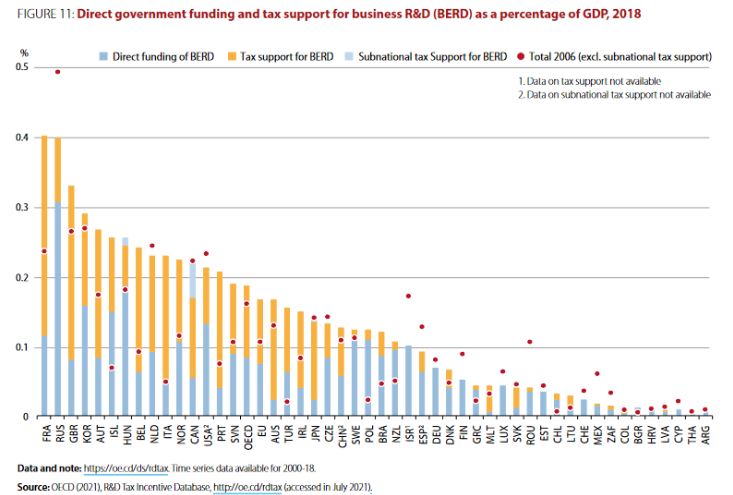
So we are way off the pace here. And it has been noted for some time that we do not invest enough in R&D. It was one of the reasons the R&D tax incentive scheme was introduced. So, as I said, there’s plenty to consider in this report with heaps of detailed appendices that you can trawl through.
Robin Oliver tax policy scholarships
And talking about tax policy, this week the Tax Policy Charitable Trust announced its annual Robin Oliver tax policy scholarships worth $5,000 for students majoring in tax at either Victoria University of Wellington or at the University of Auckland.
And later this year the Tax policy Charitable Trust will be launching its 2021 competition scholarship competition for tax policies. You may recall that we had the 2019 winner, Nigel Jemson, as well as one of the runner ups John Lohrentz on the podcast. I’m looking forward to seeing what comes out of these policy submissions in due course.
Well, that’s about it for this week. But before I go, it so happens that it is now 17 years since Baucher Consulting started. And as some of you may know, we recently undertook a slight reorganisation carving out some of our compliance functions to Agentro Limited. Big step that, it’s been a great journey for the last 17 years. And I’m looking forward to the future.
I’d just like to take this opportunity to thank my colleagues Eric, Darryn and Judith for helping me get here together with all our clients and many well-wishers who responded to our latest newsletter covering this news. Thank you very much. We really couldn’t have done it without you.
Well, that’s it for this week. I’m Terry Baucher and you can find this podcast on my www.baucher.tax or wherever you get your podcasts. Thank you for listening. And please send me your feedback and tell your friends and clients. Until next week, ka kite āno.

2 Aug, 2021 | The Week in Tax
- Time for a more generous approach to working from home allowances
- Tax agencies stepping up scrutiny of crypto-assets
- Former Treasury Chief Economist takes a swing at the Government’s tax policy.
Transcript
A couple of weeks ago, I reported that the Inland Revenue main office in Wellington had been closed and the staff were working from home as a result of a potential earthquake risk which had been identified.
There’s still no timeline as to when Inland Revenue staff, almost over a thousand of them, will be able to return to the office. In the meantime, they’re working from home. And the question has now popped up “Well, how about a bit of reimbursement for extra costs like heating and broadband?”
Now, apparently, Inland Revenue response has been “You’re saving money by working from home. You don’t have to pay for commuting, lunches and all the rest”. But the Public Sector Association is saying, “They have to work from home through no fault of their own.” And maybe it’s time that Inland Revenue recognised that and reimbursed them for it.
One Inland Revenue staff member has noted the argument that he was saving money on commuting costs doesn’t wash, because as he put it, “the five dollars a day I spend travelling in and out of work has never been deemed by Inland Revenue as a work-related expense. It’s a personal expense and it’s not claimable.”
Now, what this points to is a grey area which requires a mix of better tax policy which lays out some better guidelines and perhaps employers as well coming to the party. The position is, as I set out last year, when this whole thing became very, very relevant when we were all working from home during the first lockdown, is that employees cannot claim a deduction for home office expenses. They are meant to be reimbursed reasonable costs by their employer. This apparently seems not to be happening generally and it seems Inland Revenue is also reluctant to do this.
There was a determination issued during last year which covered the pandemic, which said that an employer could pay an allowance to an employee working from home that covers general expenditure and up to $15 per week would represent as exempt income. But $15 a week is pretty low with broadband costs and heating costs.
So the question was raised back then and it’s now back on the agenda again in a slightly more ironical context that we perhaps need to be setting out better guidelines. It occurs to me, for example, in the film industry, I understand per diems have been agreed of around $50 per day for contractors working in the film industry. And that’s taken to be a reasonable estimate of the costs they would have incurred.
The position I’m coming to here is Inland Revenue perhaps needs to grasp the nettle and issue more determinations which are more generous in scope and make it clear that for employers who pay these allowances, the extra allowances will be deductible, and the expenses will be non-assessable for employees.
Working from home does shift some of the costs to the employee. And I think it’s only fair that they get reasonably reimbursed. The legislation is in place, but I think it seems clear that the correct practise isn’t always understood and followed by employers. So maybe setting out new actual monetary limits would be a better approach going forward, even if Inland Revenue seems rather reluctant to do that.
Everyone is looking at cryptoasset taxes
Moving on there is increasing scrutiny of the cryptoasset world, and it’s tied into tax authorities wanting to get a better understanding of people’s assets, plus suspicion that people are using virtual assets to evade tax and also that cryptoassets are part of illegal activities and money laundering.
So as part of that, earlier this week, the United Kingdom Treasury announced a proposal that will require any virtual asset transfer of above £1,000 to be accompanied by detailed personal information of both the originator and the beneficiary.
This is tied into proposed amendments to money laundering legislation required to keep the UK’s regime in compliance with the recommendations of the Global Financial Action Task Force. The Financial Action Task Force said in July 2019 anti-money laundering legislation should cover cryptoassets. Putting the legislation in place has always taken a little bit of time.
Anyway, this is another sign of the increasing attention that tax authorities and authorities generally are paying to virtual cryptoassets.
Over in the United States the Internal Revenue Service, in conjunction with the New York State U.S. attorney’s office, has been briefing experts on the latest U.S. government enforcement efforts related to virtual currencies and cryptoassets.
As of April 2021, the IRS has joined its civil and criminal cryptocurrency units through Operation Hidden Treasure. Its Fraud Enforcement Office and Criminal Investigation Units are working with international law enforcement and crypto industry experts to root out tax evasion. And apparently, these include something called John Doe summonses, which sounds pretty sinister, and no doubt will pop up on some American TV show in due course and be explained to us.
The US Federal tax returns, Form 1040, now includes a question on virtual currency income, and it’s actually at the top of the form. That’s deliberately designed in order to make it easier to prove the knowledge and willfulness element for criminal cases in this matter.
So what we’re seeing is a trend all around the world of really amping up the scrutiny of cryptoassets. It’s a fast-moving field and the tax treatment isn’t always as clear as it could be. But Inland Revenue here is continually issuing guidance on the matter. And people need to pay attention to this. You should expect that the tax authorities will have some idea of your cryptoassets holdings and therefore you should follow the law and file returns as appropriate.
Facing up to unintended consequences
And finally this week, a couple of things in relation to the ongoing arguments over the Government’s interest limitation rules. Firstly, Inland Revenue has issued a very useful precis of all the questions and answers relating to the interest limitation rules and bright-line tests.
At 22 pages it’s a much more digestible document than the main discussion document. And of course, Inland Revenue is still working through all the submissions. So it’s a useful one stop shop to go through and get an idea of what’s been said so far. However, you should not take what’s in this Q&A as actual policy. They’re still working through it and the final version still has to be signed off by the Minister of Revenue and Cabinet.
But meantime, Norman Gemmell, who is the chair in public finance at Wellington School of Business and Government, Victoria University of Wellington, and former chief economist at New Zealand Treasury has come out with a working paper entitled What is Happening to Tax Policy in New Zealand and is it Sensible?
It’s a very quick read about 14 pages which looks at the increase in the top income tax rate and the housing package, that is the interest limitation rules, increased bright-line period and other related matters. Basically, it takes the view that both represent ad hoc responses without a coherent strategy. It notes that these were pushed through very quickly based on limited analysis and against most official advice on the matter as to how to deliver on the Government’s objectives.
And in Gemmell’s view, there are potentially serious unintended consequences. In particular, the coherence of the tax system is at risk, and it’s not an unreasonable argument. In fact, someone quipped that’s a statement of fact not an argument,
But this comes back to what I said last week, that when you look at where there is incoherence in the tax system, it keeps coming back to the question of the taxation of capital and of property in particular. We keep fencing around this issue and the unintended consequences of doing so, force further unintended consequences of the actions taken to try and remedy that.
There won’t be an easy answer to this solution until that nettle is very firmly grasped and the politicians put the politics aside and look at how exactly are we going to achieve a coherent tax system and address the issues of diversion of resources away from productive assets, inequality, and housing affordability.
All of those require a comprehensive approach and taking a different approach to what we’ve been doing up to now. The latest patches may work, perhaps, but they come with unintended consequences as Mr Gemmell points out.
That’s it for this week. I’m Terry Baucher and you can find this podcast on my website www.baucher.tax or wherever you get your podcasts. Thank you for listening and please send me your feedback and tell your friends and clients. Until next week ka kite āno!
26 Jul, 2021 | The Week in Tax
- Beware the great unknown of NZ tax – the financial arrangements regime
- Not many happy about the interest limitation proposals
- Time for a new approach – the fair economic return
Transcript
The former US Secretary of Defense Donald Rumsfeld died recently. In the run up to the Iraq war he mused that there were things that we didn’t know we didn’t know. I was reminded of Rumsfeld’s quote yesterday when a new client approached me in something of a panic.
Their accounting system was picking up on unrealised foreign exchange movements, but they weren’t aware of the relevant tax for treatment. It was something of a shock to them when I ran through the provisions of the financial arrangements rules probably the biggest ‘didn’t know that we didn’t know’ in the New Zealand tax system.
To recap, because there’s not much on the Inland Revenue website about these rules, a financial arrangement is broadly defined as an arrangement where a person receives money in consideration for money to be provided in the future. Bonds and mortgages are two of the main types of financial arrangements caught. But the regime also applies to term deposits because there is a promise to pay interest at a later date. The regime also covers foreign exchange accounts such as those held by my client
Unfortunately, the rules have proved particularly troublesome for holders of overseas mortgages. For example people who may have migrated here from overseas but rent out their previous property in Australia, the UK, or the US, over which they have a foreign mortgage. Although they are reporting the rental income as they should, they get caught by the foreign exchange movements on the mortgages
The most extreme example I ever encountered was for one client who had a $300,000 positive movement in one year resulting in income and tax payable which subsequently reversed entirely in the following year. They still had to pay the tax in the first place, a very frustrating result for all concerned.
So these financial arrangements rules are nightmare for the unwary as it’s an incredibly comprehensive part of the act but it is not at all well known.
Fortunately, by and large most people are not subject to the rules because they are within the exemption for what we call a ‘cash basis holder’. But that exemption itself has a couple of traps in it and this is what unfortunately has caught my client.
Generally speaking, you can be a cash basis holder and you don’t have to calculate income on an unrealised basis if either the absolute value of all your income and expenditure in a foreign arrangement for an income year is $100,000 or less.
Remember that’s adding income and expenditure together; the rules do not operate on a net basis. When calculating these limits that still needs to be kept in mind as it’s one of the other traps that people fall into. For example, if you had $500,000 on term deposit and you had a $500,000 mortgage overseas so although your net financial position is nil, for the purposes of the financial arrangement you have $1,000,000 of financial arrangements so you’re outside the cash basis holder exemption.
By the way, the $1,000,000 limit applies if on every day in a particular income year the absolute value of each of each of the persons financial arrangements added together has a total value of $1,000,000 or less.
Now as I said most people should be able to be within those limits. The problem is there’s another clause which trips people up which they need to be aware of. This is where if the difference between the income which would be calculated on an unrealised basis (what we call accrual income) and income calculated on the cash basis, that is what you’ve actually received or realised, exceeds $40,000 at any time then you cannot be a cash basis person. What this means is that sudden movements in exchange rates can pull people into the financial arrangements regime, the classic example here being what happened following the Brexit referendum vote.
The financial arrangements rules are very much a trap for the unwary. How well it’s enforced of course is another matter because these are fairly arcane provisions and I’m not entirely sure Inland Revenue has all the resources to keep on top of what’s happening in this space.
Of course, it might help if Inland Revenue and the Government reviewed these thresholds and adjusted them more frequently. The $1,000,000 exemption threshold has not been adjusted since 1999. Quite frankly the financial arrangements regime should not really be pulling in small businesses into its net simply because of an out-of-date threshold.
This is one of the practical matters around the operation of the Income Tax Act which seems to be get left lying around until someone somewhere in Inland Revenue realises, we haven’t actually done anything in this space for 22 years. Anyway, the lesson is to be wary of financial arrangements regime as it applies much more widely than people realise and can trigger unexpected tax consequences.
Bypassing the proper review process
Speaking of unexpected and unintended tax consequences, submissions closed on 12th July for the Government’s discussion document on its interest limitation proposals. It’s fair to say that the proposals have generated a fair bit of controversy. I understand Inland Revenue’s received several hundred submissions so far and very unsurprisingly the majority are opposed to the proposals.
Some of these submissions are now available to the public and so it’s interesting to look at what other submitters have said. Chartered Accountants Australia and NZ have produced a massive and extremely comprehensive submission which runs to 108 pages. Now remember the discussion document itself was 143 pages so when the commentary on a document that size itself runs to 108 pages we’re talking about a great deal of complexity. We’re almost certainly heading into a lot of unintended consequences as CAANZ’s submission points out.
This is echoed by its fellow accounting body CPA Australia.
It points out that the measures were a surprise and did not go through the normal Generic Tax Policy Process and it foresees considerable confusion and remediation for the rules as a consequence.
CAANZ was also unhappy about the fact that the proposals did not go through the Generic Tax Policy Process (GTPP). This is meant to work out in advance of an implementation date what the issues are and get the legislation to a point where everyone is mostly satisfied with what’s being introduced. That didn’t happen here and is one of the reasons a lot of tax consultants, larger accounting firms and accounting bodies are unhappy about the proposals.
It’s interesting looking back that where there’s been departures from the GTPP these have commonly happened around taxation of property.
There were several unheralded moves by the previous National led Government outside the GTPP. In the 2010 Budget for example, depreciation on residential and commercial buildings was withdrawn without any forward consultation. Likewise, the same budget put an end to the loss attributing qualifying company regime partly in response to what was perceived to be issues around tax avoidance. But the depreciation changes and withdrawal of the LA QC regimes were also responses to the tax treatment of residential investment property being perceived to be too generous. Then in 2015 the first iteration of the bright-line test was introduced again outside without prior consultation through the GTPP.
I too agree with CAANZ and CPA Australia that there will be unintended consequences as a result of these changes but it’s also interesting to note that the taxation of property has been a headache for governments for some time to the extent they felt compelled to take action outside the normal policy process.
Patching another unreviewed policy
One of the things that hasn’t been done and probably should be is a comprehensive look at property taxation legislation. We haven’t had a review of the original bright-line test legislation and its consequences. These reviews are quite normal under the GTPP. But now we’re putting patches on that legislation and extending its period to 10 years. Meanwhile it’s clear there’s confusion about whether a property sale is subject to bright-line test or other taxing provisions within the Income Tax Act.
It’s against that backdrop Professor Susan St. John and I decided to move forward the idea of what we called a Fair Economic Return. This is building on an idea that was first mooted by the McLeod Tax review in 2001. It suggested applying a deemed rate of return to property as an alternative taxation basis. No-one is particularly sold on a capital gains tax but there was a recognition even 20 years ago that the tax treatment of property was favourable and causing distortions in the tax system. Those distortions have become magnified over the past 20 years resulting in measures such as we’ve just described attempting to address these issues.
With that in mind Professor St. John and I have produced a working paper suggesting a Fair Economic Return. We haven’t formalised a rate that should apply but the working paper has examples of how it would operate whether rate was 1, 2, or 3%.
This rate would be applied to the net equity of all property held by a person.
To get around the definitional issues of what is the main home, we have suggested there should be an exemption available to each person. In our initial working paper, we’ve suggested that exemption could be $1,000,000.
Here’s an example of how it would work for a couple living in Auckland whose only property asset is their house worth $3 million with a $500,000 mortgage. The net equity in the property is therefore $2.5 million. Applying each person’s exemption $1,000,000, this leaves $500,000 subject to the Fair Economic Return at a rate of let’s say 1%. This results in income of $2,500 for each person.
This is the idea Susan and I have put out there and we’ve been talking this week on radio about it. It’s obviously going to generate a fair bit of feedback, not all of it favourable, but that’s not surprising.
The view we’ve reached is it’s time to try a different approach because patches to the existing tax system such as interest limitation rules, extension of bright-line tests but incorporating exemptions for new builds etc, do not work, these are just patches, it’s time for a comprehensive and different approach to the whole issue of property taxation.
We’re updating the paper to absorb commentary and we’re always happy to take comments on that.
In the meantime, that’s it for me for this week. I’m Terry Baucher and you can find this podcast on my website www.baucher.tax or wherever you get your podcasts. Thank you for listening and please send me your feedback and tell your friends and clients. Until next week ka kite āno!

21 Jul, 2021 | The Week in Tax
- Parliament’s Finance and Expenditure Committee launches enquiry into cryptoassets, tax treatment of forks and hard drops
- Deductibility of meal expenses of self-employed
- Inland Revenue office closed for earthquake risk
Transcript
Earlier this week, Parliament’s Finance and Expenditure Select Committee announced it was launching an enquiry into “the current and future nature impact and risks of cryptocurrencies.”
This is a very broad ranging enquiry, the terms of reference include enquiring into and establishing the nature and benefits of cryptocurrency, how they are created and traded, understanding the environmental impact of mining cryptocurrency (which is something increasingly in the news). Identify risks to users and traders of cryptocurrency, what risks cryptocurrencies pose to the monetary system and financial stability. The tax implications in New Zealand and how cryptocurrencies are used by criminal organisations. And to establish whether the means exist to regulate cryptocurrency either by sovereign states, central banks or multilateral cooperation.
Now this is part of a worldwide trend. Cryptoassets are now worth over a trillion dollars following a huge surge in value. Increasingly, governments around the world are looking at what’s going on in this space, particularly as cryptocurrencies are also linked to the ransomware attacks that we’ve been seeing, the most notable example in New Zealand being the Waikato DHB.
Over in Australia, the Australian Tax Office (the ATO) is concerned that many taxpayers are not meeting their obligations, thinking cryptocurrency gains are tax free or only taxable when the holdings are cashed back into Australian dollars. ATO data shows a dramatic increase in trading since the beginning of 2020. It now estimates there are over 600,000 taxpayers in Australia that have invested in cryptoassets.
The ATO has said that it is going to write to around 100,000 taxpayers with cryptoassets, explain their tax obligations and urge them to review their previously lodged returns. That’s quite a big project. It also expects to “prompt” almost 300,000 taxpayers as they lodge their June 2021 tax returns to report their cryptocurrency capital gains or losses. So the ATO has come out swinging.
Over here Inland Revenue has been consistently expanding the release of information on how it considers cryptoassets should be treated. And a couple of weeks back, it released its final versions of a couple of “Questions we’ve been asked” about the consequences of receiving cryptoassets from either a hard fork or an airdrop. These are QB 21/06 and QB 21/07.
QB 21/06 deals with the tax treatment of cryptoassets received from an airdrop. Briefly, it’s saying that receipt of such airdropped cryptoassets are taxable where the person has a cryptoassets business, acquired the cryptoassets as part of a profit-making undertaking or scheme, provided services to receive that airdrop and the cryptoassets are a payment for those services or receives air drops on a regular basis. But beyond these circumstances the airdrop is probably not taxable.
Now, just quickly, an airdrop is basically a distribution of tokens without compensation. What I understand, is that these are undertaken with the view of increasing awareness of a new token. It might also be done to increase the supply of cryptoassets in the market. The income tax treatment will very much depend on the nature and purpose and intent of the investor who receives them.
What happens when a person who received airdropped cryptoassets disposes of them? Well, it’s taxable if it’s part of a business or they provided services to receive them, or they acquired them with the purpose of disposing of them. But in some cases, the cryptoassets were possibly acquired by the investor who was just sitting on a particular cryptoasset and received an airdrop without providing any services for it. So that may not be taxable because can you say that the airdropped cryptoassets were acquired with a purpose of disposal?
QB 21/07 deals with the consequences of receiving cryptoassets from a hard fork. A hard fork, by the way, is generally defined as where the protocol code of the block chain has been changed to create a new version of the block chain outside the old version. You have a new token which operates under the rules of an amended protocol, whereas the original token continues to operate under the existing protocol. An example would be the July 2017 hard fork of Bitcoin which saw the creation of Bitcoin cash alongside Bitcoin.
In the wonderful terminology of the crypto world there’s also a software which updates the protocol but is intended to be adopted by all users on the network. And so no new coin is expected to be created. The example given here is the August 2017 SegWit fork to the Bitcoin protocol.
2017 is probably a century ago in the cryptoassets world as this is a space that’s moving very, very quickly. Hence why the Finance and Expenditure Committee wants to have a look at enquiry into what’s going on.
Now, generally speaking the principles are similar to that of QB 21/06. So, if someone’s received cryptoassets following a hard fork, it’s taxable if they’re in a cryptoassets business or acquired the cryptoassets as part of a profit-making scheme or undertaking. In most other circumstances, the receipt is not taxable.
However, when cryptoassets received from a hard fork are disposed of, those will be taxable again, where the person has a cryptoassets business or acquired the cryptoassets as part of a profit-making undertaking a scheme or for the purpose of disposing of them.
As ever, there’s a lot going on in the cryptoassets space. Inland Revenue is, like most other tax authorities, and the ATO is a good example, trying to keep up with the play here. It will be interesting just to see how matters develop. Australia has a capital gains tax, so to borrow a line from Blondie “One way or another, they’re going to get you”. But here the rules are a little less clear. It’s actually good Inland Revenue is setting out rules, but the pace of change means that it’s probably sometime behind the eight ball.
GST on meal expenses for the self employed
Moving on, Inland Revenue released an Interpretation Statement IS 21/06 last week. This deals with the income tax and GST treatment of meal expenses incurred by self-employed persons.
Now, this is quite a substantial document, it actually runs to 37 pages, because what it also does is discuss the treatment of meal allowances paid to employees. It does so to illustrate the differences with the treatment of self-employed persons and also the treatment of entertainment expenditure.
The basic principle it is setting out is that in general, self-employed taxpayers cannot deduct meal expenses for income tax purposes. That is because they are treated as expenditure which is of a private nature. This is what they call the “private limitation” rule. Now, there are some certain limited circumstances where amounts expended on food could be deductible, such as where the requirements of the taxpayer’s business imposed extra meal costs such as a remote working location or unusual working hours.
The Interpretation Statement then goes on to explain there is a clear distinction between the treatment of self-employed taxpayers’ meal expenses compared with employees receiving meal allowances reimbursements while performing their duties. The latter is deductible expenditure to the employer and exempt income for the employee, not subject to FBT. The Interpretation Statement suggests self-employed persons may decide to operate through a closely held company and they become an employee of the company. In which case the same treatment applies. The reason given for this distinction is the different legal arrangements existing around these situations.
There’s also a difference in the treatment of entertainment expenditure. Entertainment expenditure generally for businesses is only 50% deductible. However, for the self-employed the Interpretation Statement considers the entertainment rules are overridden by the private limitation, so no deduction is available.
In relation to GST, where meal expenses are either private or domestic in nature for income tax purposes and non-deductible, then no GST input tax can be claimed. This is because they are being used for private and domestic purposes and not for making taxable supplies.
This Interpretation Statement is not going to be terribly welcome for self-employed taxpayers. It’s interesting to see this come out, but I wonder whether Inland Revenue will actually be devoting considerable energy into its implementation. But the rules are there and there’s a very clear if harsh distinction drawn between the self-employed and employees receiving meals allowances from their employer.
IRD Wellington is working from home
And finally, Inland Revenue, or at least its central Wellington office is homeless. The head office of Inland Revenue is in the Asteron building in Featherston Street, Wellington. About a thousand IR staff work there, mostly senior management, the policy and technical people and maybe some investigation staff. It’s not one of the big call centres dealing with the general public.
Anyway IR has closed the office and sent staff home after a new seismic assessment put the Asteron building at a lower level of earthquake compliance than previously thought. This is quite a major disruption, but thanks to Covid-19, we’ve got used to working from home. Inland Revenue certainly, yesterday ran a meeting that was scheduled without any particular interruptions.
Tongue in cheek now, I wonder if Inland Revenue might now be prepared to consider the treatment of remediation expenses a little bit more generously. This is an unclear area.
Fortunately, the reintroduction of depreciation does address a problem which had emerged where remediation expenses were considered non-deductible and were also non-depreciable, hence putting building owners under the pump. That’s been somewhat resolved by the reintroduction of building depreciation from 1st April 2020.
The Asteron building was apparently the largest office building in in Wellington. So that’s a significant loss. Seven floors are closed and one thousand staff, which is 20 per cent of Inland Revenue are now working from home. That’s going to be very disruptive. I hope it’s resolved very quickly because although we’ve got used to working from home there are benefits from working together and people will miss their colleagues. So anyway, good luck to the Inland Revenue staff affected. I hope this is sorted out pretty quickly.
Well, that’s it for today. I’m Terry Baucher and you can find this podcast on my website www.baucher.tax or wherever you get your podcasts. Thank you for listening and please send me your feedback and tell your friends and clients. Until next week ka kite āno!

12 Jul, 2021 | The Week in Tax
- The unintended consequences of the interest limitation proposals
- A coming clampdown on the fringe benefit tax rules around twin cab utes
- Inland Revenue updates its advice on non-cash dividends
Transcript
Having pored over the 143-page discussion document on the interest limitation proposals for the last few weeks and discussed them with colleagues, the summary position I’ve reached is that the Government should be very mindful that there will be some unintended consequences, and it should therefore be prepared to fine tune its proposals.
In particular, two issues seem to be emerging. One is that the interest limitation rules and the proposals to allow an interest incurred in relation to new bills, may mean that the trend which was causing concern of first home buyers being squeezed out in favour of developers and investors with access to plenty of assets and therefore leverage, is probably going to accelerate.
Developers and investors are able to outbid first home buyers for vacant plots of land or buildings where a single home might exist now but has potential for it to be converted into two, three or more dwellings. Given that under the new build proposals, interest deductions will continue to be allowed for building additional dwellings the likelihood of first home buyers being able to buy vacant land, put a building on it and move in is likely to be diminished. They’re simply going to be outbid by those who have access to greater access to finance. And I think that trend will be accentuated by these proposals.
That probably is not an intended consequence, but as in taxes everywhere, unintended consequences are often in play and the housing market is probably one where the unintended consequences of decisions taken 30 or more years ago have now come home to roost with a vengeance.
And the other unintended consequence I believe is going to come about, is that the burden of these proposed changes will fall on a group that aren’t really its target. And they also happened to be the least equipped to manage the level of detail and compliance that will be expected. And this group here are the is the so-called mum and dad investors, people who have one, maybe two investment properties which represents their retirement fund.
This is a group of people who are not really in the Government’s target, they’re not the larger investors who are able to have been able to leverage up significantly and outbid first home buyers. These are people that have decided to purchase investment property for their retirement. Or it may be that a couple have formed a relationship and they’ve moved into one property and rented out the other property,
Whatever their circumstances, this is a group that’s going to face a significant amount of compliance going forward, and for very little reward for the Government I would add, either politically or in terms of actually improving the housing market.
It seems to me the Government ought to think seriously about an exemption for such a group. Maybe to say that holders of one investment property are exempt or the rules only apply above a threshold.
Currently, the average rental income in the country is about $25,500 dollars a year. Maybe if the gross rental income is, say, $30,000 dollars or less the rules won’t apply.
Alternatively, if the Government still wants to remove this tax anomaly of a full interest deduction for a partly untaxed return in the form of capital gains, it could then say only 50% per cent of the interest is deductible. By the way that was something a previous guest John Cantin suggested could be an option. It would be a more straightforward option.
The thing that has been interesting when dealing with the discussion document proposals is that although the concept of denying interest deductions seems straightforward in itself, what has been really revealing is the level of detail we’ve had to work through, particularly in relation to the new build exemption.
The complexity means tax agents like me, other advisers and individuals are now at a greater risk of getting their tax returns wrong – for example incorrectly calculating the proportion of interest that’s deductible. Greater complexity means a greater likelihood of something happening and a client suing for negligence. It could be that professional indemnity insurance premium premiums rise as a consequence.
But anyway, both advisers and those affected by this would want to see the Government think hard about making the proposals less onerous from a compliance perspective.
Submissions close on Monday the 12th. As I have said previously, be constructive with your submissions. The Government isn’t going to listen to people moaning that these are terribly unfair. That’s a fact of life. These submissions will be considered by Inland Revenue, and we’ll know more in about four to six weeks when the final form of the proposals is released together with the draft legislation. It’s a tight timeline because all of this is meant to be in place by 1st October.
Fringe benefit tax
Moving on, the issue of twin-cab utes and FBT is back in the press with Minister of Revenue, David Parker, saying he was considering a clampdown on the fringe benefit tax rules. He has apparently received advice on how twin-cab utes were being taxed and he has confirmed that he was considering acting on it.
Inland Revenue advice was that there is no exemption to twin cabs, which I’ve previously discussed. And that’s correct, even though there’s a popular belief there was one. What Inland Revenue believes is that the existing rules aren’t being properly enforced, which is also my conclusion.
The astonishing thing, though, is that Inland Revenue went on to say it wasn’t so keen on chasing down this matter because it wouldn’t bring in much money. David Parker said, quote, “Inland Revenue advised me that it’s not as big an issue relative to other enforcement priorities. But we’re having a look at the issue because they are proliferating.”
There are two points to be made about this. Firstly, Inland Revenue has a duty under section 6 of the Tax Administration Act 1994 “to protect the integrity of the tax system.” including people’s perception of the integrity of the tax system.
So a public statement making it known that it really didn’t feel that this was a big issue sends completely the wrong message about enforcement for myself and other tax advisors and those conscientious taxpayers, the vast majority of which want to follow the rules. Inland Revenue basically saying,” Well, we’re not really bothered about this”. In the context of an $85-billion annual tax take saying an extra $100 million a year isn’t that significant may be true, but it does nothing for the integrity of the tax system to say so.
The other thing in here which David Parker has picked up on – he is also the Minister for the Environment – is that the climate change policies are undermined by not enforcing rules around twin-cab utes. These are high emitting vehicles and the Productivity Commission noted we are importing higher emission vehicles relative to what’s available in the rest of the world. In other words, New Zealand has become a bit of a dumping ground.
And so if we’re tackling emissions, reducing emissions is an ongoing job and in that context, not enforcing the FBT rules makes that job harder. Transport emissions are one area where New Zealand can make progress in reducing its emissions. Leaving aside the issues around reducing methane emissions from our agricultural sector, we can certainly do more in improving emissions from the transport sector.
So it will be interesting to see how this plays out. Inland Revenue I think will be upping the ante on this. Get any group of tax advisors together and we’ll all have stories about some of the abuses we’ve seen. Like Inland Revenue previously photographing or sending someone to watch popular boat ramps and boats being launched at the weekend, just to see whether a purported company vehicle was being used in a private capacity. Apparently one such boat launching ramp in Gisborne was opposite the Inland Revenue office and one company after a few weeks got a call from Inland Revenue asking if they were, in fact, correctly reporting FBT.
Transfers as ‘dividends’
Moving on, Inland Revenue has this week released a number of Interpretation Statements which give its view of how the law operates. One that people should pay particular attention to is Interpretation Statement 21/05 on non-cash dividends. Now, what this does is consider when a transfer of value from a company to a shareholder is treated as a dividend for tax purposes. These are sometimes also referred to as the deemed dividend rules.
The Interpretation Statement wisely, in my view, focuses on the type of non-cash transactions that are often entered into between small and medium companies and their shareholders. Now, sometimes FBT picks up some of these issues, but other times they don’t. A common example of a non-cash dividend would be a loan from a company to a shareholder.
So what the interpretation statement does is set out a number of examples of how these rules might work. For example, there’s a banana company which provides one of its shareholders with a large number of fresh bananas. That is a dividend. Another example would be the shareholder owes the company money and the company forgives the debt. That’s another as a dividend or a telecommunications company provides one of its shareholders with telecommunication services for free.
The interpretation statement works through various scenarios like this and clarifies which are dividends together with the rules for calculating the dividend and when the dividend is deemed to have been paid.
It’s actually a very valuable document. It’s also quite astonishing to realise it is in fact an update of a previous item on deemed dividends which dates from March 1984. I know Inland Revenue has got a lot on its plate, but it is a bit of a surprise to see it taking 37 years to update this sort of matter.
Anyway, the interpretation statement is out there. So people should be more aware of this deemed dividend issue. It obviously indicates that this is one of the areas Inland Revenue is looking at. They have, in fact, been quite interested in the area of shareholder advances, that is loans from the company to shareholders for some time. So this Interpretation Statement should serve as a warning.
Well, that’s it for today. I’m Terry Baucher and you can find this podcast on my website www.baucher.tax or wherever you get your podcasts. Thank you for listening and please send me your feedback and tell your friends and clients. Until next week ka kite āno!