

Comparing New Zealand’s taxation of property with other countries

Comparing New Zealand’s taxation of property with other countries

  • Comparing New Zealand’s taxation of property with other countries
  • OECD heralds a clampdown on crypto assets
  • Another warning from Inland Revenue about attempts to manipulate income to avoid the 39% tax rate

Transcript

In last week’s Sunday Star Times, Miriam Bell looked at the question of how New Zealand’s taxation of property compares with other jurisdictions.

In doing so, she spoke to myself, Robyn Walker of Deloitte, and John Cuthbertson, the tax director for Chartered Accountants Australia and New Zealand. We all gave differing takes on the position.

According to the OECD statistics, we are near the bottom end of the range as a percentage of GDP. Including local government rates, New Zealand’s taxes on property for 2020 was approximately 1.9% of GDP and the total tax take for the year of 32.18% of GDP. By comparison, Australia’s taxes on property was 2.718% of GDP (2019 numbers), the UK was 3.855% and Canada 4.15% of GDP (both 2020 numbers).

As you can see, Canada and the UK are significantly above New Zealand. One of the reasons for this, as Robyn and John pointed out, is that they have a range of stamp duties that may apply. But also, as we all pointed out, all three jurisdictions, Australia, Canada and the UK, also have capital gains tax and in the case of the UK, inheritance tax may also apply on some properties on transfer.

The article provoked a fairly lively debate, as you would expect. The range of views across the board is that, yes, it looks like we’re under taxed. But the bright-line test is in place which is problematic in that although it looks like a capital gains tax, it doesn’t apply comprehensively, unlike in the other three jurisdictions.

Robyn Walker then made a very good point following through that the design of the bright-line test is basically all or nothing. If you hold property for more than 10 years, you’re outside the test, which means that you’re likely not to be taxed on it. So you get this wide variance in the tax effect of sales or property, which you don’t see to the same extent in other jurisdictions.

Robyn subsequently did a nice little post on LinkedIn, in which she looked at what would be the tax consequences in Australia, Canada, the UK, and New Zealand for the sale of a property which realised a $100,000 gain. Because we treat it as income, we’ll tax the full gain at the relevant marginal rate and for the purpose of the example that was 33%. Canada and Australia will tax only half the gain at the relevant marginal rate, although non-residents in Australia will be taxed on the full gain. And although the UK will tax the full gain the top rate applicable is 28%.

The end result was that if the bright-line test applied, then the tax payable in New Zealand would be highest relative to the other three jurisdictions. But if the bright-line test didn’t apply, then it was the lowest. In fact, it would be nil. And this reinforces Robyn’s point that it is a poorly designed test which can be very unfair in its application. You hold a property for nine years and 363 days, you’re taxed. Hold it for 10 years and one day you’re probably not.

The point I stressed in the article is that we want to look at broadening the range of taxation, and it’s fair if we do so because we start to get round these arbitrary distinctions. As I’ve previously said, my preferred methodology for expanding the taxation of capital is that promoted by Associate Professor Susan St John and myself the fair economic return, not a transactional based capital gains tax.

Anyway, this debate will continue to run and run. Miriam Bell’s article provoked a fierce reaction on Stuff, unsurprisingly, and there’s been an interesting debate around Robyn’s LinkedIn article. I urge you to take a look at that.

I think we really do need to address the issue of taxing property particularly when you consider what the Infrastructure Commission said earlier this week about property owners benefiting to the extent of house prices being 69% higher than they would have been without actions being taken to restrict the supply of housing.  Housing and the taxation of property is a touchpoint now and will be in next year’s election. We’re going to see plenty more of this debate

Taxes on crypto assets are coming

Moving on to another controversial asset class – crypto assets. Now the value of crypto assets has just simply exploded in the last 10 years. Because of the explosion of the value, it has forced its way onto the tax agenda and tax authorities all around the world are looking to see how this new asset class fits in with their existing rules. New Zealand is no different from other jurisdictions which are all struggling with this.  The recent tax bill that was passed last week, by the way, had provisions relating to the application of GST on crypto-assets.

A couple of weeks back, the OECD released a public consultation document proposing a new tax transparency framework for crypto assets. What it has identified is that crypto assets can be transferred and held without going through the normal financial intermediaries, such as banks, and fund managers.  And from a tax perspective, there’s no central administrator having what the OECD calls full visibility on either the transactions carried out or on the location of crypto asset holdings.

It also appears that malware attacks and ransomware attacks, payments are increasingly demanded in crypto-assets, which are largely untraceable. So that’s obviously a matter of concern to not just tax authorities.

The OECD paper also points out that some new paid payment products. Such as digital money products and central bank digital currencies, which also provide electronically storage and payment functions similar to money held in traditional bank accounts.

But at the moment, none of these are covered by the Common Reporting Standard on the Automatic Exchange of Information. A reminder the Common Reporting Standard is an agreement between almost 100 jurisdictions where they agree to swap information on financial accounts held in their country by citizens or tax residents of another jurisdiction. It’s been a huge step forward in tackling adn improving tax transparency and tackling tax evasion.

And what the OECD is proposing is, it wants to develop a new global tax transparency framework, which will involve the same reporting for transactions related to crypto assets as for financial assets covered by the Common Reporting Standard. And it’s calling this the Crypto Asset Reporting Framework, or CARF. The paper proposes that the following types of transactions involving crypto assets will be reportable under the CARF:

  • exchanges between crypto assets and fiat currencies;
  • exchanges between one or more forms of crypto assets;
  • reportable retail payment transactions; and
  • transfers of crypto assets.

This would bring about a very significant change in the crypto asset world as a result. It will basically be bringing the whole crypto asset world in line with other reportable transactions under the existing Common Reporting Standard framework. I doubt that will be very popular with investors in the crypto world, but it certainly will be for tax authorities and other authorities, such as financial regulators and police, as they deal with the implications of the arrival of this asset class. Consultation is now open on the document through until 29th April.

Same old problem returns

And finally, this week, a couple of weeks ago I discussed the new Inland Revenue consultation paper on countering attempted top tax rate avoidance. It so happens that yesterday RNZ had a story on the paper and Inland Revenue’s concerns that “structures may be being used to reduce incomes below $180,000.”

Inland Revenue has provisionally estimated that income from these high earners will be down $2.88 billion, or about 14% from the year prior.  This is on the basis that the average self-employed person – who has the most control over their income – might declare 13% less income than they did the year before, to drop from $191,000 to $166,000 (and by happy coincidence below the $180,000 threshold).  The number of PAYE earners is expected to reduce, and also declare lower incomes, from an average of $228,000 to $217,000.

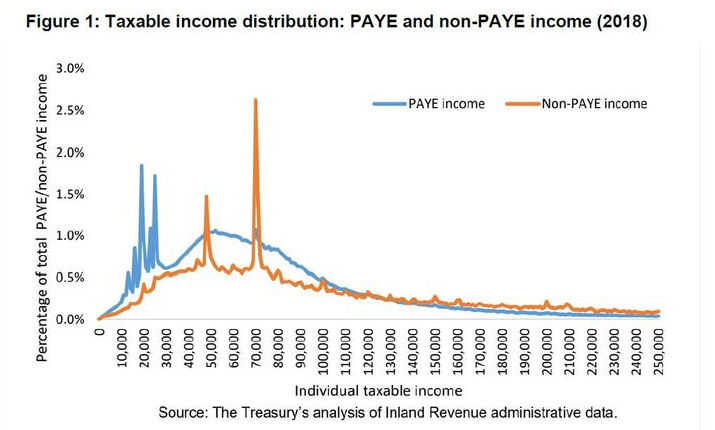
If that is happening then I would expect Inland Revenue to react aggressively. On the other hand, Inland Revenue has known for some time that self-employed income spikes around the $48,000 mark (the threshold when the tax rate increases from 17.5% to 30% and $70,000 dollars when the threshold tax rate increases to 33%). I’m not yet aware of increased Inland Revenue investigation activity into such apparent income manipulation. It seems to me that although Inland Revenue has concerns about manipulation involving the new 39% tax rate, what appears to be happening around the $48,000 and $70,000 thresholds seems very blatant.

The RNZ report included a chart from Inland Revenue of the taxable income distribution for the 2018 income year which illustrated these spikes occurring at the $48,000 and $70,000 thresholds.
The graph mirrors one produced in 2008 (when the top tax rate was 39%). You can see exactly the same pattern of income spikes around $38,000, the threshold at which the tax rate increased from 19.5% to 33% and then at $60,000 when the tax rate rose from 33% to 39%.
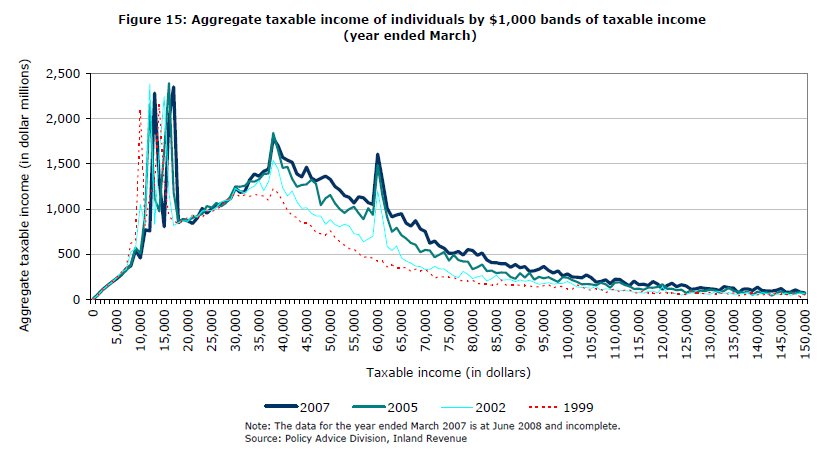
In other words this is a very longstanding problem and the question arises why that issue has been allowed to continue? Does Inland Revenue have the resources to address it? They most certainly will say they do, and they would also probably say that they have had a lot to deal with managing the COVID-19 response over the last two together with finalising the Business Transformation project. Either way you should expect action on this from Inland Revenue.

Incidentally on the question of high tax rates, another news report covered the effect of increases for working for families tax credits. It pointed out that the effective marginal tax rate for recipients of working for families can in some cases be 57%. This is the combination of 30% tax rate on incomes over $48,000 and the 27 cents in the dollar abatement, which applies above a threshold of $42,700.

So before people start complaining about 39% being a very high tax rate, think about what’s going on with working for families, accommodation supplement and other social welfare payments. It’s quite conceivable that someone on $60,000 per annum, receiving working for families with a student loan could have a marginal tax rate on every dollar earned of 69%. This represents 30% income tax, 27 cents on the dollar abatement on their working for families and 12% student loan repayments.

By the way, the $42,700 threshold when the working for families’ abatement kicks in is now, by my calculations, less than the annual income of someone working 40 hours a week on the current minimum wage would earn. It’s another case of where governments have allowed inflation to quietly increase the tax take with worse consequences for people at the lower end of the scale. Yet another issue we’ve talked about repeatedly.

Well, that’s it for this week. I’m Terry Baucher and you can find this podcast on my website www.baucher.tax or wherever you get your podcasts.  Thank you for listening and please send me your feedback and tell your friends and clients.

Until next time, kia kaha, stay strong.

Inland Revenue enlists the help of the Chinese tax authorities in a tax evasion case

Inland Revenue enlists the help of the Chinese tax authorities in a tax evasion case

  • Inland Revenue enlists the help of the Chinese tax authorities in a tax evasion case
  • OECD report reveals the impact of COVID-19 on tax revenue
  • Inland Revenue turns off its old computer system

Transcript

The Taxation Review Authority last week upheld the Commissioner of Inland Revenue’s assessments on unreported income from property transactions. There’s nothing particularly unusual about the facts of this case at first sight. The taxpayer was involved with the purchases and sales of five properties. He arranged the purchase of bare land, the construction of a house on the land and then sold the house.

He maintained he was only a manager and was actually acting under a power of attorney for Chinese nationals and merely managing the properties and receiving payments for services such as arranging the land development and transactions.

But the Commissioner decided to take a look at his affairs for the three tax years ending 31 March 2014, 2015, and 2016.  And it transpired that in fact, he wasn’t acting as a manager, but he personally controlled the transactions, and he made the profit from proceeds of each property over and above the management fees he had returned in his tax returns. These transactions all pre-date the introduction of the bright-line test, so the Commissioner assessed him on the basis that the properties were acquired with a purpose or intent of sale.

Ultimately, the amount that was assessed after deductions over the three years turned out to be over $1.6 million. In addition, because he had only been returning the management fees, he had actually also claimed working for families tax credits of just under $9,000 to which he wasn’t entitled. The commissioner took the view all this represented tax evasion and imposed shortfall penalties of initially 150% of the tax evaded but reduced by 50% for a first offence. Even so these penalties amounted to $407,000.

So far this is relatively routine. Inland Revenue are tracking property transactions and if something gets suspicious, they’ll look to see if a pattern emerging.

What caught my eye about this one is the Commissioner’s investigations included obtaining information from the People’s Republic of China under the double tax agreement we have with the PRC. As a result of that enquiry the registered proprietors of the land said, “Hey, we’ve got no knowledge of our involvement in these property sales, and we have not received any benefit from these sales”.

Now, one of the great unknowns that I think people aren’t aware of is how much information sharing goes on between tax authorities. But this is the first one I’ve seen where it’s been clearly acknowledged that the Chinese tax authorities in the People’s Republic of China have been involved.

So, there’s a warning for people to be very aware that Inland Revenue information gathering powers are enormous and they have discretion to ask overseas tax authorities for information in relation to any enquiry. Undoubtedly, the Chinese tax authorities would have been very interested in this as well because they would have people at their end who may have been involved in tax evasion.

A couple of years back, I asked Inland Revenue under the Official Information Act about how many requests for information were made between it and the Chinese tax authorities during the year ended 31 December 2018.  The official response was

The information above is refused because making the information available would likely prejudice the international relations of the New Zealand Government. It would also likely prejudice the entrusting of information to the New Zealand Government on a basis of confidence by the tax agency of the People’s Republic of China.

Incidentally I asked a similar question in relation to the double tax agreements with Australia and the UK, and the information was supplied.  Talking with a journalist who often deals with OIAs being declined, he was quite impressed because he hadn’t had an OIA declined on those grounds.

But international relations aside, the key point people should be aware of is that Inland Revenue has wide information gathering powers, and that includes being able to talk to other tax agencies and overseas. And in this case, that was probably pretty fatal for the taxpayer’s chances in this case. You have been warned.

The economic tax take in a pandemic

Speaking of international tax, the OECD earlier this week released its Revenue Statistics 2021, which showed the initial impact of COVID 19 on tax revenues within the 30 odd countries of the OECD.

On average tax revenues represented 33.5% of GDP in the 2020 calendar year, which is 0.1 percentage points of GDP up relative to 2019. But of course, this is against the backdrop of the impact of the pandemic which resulted in widespread falls in nominal tax revenues and nominal GDP. And that’s why the tax take relative to GDP rose because in most countries, GDP fell by more than nominal tax revenues.

As typically with OECD reports there’s heaps of interesting data that you can dive into.  For example, in 2020, Denmark has the highest tax to GDP ratio of 46.5%, whereas Mexico, at 17.9%, has the lowest tax to GDP ratio. Overall, in 2020 for the 36 countries that were measured, the ratio of tax to GDP rose in 20 and fell in 16.

The largest ratio increase was in Spain, which went up 1.9 percentage points, apparently because of a large increase in social security contributions. But the largest fall, on the other hand, was Ireland, which fell 1.7 percentage points. And that was because its GST revenues fell quite substantially following a temporary reduction in GST rates as part of its response to the pandemic.

Where does New Zealand feature in all of this? Well, its ratio provisionally rose to 32.2% of GDP, which is up 0.7 percentage points from 31.5% in 2019. By the way, the tax to GDP ratio is also shown for the year 2000.  Back then the ratio was 32.5% and New Zealand since then has pretty much tracked around that thirty-to-thirty two percent of GDP ratio since then. Incidentally, Denmark’s has actually been pretty stable over the same period. Its tax to GDP ratio back in 2000 was 46.9%. The average across the OECD back in 2000 was 32.9% and in 2020, it’s 33.5%. So, you can see stability across the tax take for quite some time.

The report has a breakdown between tax types and interestingly, corporate income taxes in New Zealand at 12.4% of total tax revenue in 2019 is significantly above the 9.6% average across the OECD.  Similarly, GST at 30.3% is well above the 20.3% average in the rest of the OECD. (Chile incidentally collects 39.9% of its tax revenue from GST, which is the highest in the OECD. As always there’s plenty to dig into in these OECD reports.

From FIRST to START

And finally, this week, Inland Revenue has finally switched off its old FIRST computer system, as it’s now practically completed its Business Transformation programme. The total cost of this Business Transformation has come in at just under $1.5 billion, which is less than the $1.7 billion that was originally budgeted, including the leeway for contingencies.

So that has rightly drawn some praise from various sectors for managing that transition. I think you can look back at the Novopay scandal as to see how these things can go wrong. Consequently, the Inland Revenue had to make regular reports to the Cabinet about its progress.

And one of the effects for Inland Revenue of the programme and which was part of its business case, is that its workforce has gone from 5,662 in June 2016 to under 4,000 now, a quite significant change. My understanding is that back in 2016 under the old system, a significant number of processers were employed simply to re-enter everything into the system so it could actually be used.

Regular listeners to the podcast will know I’ve not always been entirely complimentary about what’s going on with Business Transformation. There have been some issues for tax agents and we’re still working through some teething problems. Generally, I think when the Business Transformation programme was being designed and implemented, the role of tax agents was not well considered. We tax agents are actually the biggest single users of the system and perhaps having tax agents involved earlier on might have made it a more user-friendly experience from our end.

However, it has to be said that this programme was much needed. FIRST was introduced in 1989, I think, and it was really showing its age. And fortunately for all of us Inland Revenue had Business Transformation well advanced when the pandemic arrived. Inland Revenue officials have told me none of assisting the Ministry of Social Development with the wage subsidy scheme, implementing the small business cashflow loan scheme and the ongoing resurgence support payment scheme could have happened under the old FIRST system.

I know the local IT sector was very unhappy at the start of the project at being shut out of the process, although some local providers have got involved as it developed. At a conference in 2014 which was a precursor to the start of Business Transformation it got bit spicy as local software providers climbed into Inland Revenue over their decision to use Accenture and other offshore companies to lead the project.

Local software providers made two points. Firstly, they had the capability and expertise. One announced it had designed and implemented Bermuda’s GST system within six months. The view was the expertise was already in the country.

But secondly, and this is a point which I think has to be kept in mind on a broader economic framework, if software companies are trying to export, but they’re not winning government contracts, that makes it a harder sell for them. That was a point which I also heard when I was on the Small Business Council.

Anyway, congratulations to Inland Revenue for migrating fully across to the new START platform. It’s onwards and upwards from here and although there will always be some teething problems, we’re working through these. So that was a welcome completion of a project.

Well, that’s it for this week. Next week, it will be my final podcast of the year. I’ll be looking back on the big stories for the year. Until then, I’m Terry Baucher and you can find this podcast on my website www.baucher.tax or wherever you get your podcasts.  Thank you for listening (and reading) and please send me your feedback and tell your friends and clients. Until next week kia pai te wiki, have a great week!

Today I talk to Craig Elliffe, Professor of Law at the University of Auckland, to discuss recently announced agreements on international taxation.


Transcript

My guest today is Craig Elliffe, Professor of Law at the University of Auckland. Craig has had a very distinguished and accomplished career. He was a tax partner at KPMG and then at Chapman Tripp before moving into academia at the University of Auckland. Craig was also a member of the Michael Cullen chaired Tax Working Group and in April this year published the award winning, and highly relevant book, Taxing the Digital Economy. He’s joining me today to discuss the recently announced agreements on international taxation.  Kia ora. Craig, welcome to the podcast. Thanks for joining us.

So what has been agreed and how important are these agreements?

CRAIG ELLIFFE
Well, there’s been a lot of discussion, a lot of politics, and even just as recently as last month, a clear political statement by what are now at least 141 countries, representing greater than 95% of the world’s GDP. And what they’ve agreed is effectively two brand new pillars which they’re calling Pillar One and Pillar Two. They are a new consensus reached on how to tax global transactions.

TERRY BAUCHER
There’s two parts, as you say, Pillar One and Pillar Two.  And Pillar Two, is the one attracting quite a bit of attention because it’s basically proposing a global minimum corporate tax rate of 15%. Is that high enough?

CRAIG ELLIFFE
Well, many commentators say no. And I guess this is the thing when you have a global consensus, you don’t get a global consensus with an extreme of one sort or another because there will be some countries who don’t want a global minimum tax at all. And there’ll be some countries who fiercely want it for a variety of different reasons. In the end, I think 15% represents an amount which is certainly lower than most developed countries’ corporate tax rates.

But we’re in a period of time when I think Corporation Tax is under quite significant focus because there will be quite a few budgets that are both in deficit and economies with substantial borrowing. So my sense is that 15% is quite a good place to have landed in the sense that for those countries for whom the tax rate is viewed as competitive, they still probably feel as though they can do something. And for those who view this as a key element of cooperation amongst different countries, it’s significantly better than the than the current position with of not having one at all.

TB
Yes, and just talking about those who haven’t joined Nigeria, Kenya and Pakistan were three of those countries.  Nigeria and Pakistan are in the top 10 most populous countries in the world, and Nigeria is also Africa’s biggest economy and Kenya is also a bit of a hub for East Africa. What do you make of this or are they just simply showing a bit of muscle about the politics here?

CRAIG ELLIFFE
They might be doing that, but I often think it says more about the domestic politics than it might do about the international politics. If that’s the right way to describe it. Sri Lanka is another one that is in that situation. My sense is overall that what they are doing is they are playing to perhaps domestic incentives and domestic politics whereby they can’t commit to it because they believe that it would be giving away too much. The opportunities for incentives or for creating special hubs of a certain kind might be such that therefore they don’t want to join up. I wouldn’t focus on these holdouts. They represent such a small proportion of the world’s economy.  It sounds really rude to say that they’re not big players because they are obviously much bigger than we are, that’s for sure. But notwithstanding that in terms of world economic and GDP, you know that we’re talking about minor players, really. And certainly, when you compare all the countries that have signed up to it, this represents a hugely significant change.

It’s not that the amount of money here is so dramatic. Although there are reasonable sums of money, Pillar One, which is the new regime for taxing very large multinationals and digital companies, is expected to allocate US$125 billion to market jurisdictions. Pillar Two, which is the minimum corporate tax, is expected to raise US$150 billion of tax.

Those aren’t small sums of money, but the consequence, if you like, is more strategic than it is financial because this is a change to the world order of taxation. And this is why it has been 100 years in the making, really.

The key fundamental tenants that existed in the 1920s and the 1930s when the forerunner to the OECD struck the first tax deals, were focussed really on some really important principles, such as arm’s length profits. It had the concept of permanent establishment, which came out of the 1930s for business profits to relieve double tax. And it was a whole system which was predicated on the basis that taxation largely occurred in the country of origin, where the goods or services were manufactured, or where the capital was employed, rather than in the marketplace where the consumers were, or in the modern digital economy where the users are based. And this new agreement turns that on its head and allocates a percentage to that market jurisdiction.

So this is a very big change, not in terms of dollar amounts, but in terms of opening the door, the thin end of the wedge, I suppose, would be another way to describe it. This is the opportunity for a new fundamental architecture for the international tax regime. That’s a that’s a big issue really with ultimately very large consequences.

TB
I agree. I think we’re seeing how the combination of the Global Financial Crisis and now the Pandemic has shifted all the thinking. This paradigm that we’ve been working in for the last 40 years of relatively low tax, low regulation, I think that’s gone. These agreements reflect trends I see emerging.

And one of the things I think we’ll see is the end of the traditional tax haven with zero corporation tax rates those are going to go. Most of them, really when you look at them, are such minor players they survived by grace and favour and now I think their days are numbered. It wouldn’t surprise me if in 10 years’ time they are gone, because they’re going to have to raise tax rates. For example, take the British Virgin Islands. They basically now have to have a 15% corporate minimum corporate tax as a result of this agreement.

CRAIG ELLIFFE
Well, that’s right. If they choose to operate on their existing level, then companies that own British Virgin Islands entities or individuals that are based in a jurisdiction that has signed up to Pillar Two, will be obliged to tax the profits in the British Virgin Islands up to 15% if the BVI government doesn’t decide to impose a minimum tax. So yes, a whole new change.

And I think you’re right. The big trend I see here is firstly towards more effective source taxation, I’ve just written a paper on this issue. I think that’s a by-product of more than just the big, wealthy OECD countries being involved in these agreements.  The big source-based countries like India, Brazil and China, were involved and had powerful negotiation stances. So one trend will be more effective source taxation.

Next is multilateralism, which is the technique which involves not only just the process of getting the consensus, which is the group of countries operating in the inclusive framework, but also the mechanism that they achieve it by which is through multilateral treaties.   These are much more sophisticated and much more effective in terms of rapidly rolling out changes.

And then lastly, away from competition and towards cooperation. And I think that’s what you were alluding to before in terms of looking at the rights to tax. What we’ve got is something which is much more cooperative and may well be that that taxation may deal with world problems in a more co-operative manner.

But these types of issues are going to emerge, you can see it already. We’ve already had the health crisis. We’ve got an environmental crisis that’s been going on for a long period of time. And so we need countries to be operating in this cooperative way, using multilateral instruments and processes to solve problems which are not just purely domestic, but are in fact international.  This change stems from multinational tax and the lack of payment by some of the big multinationals became domestic politics for most jurisdictions.

You know, there were the big Senate enquiries in the US, the British parliamentary committees and the Australians had enquiries as well. So suddenly, politicians with domestic agendas were trying to grapple with issues which involved international agreements. And so we’ve seen, if you like, the popular democratic process having an impact on the need to negotiate and get consensus at a worldwide level. It’s quite a fascinating time.

TB
Oh, very much so. You would have seen this on the Tax Working Group with submissions from the public about multinationals not paying their fair share.   I see this regularly in general commentary.  Last week for example we had the Radio New Zealand report about Uber’s tax practises. Personally, I think Uber is an extreme worst case of tax avoidance, which is why I won’t use Uber.

But it’s an interesting point, that domestic politics is now coming to bear.  Multinational companies may not like it, but they seem to be accepting that you can’t push the envelope as far as they have done without getting pushback from the politicians.

When you were on the Tax Working Group, you would have looked at the question of international taxation. And so have these changes come quicker than you expected at that time, or perhaps hoped might happen?  I think you could see this trend developing, but I don’t know if you and the group were saying we’ll see big change in the next three years.

CRAIG ELLIFFE
It’s a good question. No, I didn’t expect the changes to come as quickly as they hit. But I certainly would have hoped that they may have come that quickly. And so I’ve been pleasantly surprised. When I set out to write Taxing the Digital Economy it was interesting because  it was during a period of great change. But I began writing at a point in time where it had been 100 years since there had been such a significant change. So I wasn’t confident at all that I wasn’t going to be spending greater than the year writing the book doing something that was relevant.

As it turns out, and I think that the thing to remember in terms of tax changes is that when you have a status quo, an existing situation, which is unacceptable, you have to expect that there will be change. It’s just a question of what that change is. Now we had it definitely in international tax because you had the largest, most profitable and most successful businesses in the world not only not paying tax in source jurisdictions where they were operating, but they also actually weren’t paying that much tax in their home jurisdiction because of the inadequacies of residency taxation which was particularly true for the United States. So, there was always going to be some significant change.

And it’s another reason why, by the way, as a complete aside from this topic, why there’s a pretty reasonable chance that at some point in time in this country, we will have additional tax on capital because the current proposition is largely unsustainable as the population ages. The long-term Treasury forecasts suggest that something has to give.   I know in discussing this with you that I’m already preaching to the converted, but there are plenty of unconverted people out there!

TB
That is indeed a whole other conversation.

When you were writing Taxing the Digital Economy was it surprising to see what was happening around for you? You sound as if you happened to hit that fortunate, Zeitgeist moment when you’re writing something and it’s becoming ever more relevant as you’re progressing.

CRAIG ELLIFFE
Yeah, look, I think that’s right, Terry. I was very lucky. I was based in Oxford alongside the Oxford International Tax Group and I spent a lot of time with people like Michael Devereaux and John Vella and they were very kind. It was only just a short trip across to Paris to talk to the OECD, and so it was a great place to be. I need to thank enormously the New Zealand Law Foundation for the fellowship that they gave me, which enabled me to live in Oxford for those six months. So that was a real advantage.

But I think to answer your specific question about what sort of dynamic was emerging, I think it was one of those sorts of situations where people were looking for alternatives to the current system and the Oxford Group in particular are very keen on change. Speaking with Michael Devereaux at dinner one night he gave an insight that he had really spent quite a lot of time considering  why and how consumption taxes such as GST are so effective. And the simple answer was because they tax on the residency of the consumer, and that’s a much more difficult thing to manipulate and very hard to change.

A lot of his thinking when he began writing about destination basis of taxation for corporate taxation is linked to this idea that the place of destination is where the consumer resides. Now, it’s really important to not get this confused with consumption taxes that is, you know, they are the same groups of people, but one is a tax on consumption, the other is a corporate tax that’s on the supplier of the goods or services, not on the consumer. And the corporate is simply allocating some of its income to the demand side rather than the supply side of its of its economic chain. So it’s an allocation of income issue and it’s going to the marketplace rather than the country of origin. So that’s the logic behind it.

TB
That’s fascinating. I mean, we talked about this international agreement, and you touched on something earlier when you said the tech giants were part of this agreement. What is its likely impact for New Zealand? Are we talking tens of millions or hundreds of millions of dollars additional revenue in a year?

CRAIG ELLIFFE
Look, I don’t truly know. I suspect that we’re talking tens of millions and not hundreds of millions. I think, for New Zealand, most of the revenue, I suspect, will actually come about through Pillar One, through the allocation of mostly digital companies with their transactions with our user base and our market jurisdiction, which is currently largely escaping tax. So that, I think, is probably the area where New Zealand will pick up a bit of tax.

In terms of Pillar Two because we have very good and pretty effective controlled foreign company rules, I can’t see that the New Zealand economy will benefit greatly to the same extent. But it is possible the impact that we might actually have would be on foreign owned multinationals operating here in New Zealand and that if they don’t pay sufficient tax in New Zealand, then there is a chance that those foreign owned New Zealand based multinationals will end up with Pillar Two responsibilities elsewhere.

And probably the major issue, I think, is New Zealand capital gains made by for example, a French multinational which owns a New Zealand subsidiary that it sells and makes a huge capital gain.  In this case the French multinational’s effective rate of tax here in New Zealand is going to be low, possibly lower than 15%. So, there might be some issues there. There is some talk that New Zealand might actually impose some minimum tax in such a case because if someone is going to pay tax, we might as well get it. So, there is a possibility that we might have some domestic based top up tax designed really to get in first on Pillar Two ahead some of the foreign multinational.

TB
That’s interesting. I hadn’t even considered that one.

One of the things that may have fallen by the wayside are digital services taxes (DSTs) which the Tax Working Group would have considered. Are these gone for good? I’m surprised India signed up to this agreement. I think this was significant, because it has some DSTs in place.

As the agreement stands DSTs are to go once everything is in place, but will we see them come back in a different way? We’ve just been talking about the tech companies like Google, for example. We have no idea exactly how much Google takes out of New Zealand, but estimates run to $600 million or more. Yet its reported taxable profit is about $12 million. Pillar One may increase that, but still, that’s a big discrepancy and it’s gutted our media industry.

So would we see the sneaky old “We’ll call a tax a different thing”, to get round this prohibition, something like a “Digital Advertising Levy”, which I think is what India has looked at. And I saw something about Maryland in America imposing such a charge.

CRAIG ELLIFFE
Yes, you’re right. I mean, the first thing we have to realise about DSTs is that they are extremely ugly taxes. They are ugly because they’re not creditable. [May be offset against corporate tax liabilities]. In order to be effective, they need to apply to both residents and non-residents so that they’re not discriminatory under the World Trade Organisation obligations. To work in conjunction with double tax treaties they can’t be regarded as corporate taxes, they must be turnover taxes, not income taxes.

So they are a tax of last resort if one looks at it from a purist perspective and their purpose was to bring the Americans in particular to the table in order to fit the multi-lateral consensus.

My own personal view, not the view of the Tax Working Group, nor indeed the view of the New Zealand Government, was that it was good and sensible for us to be considering the implementation of one up until the point in time, we would get a multilateral consensus. We now have that. I suppose if the consensus doesn’t work for any reason, that if the rules on the Pillar One are not what we would hope for or in some way fall away, then we will possibly end up looking at digital services taxes again.

But consensus that’s really a Plan B or Plan C, and what we’ve got is actually something which is more which is vastly superior, actually, because it is creditable, it’s designed not to have a double tax effect. It’s simply a reallocation of taxing rights for what is really the top 100 companies in the world. They all have a turnover of greater than 20 billion euros, and they’re all profitable. What’s been agreed is sort of a trial period with the big players, and then it’ll roll itself out to smaller companies.

So as time goes by and we will get used to this idea, I think.  The common misconception, unfortunately, is that changes everything and it sort of does, but only really for the biggest players. I mean, no companies in New Zealand will be affected by Pillar One at this point in time. I think in terms of the future, as far as Pillar Two is concerned, there certainly will be some that will be affected by it.

But you know, this is the opening of the door, the thin end of the wedges. There will be changes and generally I think it’s good they’re happening.

TB
Well, that seems to be a good place to leave it perhaps, Craig. Thank you so much. It’s exciting times, as always. We’ve both been in tax for a long time, and it’s things like this which keeps us fresh and energised and interested in what’s going on around us.

CRAIG ELLIFFE
Thank you for inviting me on. It’s been a pleasure.

TB
Well, that’s it for this week. I’m Terry Baucher and you can find this podcast on my website www.baucher.tax or wherever you get your podcasts. Thank you for listening and please send me your feedback and tell your friends and clients. Until next week kia pai te wiki, have a great week!

The potential tax implications of the Climate Change Commission’s draft advice.

  • A look at the potential tax implications of the Climate Change Commission’s first draft advice to the Government
  • The latest from the OECD on international tax
  • A look at what a recent slew of reports and documents say about the state of Inland Revenue and its priorities

Transcript

Last Sunday, the Climate Change Commission released its draft advice for consultation. The draft advice has already stirred up a great deal of controversy and discussion about the suggested objectives for the country and how they are to be met.

On tax, the Commission’s Necessary Action 3 recommended accelerating light electric vehicle (EV) uptake.  As part of this it suggested the Government –

“Evaluate how to use the tax system to incentivise EV uptake and discourage the purchase and continued operation of internal combustion engine vehicles.”

I’ve covered this elsewhere and my suggestion is that Inland Revenue needs to look at greater enforcement of the fringe benefit tax rules, maybe including an exemption for electric vehicles and looking also at the application of FBT to parking.

What else did the Commission discuss on the taxation side? Well, it noted that the climate transition will impact government taxation and spending and that the Government needs to plan for this. It noted that fuel excise duties, the revenue comes from that which is spent on land transport, will change and probably decline. It also noted that reducing oil and gas production will result in less tax revenue and also affect the balance of exports because of the reduction in oil exports.

On the other hand, the emissions trading scheme will generate income from the sale of emissions units. Obviously the amount raised will depend on the volume of units and the market price for years, but at current estimates are that it could equate to about $3.1 billion over the next five years.

Now, what the Commission has suggested is that maybe these funds could be recycled back into climate change projects. And that’s something I would agree with. In my piece on the Commission’s draft report I suggested that increased FBT take should be recycled into funding a vehicle purchase scheme.

So I think one of the things that comes out of the Commission’s draft report is that its recommended changes are  going to affect the country and the community greatly, and we need to mitigate for that. And if funds are being raised from environmental taxation, my view is they need to be recycled into the economy to mitigate the impact of change.

That, by the way, was also the view of Sir Michael Cullen when he presented the Tax Working Group’s report, which covered environmental taxation, but its interesting observations on that were completely lost in all the hoo-ha over capital gains tax. As the Commission notes, one of the key objectives going forward is a

“process for factoring distributional impacts into climate policy and designing social, economic and tax policy in a way that minimises or mitigates the negative impacts.”

There’s going to be a very interesting debate on this issue which will continue for quite some time. But we are at a point where we’re going to need to take quick action, I believe, which come with consequences. We need to mitigate those consequences as far as possible.

Late last week, the OECD held its 11th meeting of the OECD/2020 inclusive framework on base erosion and profit shifting (BEPS). This is the international project on reforming international taxation.

The (virtual) meeting included a last address from the outgoing Secretary-General of the OECD, Angel Gurría. He talked about what has happened over his 15-year term as Secretary-General. As he said when he took the helm in 2006 –

“tax avoidance and evasion were running rampant. Urgent action was needed, and the aftermath of the global financial crisis presented the opportunity to crack down on these nefarious practices backed by the newly established G20.”

The Secretary-General then ran through the latest developments noting that 107 billion euros of additional tax revenue has been identified as a result of the initiatives such as the Common Reporting Standard and the Automatic Exchange of Information. There have been over 36,000 exchanges of tax rulings between jurisdictions and over 84 million financial accounts have been identified and exchanged in 2019, with a total value of around 10 trillion euros.

He also made a very important point that in a globalised world, tax cooperation is the only way to protect tax sovereignty. That was true at the start of his term in 2006 and remains the case now.  Without such cooperation each country’s domestic tax policies are at risk. The latest state of play is a reflection of this where if an international solution is not found by the middle of the year, over 40 countries, including New Zealand, are considering or will move ahead with a unilateral digital services tax.

The solution to this is the so-called Pillar One and Pillar Two proposals. Now, these are progressing, and an encouraging fact is that the new United States Secretary of the Treasury, Janet Yellen, as part of her confirmation hearings stated the United States is –

“committed to the cooperative multilateral effort to address base erosion and profit shifting through the OECD/G20 process, and to working to resolve the digital taxation disputes in that context.”

So that’s extremely encouraging.

The Secretary-General also picked up the Climate Change Commission’s draft report, that carbon pricing is an issue that needs to be addressed. As Mr Gurría noted across the OECD 70% of energy related CO2 emissions from advanced and emerging economies are entirely untaxed. And so, as he put it, “putting a big fat price on carbon is one of the most effective ways to tackle climate change by creating incentives to reduce emissions.”

Now, the Climate Change Commission’s recommendations and the ongoing OECD BEPS Initiative are just two of the major policy issues on which Inland Revenue will be needing to provide policy advice and ultimately implementation. Although the Treasury provides advice to the Ministers of Finance and Revenue on tax policy, Inland Revenue is the main tax policy adviser to the Government. That’s actually quite unusual by world standards, where more often it is the Treasury Department that drives tax policy advice.

So where is Inland Revenue at in terms of where it thinks tax policy is going? Well, as part of its general processes it prepares a briefing to each incoming Minister of Revenue. And the briefing Inland Revenue provided to the new Minister of Revenue, David Parker has now been released.

Inland Revenue, in conjunction with Treasury, will develop a tax policy work programme, which is then signed off by the Ministers of Finance and Revenue.  These programmes will show what the priorities are and the expected policy focus over the next 18 months.

Now, obviously, Covid-19 will have some impact on the programme. The five top policy issues that Inland Revenue have identified as key priorities are rebuilding the economy, issues related to misalignment of the top personal tax rate, the role of environmental taxes and what an environmental tax framework should look like, improving data analytics, and international tax settings.

And the briefing then goes on to set out significant current policy issues, most of which reflect these policy priorities.  There is a specific item on taxing the digital economy which notes –

“Ministers will need to make a decision about the suitability of any OECD multilateral solution for New Zealand and whether to progress a unilateral digital services tax.”

But as often is the way it’s what’s not actually said in a document that makes it interesting. Briefings to Incoming Ministers are usually frank in giving an overview of where the department is at, what the main policy issues are as it sees it, and how it proposes that it should deal with the issues. But not everything is revealed.

And there are one or two interesting redactions in here, one of which appears to relate to some form of investigation into taxation of wealth.  At a guess this is identifying the wealthy in the group, usually defined as those with more than $50 million dollars in assets, their tax behaviours, how much tax they pay and what are they doing to mitigate tax.

Interestingly, by the way, the tax concessions charities and not for profits get is going to be reviewed to “ensure they operate coherently and fairly and to ensure the integrity of the tax system is protected.”  As the Tax Working Group noted, it received a number of submissions complaining about tax preference treatment of charities.

The Briefing also talks about Inland Revenue’s Business Transformation project, described as “complex, high-risk and fiscally significant (costing $1.8 billion)” in the separate briefing provided by the Treasury to the Minister of Revenue.

And there are some more very interesting redactions in here relating to funding of the Inland Revenue including references to other reports which have not been provided and which I have therefore requested under the Official Information Act.

What some of these redactions to an issue that in my view the Minister of Revenue and the Commissioner of Inland Revenue, Naomi Ferguson, need to address,  is the poor state of morale.

Inland Revenue’s 2020 Annual Report, released just before Christmas, at the same time as the Briefing to Incoming Minister, puts its staff engagement at a shocking 25%. And it has been bumping around at the 25 to 29% for several years now. And that’s an impact of Business Transformation, which has shaken up the workforce in Inland Revenue quite substantially. In the year to June 2016, the headcount of Inland Revenue was 5,789. As of 30 June 2020, that has fallen to 4,831.

So a substantial amount of change has gone on in the department which doesn’t appear to have been welcomed or met with enthusiasm.  It has certainly had a dramatic impact on the Inland Revenue staff engagement and morale. Whatever you might think about Inland Revenue and its activities, poor staff engagement is not good for tax payers at large.

It should be said that remarkably and consistently Inland Revenue staff in their direct interactions with tax agents like myself and the general public continue to be highly professional, well-mannered and and responsive to our needs. But clearly behind the scenes, there is stuff going on that needs to be fixed and that should be a priority for the Minister of Revenue and the Commissioner of Inland Revenue.

There’s also ongoing controversy around exactly what savings are going to be achieved from Business Transformation. The scale of the Business Transformation project means the Cabinet gets regular updates on progress. So next week I’m going to take a closer look at a couple of the documents that have also been released in relation to Business Transformation.  These report on how it’s progressing relative to what was expected and what changes and additional funding, if any, may be required.

Well, that’s it for today. I’m Terry Baucher and you can find my podcast on website www.baucher.tax or wherever you get your podcasts. Thank you for listening. And please send me your feedback and tell your friends and clients. Until next week, Ka kite āno.

The OECD’s latest update on progress in taxing the digital economy

  • The OECD’s latest update on progress in taxing the digital economy
  • The potential impact of the United States House of Representatives Judiciary Committee’s Subcommittee on Antitrust, Commercial, and Administrative Law’s report on competition in digital markets
  • An accidental new lover tax?

Transcript

This week, the election tax talk has all been about a possible wealth tax, which Jacinda Ardern has repeatedly ruled out. Personally, I found the repetitive questioning whether the tax would come in to be pointless. A better line of enquiry would have been to ask both leaders of the main parties why they don’t think a wealth tax is needed and what they’re going to do about taxing capital.

On the other hand, Labour is committed to introducing a digital services tax GST in certain circumstances, and several major reports have been released the past few days, which underline why taxing the digital economy is going to be increasingly important and something that the new government, regardless of who forms it, will need to take action about.

The first of these reports was the United States House of Representatives Judiciary Committee’s Subcommittee on Antitrust, Commercial, and Administrative Law’s report on competition in digital markets. At 449 pages this is a real blockbuster and the culmination of a sixteen-month investigation launched in June 2019 into the state of online competition

The report focuses on the dominance of the “GAFA”—Google, Apple, Facebook and Amazon and is damning.  The Subcommittee heard from the CEOs of the GAFA and concluded “Their answers were often evasive and non-responsive, raising fresh questions about whether they believe they are beyond the reach of democratic oversight.”

The report brands the GAFA “dominant platforms” as they possess monopoly power due to factors including their role as “gatekeepers” of key distribution channels, which allows them to control access to digital markets. Consequently, as the report states

 “…companies that once were scrappy underdog start-ups that challenged the status quo have become the kinds of monopolies we last saw in the era of oil barons and railroad tycoons… These firms typically run the marketplace while also competing in it—a position that enables them to write one set of rules for others, while they play by another, or to engage in a form of their own private quasi regulation that is unaccountable to anyone but themselves.”

The investigation found that the GAFA engaged in a series of anti-competitive conduct to maintain their market power, including self-preferencing and so-called “killer acquisitions” of potential competitors.  To give you some idea of how many of these have happened, an appendix to the report lists over 560 acquisitions by the GAFA, going back to 1988.  Few of these have been investigated by the US federal anti-trust agencies.

The report recommends reform of the antitrust laws and breaking up the “dominant platforms” through structural separations online of business restrictions. If implemented, it would be one of the biggest antitrust trust actions taken by the U.S. government in decades.

One of the things which caught my eye about this report was that very interestingly, it referenced the 600-page Australian Competition and Consumer Commission (ACCC) Digital Platforms Inquiry report released in July 2019. This too raised concerns about the digital giants. According to the ACCC, Facebook’s sheer size “appears to protect it from dynamic competition”.  The report estimated Facebook and Instagram’s combined share of the online display advertising market in Australia to be 51%, noting “no other online supplier of display advertising has a market share of greater than 5 per cent.”

What the ACCC report did as well was take a look at the impact of Google and Facebook’s actions on Australian classified advertising revenue. It noted that classified advertising revenue has fallen in absolute terms from A$2 billion in 2001 to A$200 million in 2016. Adjusted for inflation, the decline over that period is from A$3.7 billion to A$225 million, a 94% drop in revenue.

The report pointed out that this has resulted in, amongst other things,

“a significant reduction in provision of multiple categories of reporting related to public interest journalism; that is, journalism that performs a critical role in the effective functioning of democracy at all levels of government and society. In particular, the research indicates a significant fall in the number of articles published covering local government, local court, health and science issues during the past 15 years”

I am sure that most of this will sound very familiar to everyone involved with the New Zealand media industry.  We have seen the same hollowing out of local newspapers and the struggle to financially survive.

The ACCC’s recommendations are not as potentially far reaching as those of the House Judiciary Committee subcommittee but did include changes to competition law. It also recommended Google must offer Android users the ability, as in Europe, to choose their default search engine and default Internet browser from a number of options. The ACCC also recommended that tax settings should be changed to establish new categories of charitable purposes and deductible gift recipient status for not for profit organisations that could create, promote or assist the production of public interest journalism.

Following on from these two reports, I would think that it should be an urgent matter for our own Commerce Commission to undertake a similar enquiry into the extent of the digital competition here in New Zealand.

Now, virtually the same time as the Congressional report was released the OECD released its latest tax report to the finance ministers and central bank governors of the G20 regarding its progress in addressing the tax challenges of the digital economy.

One of the matters the OECD report discussed is the progress made in relation to matters such as offshore voluntary disclosure programmes, offshore tax and investigations. And so far, these have led to the identification of an estimated €102 billion of additional tax revenues. And of course, since 2017, there has also been the automatic exchange of information under the Common Reporting Standards. So far, the exchange of information has identified 84 million bank accounts totalling almost €10 trillion.

There has been a lot of movement in investigating the tax affairs of multinational enterprises such as the GAFA. This includes almost 30,000 information exchanges on previously secret tax rulings since 2016. More than 90 jurisdictions have now become involved in the exchange of country by country reports on the activities, income and assets of multinationals since June 2018.

Now, the next big step that the OECD is currently working on is what’s called the Pillar One and Pillar Two blueprints to deal with digital taxation. Pillar One focuses on what we call the nexus and profit allocation, and Pillar Two is focussed on a global minimum tax, which is meant to address the issues arising from base erosion and profit shifting, which is the result of international tax avoidance.

Together the Pillar One and Pillar Two initiatives could increase the global corporate income tax revenues by an estimated US$50 to 80 billion per year. That’s roughly equivalent to about 4% of the global corporate income tax take. Covid-19 has delayed progress in this matter, and it is now hoped that an agreement can be reached by the middle of 2021.

The OECD also released an overview of the current taxation treatment of cryptocurrencies covering over 50 jurisdictions, including all G20 and OECD members.   It’s the first comprehensive analysis of the existing approaches and tax policy gaps across the main category of taxes applicable to cryptocurrencies.

What’s also happening in this space for cryptocurrencies is new provisions and guidelines around exchange of information relating to cryptoassets.  The OECD report estimates that as of end of September 2020 cryptocurrencies are worth US$354 billion.   And you may recall that Inland Revenue has recently targeted crypto-asset providers requesting information about customers. So this appears to be part of the OECD initiative, which we know means the information obtained will get shared at some point.

So what does all this mean for New Zealand and the new government? Well, firstly, as I mentioned, the government will be very keen to get the OECD Pillar One and Pillar Two proposals go through quickly. Interestingly, the latest is the US do not seem to be stalling action on this, but we’ll have to wait and see what happens with the American election.

What the government could do if it wanted to get things to move along, would be to apply pressure by introducing a digital services tax, which is part of Labour’s manifesto. In reality, the maximum $80 million annually it would raise isn’t terribly significant in the scheme of things, but it would be politically quite popular.

The bigger issues are whether, as in Australia and the US, the GAFA are carrying on anti-competitive behaviour in New Zealand. And if so, how do we address that? In particular, one of the issues I think the government is going to need to consider is how much financial support is needed for local media.  Allowing a tax deduction for donations to some media organisations similar to that proposed by the ACTC would be of some help.

A more significant action might be to follow the Indian example, imposing a digital advertising levy, which raised an estimated $200 million in the year to 31st March 2019.

One other international measure, which has been put into place quite recently is increased of GST or VAT on online sales goods. And this, according to the OECD, has resulted in the European Union reporting €14.8 billion from these measures in the first four years of their operation.  The New Zealand take from the expansion of online GST to online supplies has been quite significant, amounting to $207 million in the year to June 2020 according to the OECD report.

But the scale of the digital economy will mean that the incoming Minister of Revenue and the government will have should be paying a lot more attention to this space. And I think we’ll be facing demands from the media here, and rightly so, about the anti-competitive behaviour similar to that which has been called out in America and appears to be happening in Australia.

And finally, it has been a long election campaign and possibly it’s been too long for David Bennett, the current national MP for Hamilton East, who accidentally proposed a “lover tax” on one of his billboards.  This prompted the swift formation of a new tax working group to consider the issue on Twitter.  I will leave it to your imagination about some of the proposals, but I was very much impressed by the suggestion that clearly secondary tax must apply after the first lover.

And on that note, that’s it for this week. I’m Terry Baucher and thank you for listening. And until next time, Ka kite āno.