17 Feb, 2020 | The Week in Tax
- Shareholder advances under Inland Revenue scrutiny – are you paying FBT on these advances?
- More about using cheques to pay tax
- Australian tax complications when purchasing property
Transcript
This week, Inland Revenue gets curious about loans to shareholders. More about how you can pay your tax and the cost of investing in Australian property just went up.
Listeners will recall one of my previous guests was Andrea Black, who at the time was the independent advisor to the Tax Working Group. Andrea has moved on and is now the policy director and economist at the New Zealand Council of Trade Unions taking over from Bill Rosenberg, a fellow Tax Working Group member.
Andrea has just published a Top Five piece on tax and paid employment.
And one of the top five items caught my eye, because it picks up some other things that I’ve been seeing, has to do with advances from companies to shareholders.
Now, the interesting thing that’s emerged from the Tax Working Group is what happened after 2010 when the tax company rate was cut from 30% to 28% and at the same time the top personal tax rate went down from 38% to 33%. Since then amount of loans advances from companies to shareholders has exploded, and there is an eye-catching graph in a Tax Working Group paper which shows the value of shareholder current account advances.
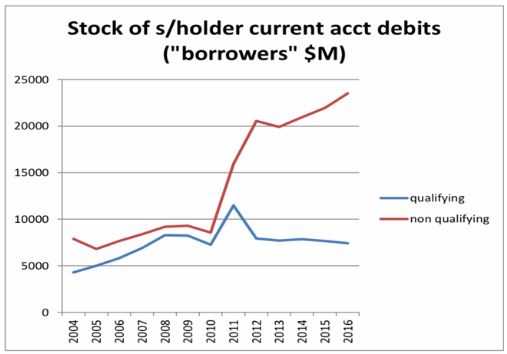
And they’ve gone from just under $10 billion in back in 2010 to nearly $26 billion by 2016. So, what’s happening here? Well, it appears that this could be a way of people trying to avoid paying the top 33% tax rate because company profits are tax paid at 28% and then the taxpayer then receives an imputed dividend and then tops up the 5% differential, assuming they’re taxed at the top rate.
But what happens if instead the money is advanced as an interest free loan or a loan to a shareholder? Now, there are rules around this, and interest free loans are subject to a prescribed interest rate. This has been cut to 5.26% with effect from 1st of October 2019. If you’re not charging interest, you are required to charge this prescribed interest rate of 5.26% on any overdrawn shareholder current account.
Now that is a longstanding rule, but in my experience, it’s not always observed, and I even had an interesting case at the start of an Inland Revenue review. The company did have an overdrawn current account for some shareholders. We advised Inland Revenue as you are supposed to saying “Look, oops our bad. This is an overdrawn current account and we haven’t been charging interest. Here’s the amount of interest we should have been charged”.
What was interesting about this case was it involved a fairly sizable company which had independent advisors, who ought to have known this. More curiously, the Inland Revenue investigator didn’t seem to be aware that that this could have been a problem. Perhaps this is why these current account debits have been gradually growing without too much observation from Inland Revenue.
So, the issue which arises here is have those companies being charging interest and if so, have they charged interest at the correct rate? Otherwise, there’s probably a load of FBT going to be payable. And why exactly are they doing this? If there is a constant pattern of substitution of, say, a salary or dividends with drawings made through the current account, Inland Revenue could follow the lead it took in the Penny-Hooper case. You may remember that case from nearly ten years ago. Inland Revenue may say, “Well, this actually constitutes tax avoidance and we’re going to treat these drawings as additional salary or remuneration”.
So, it remains to be seen what’s going to happen in this case. This is another head’s up. If you’re a company and you’re advancing money to your shareholders and you’re not charging the prescribed interest rate of 5.26% then you potentially have a problem on your hands.
And what I think we can also say with some confidence is that matters highlighted by the Tax Working Group as requiring work will be picked up by Inland Revenue as part of their work programme. The data mining capabilities of the Inland Revenue are now greatly enhanced, so I would anticipate seeing a lot more “Please explain” letters coming from Inland Revenue investigators.
Following on from last week’s item about the fact that Inland Revenue is withdrawing the general application ability to pay tax by cheques from 1st of March, earlier this week I went to a meeting between tax agents and Inland Revenue staff. And this point got raised with several agents saying, “Well, we’ve got elderly clients who either have no access to online banking or don’t know how to use it. They’re not happy about it. And we’re not happy about this”. Two things emerged from this discussion. Firstly, the Inland Revenue staff acknowledged this was something that was a potential problem. But they also pointed out that in fact, in certain circumstances, Inland Revenue will allow cheques to continue to be used to meet tax payments. Coincidentally, also this week, a new Statement of Practice SPS 20/01 was released by Inland Revenue which explains when it considers tax payments to be made on time.
The SPS discusses what the alternatives for people who used to pay by cheque, and can and are concerned they may no longer do so. And it gives a couple of examples about the options. One involves John who lives in a remote rural area and lives off the grid. He does not have any access to the internet nor a reliable phone service and is hours away from any banks. So, in this case, Inland Revenue would agree that his circumstances are exceptional, and he may continue to pay his tax by cheque after 1st March 2020.
The alternative example is another elderly person, Mary who is aged 75. She doesn’t have access to the Internet either. She has no Westpac branch. (You can actually rock up to a Westpac branch and pay your tax in cash or by using a debit card). Mary does have an EFTPOS card and the Inland Revenue here say:
“Through discussion with the customer about her circumstances, it was agreed that she is able to, with assistance by phone, set up a direct debit with us, or make payments using an automatic payments form. On this basis, an exceptions arrangement to pay tax by cheque post 1 March 2020 would be declined.”
So, there are instances that you can still continue to pay by cheque, but it’s very much a case by case basis.
I stand by what I said last week. I think that this is blanket policy which should not be allowed. I would say in that example they give about Mary, elderly people like that would be very, very cautious about talking over the phone to someone about paying tax. Particularly since Inland Revenue is sending out frequent reminder warnings about the phishing and phone scams going on.
So, I think you’ve got this dichotomy between Inland Revenue wanting to minimise its own administrative costs and not actually addressing the real concerns of people who are concerned about using online and phone banking.
The second point came out of the discussion was also pretty interesting, was that Inland Revenue had also said that in future, when either setting up or updating your bank account details, it would require a direct debit.
Now, that caused quite a stir amongst the tax agents. And let’s just say there was a full and frank exchange of views on the matter, which also coincided with us being advised that, in fact, that particular advice was going to be withdrawn. Clearly, quite a lot of people have said, “Wait a minute, what’s this?” because cancelling the direct debit with Inland Revenue is not that easy. The takeaway here is you do not have to set up a direct debit with Inland Revenue unless you really want to. Therefore, proceed with caution.
And finally, and this is a long running issue for me, a warning how the tax consequences of investing in Australia are often overlooked. There is a lack of awareness that, first of all, Australian capital gains tax will apply to property. But secondly, there’s also all the other hidden charges involved in investing in Australian property, such as Stamp Duty – or as they call it in New South Wales – Transfer Duty.
What caught my eye this week is that the state of Victoria, has announced it will withdraw its grace period for exempting foreign purchaser additional stamp duty on residential property.
This would apply to discretionary trusts that have foreign beneficiaries, for example, a New Zealand trust with, say, three beneficiaries here and one in Australia. This will now become regarded as a foreign trust for surcharge tax purposes unless the trust deed is amended to expressly exclude the foreign persons, that is the New Zealand residents as potential beneficiaries of the trust.
The change may mean that there will be a surcharge payable on the purchase by a New Zealand trust of residential property in Victoria. New South Wales has similar rules. In fact, there is a Surcharge Purchasers Duty of 8% for residential land purchases by foreign persons, which would include a foreign trust. New South Wales also has a land tax and it imposes a 2% surcharge for residential land purchases by foreign persons.
So, this is very much a case of if you’re investing in Australia, be aware there are great tax complications. I always tell my clients, “Don’t let the tax tail wag the investment dog”, but you really have to be sure if you are investing in Australian property that the returns justify the additional tax consequences that you’re going to incur.
And on that bombshell, that’s it for The Week in Tax. I’m Terry Baucher and you can find this podcast on my website www.baucher.tax or wherever you get your podcasts. Please send me your feedback and tell your friends and clients. Until next time have a great week. Ka kite āno.
10 Feb, 2020 | The Week in Tax
- Inland Revenue’s extensive powers of collection and its use of deduction notices
- Triggering a dividend through misunderstanding tax implications of transaction
- Terminal tax payment options
Transcript
As the recent story about the arrest of a student loan debtor at the border revealed, Inland Revenue has quite extensive powers to chase debt.
One of the powers it uses very frequently but which is not particularly well known, is the power to request require a person to deduct money from a payment due to another person and pass it through to Inland Revenue.
These ‘Deduction notices’ are issued under Section 157 of the Tax Administration Act 1994 and Inland Revenue makes quite extensive use of them. In the year to 30 June 2019, for example, nearly 57,000 taxpayers had deduction notices issued against them. Now these notices are usually issued to banks and employers, but the object of today’s discussion is that they can be issued to other persons such as customers and suppliers.
I recently came across one such case. A client approached me and advised they had fallen behind payments on their PAYE. This is a not untypical story. Cash flow suddenly dries up, but you still have to pay PAYE and GST. The amount owed was under $50,000 and was not what I would regard as terribly significant, certainly compared with other cases I’ve handled.
So, it was still at the stage where a discussion with Inland Revenue could have produced an acceptable payment plan for all concerned. But as I often see in cases like this, taxpayers put their head in the sand. And in this particular case there were some tragic personal circumstances developing which meant that the owner was understandably not quite as tuned into what was going on as he perhaps should have been.
What Inland Revenue did was it issued a deduction notice to one of his customers which said was ABC owes us $X and we require you to deduct $Y from any payment that you are to make to him. Now, can you imagine if you are a business and you receive a notice that one of your customers is behind on their tax? What are you likely to do? You’re likely to be concerned about your own payment schedule.
What happened for my client was that his customer took the decision to restrict the amount of work it was going to give in the future, effectively wiping out my client’s margin. And that will probably be the death knell for my client’s business.
Issuing a deduction notice is quite a big step. As I said, it involves going to a third-party supplier and saying basically this customer is in trouble. So, naturally the recipient of such a notice will take steps to protect themselves. It’s also, you could say, a massive breach of privacy, but you could probably also make a counterargument that businesses don’t want to be acting as unpaid bankers for other businesses that are struggling.
Now, the issue that has emerged in this instance is that Inland Revenue did not follow its own procedures. When we asked for a copy of the deduction notice in question Inland Revenue did not have it on file. This was a “manual notice” and Inland Revenue don’t issue many of these. For the year to June 2019, there were some seventeen hundred such notices issued, according to an Official Information Act request I made to Inland Revenue on the matter.
Generally speaking, Inland Revenue’s processes around the use of deduction notices require that the debt must have existed for 12 months before they take what is a fairly extreme step. That wasn’t the case either for my client. These cash flow issues had emerged quite recently.
So, we have an issue here where Inland Revenue haven’t followed the procedures at all. Furthermore, no attempt appears to be made to try and organise an arrangement plan, and after the notice was issued no copy was actually sent to a client. Copies of such notices are by law meant to be sent to a defaulting taxpayer.
Now Inland Revenue needs to have powers to enforce debt collection, and it does have extensive powers. But those powers must be applied properly and in accordance with the law and Inland Revenue’s own procedures. And that didn’t happen in this case. And the consequences are that the business has been hit hard, basically losing one of its major customers. And that will probably be sufficient to put the company out of business. And as a consequence of that, Inland Revenue is possibly not likely to recover the full amount that it was owed. So, it will probably turn out to be a rather counterproductive action on its part.
Now there’s a fine line to be drawn between Inland Revenue making proper use of its extensive powers and abusing those powers. And in my view, Inland Revenue crossed that line in this case. Of equal concern is the likelihood that it will bear no consequences for those actions. And that is simply wrong.
Tax assumptions
Now, moving on, you may have seen in last Saturday’s Herald a story about the unfortunate taxpayer who invested in a overseas exchange traded fund, and then had 33%, or over two thousand dollars deducted in tax when the fund was wound up.
Now, this is one of those situations involving unintended consequences which I see quite frequently. It so happened this week I encountered three similar cases where taxpayers had made assumptions about how a particular transaction would be taxed and then found out that wasn’t the case.
This brought to mind a quote I came across by someone called
Artemus Ward who said
“It ain’t so much the things you don’t know that get you in trouble. It’s the things you know that just ain’t so.”
(Artemus Ward is the nom de plume of Charles Farrar Browne sometimes regarded as America’s first stand up comic.)
And that quote probably should be written into the Tax Act, because that’s exactly what I see regularly.
All the problematic transactions I encountered this week involved companies. In each case, the New Zealand tax implications of the structure were either ignored or widely misunderstood. And as a result, the effect was to trigger a dividend and a substantial tax liability. Fortunately, we’re probably going to be able to manage the fallout from each of these cases.
Two of the cases involved companies with an overseas element. Now, the provisions in the Income Tax Act around dividends are extremely broad and taxpayers frequently misunderstand how broad those provisions are.
The golden rule for any payment made by a company to a shareholder or an associate of a shareholder is that it is probably a taxable dividend and therefore withholding taxes may apply. Keeping that in mind would have saved my clients a considerable amount of bother. The warning is if you’ve got any transactions involving distributing money or changing shareholdings by using, say, the company to buy back shares as was attempted in one of these cases, you are likely to trigger adverse tax consequence. I know it sounds like a plug for my services but get advice before you do so. And incidentally, watch out for any Companies Act implications because these were also overlooked.
And finally, Friday was the due date for payment of terminal tax for the year ended 31st March 2019. That’s for anyone who is not linked to a tax agent or who has had the extension of time arrangements available to taxpayers linked to tax agencies withdrawn.
Following up from my first story this week if you are having difficulties with making your payments today, get in touch with Inland Revenue and explain the circumstances and see if you can enter into an arrangement. Inland Revenue, believe it or not, is actually quite flexible around these issues and can be quite reasonable if approached quickly enough.
Secondly, another alternative is to use tax pooling to manage the payment. Check out the podcast episode I had with Chris Cunniffe of Tax Management New Zealand about tax pooling.
For example, right now cash flow is tight for a lot of people in the wake of Christmas. But through Tax Management New Zealand, and other tax pooling entities, the opportunity exists to make use of their services and mitigate the impact of paying the tax late and reduce the interest payable.
Just finally, a quick note that people should be aware that as of 1st March, Inland Revenue will no longer accept cheques for payment of taxes.
Now the last time I looked cheques were still legal tender under the Bills of Exchange Act. And yes, cheques might be greatly inconvenient for Inland Revenue, but it is a government agency and a substantial proportion of its ‘customers’ (as it likes to call them), are elderly or either don’t actually make extensive use of, or are uncomfortable, using online payments.
So, I think the arbitrary withdrawal of cheques is something that should never have been allowed to happen. It’s discriminatory. Although I can see Inland Revenue’s point of view, if we are all now customers and as we all know the customer is always right, then if customers want to pay by cheque that should be good enough.
Well, that’s it for The Week in Tax. I’m Terry Baucher and you can find this podcast on my website, www.baucher.tax, or wherever you get your podcasts. Please send me your feedback and tell your friends and clients. Until next time, have a great week. Ka kite āno.
3 Feb, 2020 | The Week in Tax
Progressive taxation on biological methane is John Lohrentz’s proposal to the New Zealand government as a tool to transition to a low carbon economy.
This week we look further into the importance of environmental taxation I raised last week, my first guest for this year is John Lohrentz, who works at the intersections of sustainability, social impact and tax policy.
John caught my attention because he was the runner up in the 2019 Tax Policy Charitable Trust Scholarship competition with a proposal on a progressive tax on biogenic methane emissions in the agricultural sector.
Transcript
Welcome, John. Thanks for joining us. So, what exactly are biogenic methane emissions and what is your proposal?
John Lohrentz
Yeah, well, I suppose the first thing I just want to say is thank you for having me. It’s great to be here. The discussion on environmental taxation is obviously something that I’m quite passionate about.
So, to give you a sense of what my proposal covers, I started from this thinking around the centrality of agriculture to our economy and to our way of life in New Zealand. And I started to look at what was happening over the next 10, 20, 30, 40 years.
There were a couple of trends that start to really stand out to me. One was that as the impact of climate change grows, it’s going to change the conditions for farmers. And those changing conditions are going to have impacts on how we farm and how we need to adapt our farming practices for our new world.
I also was looking at the fact that our population is going to grow by about 2 billion people globally in the next 30 years. This is going to create challenges with food security and at the same time as consumers are also demanding really new and different things. We’re seeing the rise of alternative proteins, of different milks and also a desire for better types of meat and better dairy products at the same time.
Looking at all of that, I start to just look at the agricultural sector and dairy in particular and what the future transition needs to look like. And I became quite convinced that actually really pushing ourselves towards more innovation in the agricultural sector is going to be key for the transition as we go into a low emissions economy and thinking about that.
I thought actually one of the ways in which we could quite effectively finance that move towards a more innovative agricultural sector is through a progressive tax on biological methane emissions. And basically, what my proposal is, is to look at the way in which instead of us taxing, in essence, the gross emissions of farmers at the farm gate, what we could look at doing is actually setting a tax that is built around the target.
What we do is over time, we reduce that target towards our 2030 goal and the Zero Carbon Act and our 2050 goal further on. And then the challenge for farmers is to keep up with that rate of change. And for farmers that meet or exceed that rate of change, there should be a net benefit to them. They should actually be getting money back through this proposal. And for those that are behind, a tax is applied progressively to recognise they’re actually at the further ends of the spectrum, where you can pick out the easy early emissions reductions.
And I think one of the big benefits from taking this approach is that we actually take this idea of being penalised for your emissions out of the equation. And the question is actually per either acre of land or per 10,000 litres of milk, the produce or whatever measure we want to develop, what is the level of emissions for that production? And this gives us a way forward of talking about the idea of actually maintaining or increasing production while we look at ways to de-carbonise how we do that.
TB
I mean, that’s what I find really compelling about your proposal. In essence it’s a behavioural tax. But it’s not a sort of a sin tax, like tobacco duties, etc. where the idea is to eliminate behaviours. Your proposal is to use tax as a tool to encourage a change, because like it or not, agriculture is incredibly important to the New Zealand economy and will remain so.
John Lohrentz
Absolutely, yes.
TB
And tax is a dirty word in this. But the key thing you’re doing here is picking up a theme that Sir Michael Cullen raised, and I was very intrigued by as listeners to the podcast will know. He talked repeatedly about the opportunity of using environmental taxation to recycle in and help move towards the lower emissions economy. That’s a key part of your proposal.
John Lohrentz
Yeah. I’m actually really glad you mentioned the Tax Working Group because obviously they had some things to say about environmental taxation. And I think one of the things that stood out to me from their report is that they built this framework for environmental taxation. They said these are the kind of things that we think an environmental tax would need to do in order to be a good idea, essentially.
One of the key things that they looked at is there kind of an elastic relationship between introducing this that’s going to have some behavioural sort of impact. And their analysis of emissions-based taxes is actually yes, there is some responsiveness there. This is a good area when we talk about greenhouse gas emissions to introduce taxation and then recycle the revenue back into the place where that’s coming from. The classic example might be something like a fuel tax in Auckland. The idea is if we’re taking the fuel tax out of Auckland, you put that money back into transport at the same time.
The other thing that I was quite interested in was the Parliamentary Commissioner for the Environment’s Report on farms, forests and fossil fuels, which came out last year.
TB
You cite that report quite substantially in your proposal.
John Lohrentz
I really enjoyed it. And I think I think the reason it was quite gravitational for me is it was the first time I really clicked on the reality that we talk quite broadly about carbon or about greenhouse gases. But actually, there’s some real differences when we talk about methane as opposed to carbon dioxide as opposed to synthetic gases or nitrous oxide. And they all have different ways in which they impact on our climate.
Obviously, I’m not a climate scientist. I’m a tax interested person who is coming to an understanding of this. But in very general, in basic terms, a ton of methane that’s put into the atmosphere has a very, very strong impact initially. And then over time, that impact actually falls off as the gas is basically broken down in the atmosphere. Whereas if you emit carbon dioxide, the impact is lower initially, but it stays in the atmosphere for several hundred or even thousands of years.
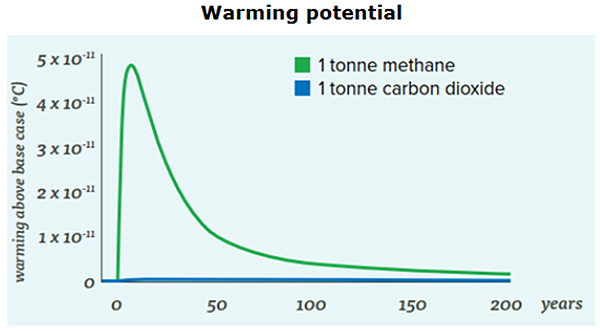
When we start to think about how we design good policy, I actually think the beginning point for us is that we need to start with the science and have a really strong understanding of the different ways in which these gases are having an impact on our climate and then build back from that into actually thinking about the different ways in which we can approach these gases.
TB
And that’s actually one of the fundamental parts of your proposal, because what caught my eye when you’re looking at this, because people right away will say “Another tax! We’ve already got to deal with the emissions trading scheme!”
In your proposal, you’re saying take methane out of the emissions trading scheme and deal with it separately because of the science behind it. Do you want to talk a little bit more why you think that change in the ETS is important in this regard?
John Lohrentz
Yeah, I mean, first of all, I think it’s really important for me to say that I’m really happy to see the work being done on the emissions trading scheme. And also, I in no way consider myself an expert on it. But when we talk about interventions, when it comes to reducing emissions, the two broad ideas either are creating a price mechanism or this kind of cap and trade system, which is the emissions trading scheme.
And there are some real benefits from the emissions trading scheme if it’s done really, really well, which is if you include all the industries, all the types of gases, then you can kind of get to this point where you have a working market, to speak, for emissions. The problem is, is that if you have that one price, single price, there’s a risk that we actually distort the decisions we’re making about where we put the most of our energy in reducing emissions, recognizing that difference in the profile of different gases.
This idea that action in different ways is all substitutable so reducing a tonne of carbon is the same as reducing certain amount of methane I think is problematic. And Simon Upton the Parliamentary Commissioner for the Environment points that out.
Some of the proposals that have come out from the Interim Climate Change Committee,
Ministry for the Environment and also some of the work done by the Productivity Commission earlier last year has looked at this. They said, well, there are definitely some pros and cons to running with the emissions trading scheme and building on what we already have or looking at the opportunity to introduce a tax or levy. And the Interim Climate Change Committee actually recommended let’s go to Malta was a levy when it comes to methane emissions from agriculture, because the profile of it is really different. And it’s also really important for us to recognize the centrality and the primacy of agriculture in our economy.
TB
Just on that a levy would not gone down well with farmers straight away. And so what you’ve gone said, well, let’s go and look at methane. And there’s two parts to it as I mentioned earlier. There is a tax on emitters of methane above a certain threshold. But more importantly, you propose recycling the tax through Research and Development tax credits.
John Lohrentz
Absolutely. And if I if I was to try and articulate how I would actually talk about my policy to people, I think I would start by saying this is a focus on innovation. And I think the tax mechanism, as useful as a way of talking about how we raise revenue to support that in a potentially innovative and effective way. But really the central focus of what I’m proposing is a 40% targeted tax credit for R&D in the agricultural space.
I did some work with numbers from Treasury and other places to kind of get a sense of how we can make this work. And it looks like one way we could do this is we could use the tax revenues we collect and split them reasonably equally between this R&D tax credit, but also a refundable tax credit to farmers who are below that threshold I talked about earlier.
The idea would be for farmers who are really pushing to operate sustainably instead of having a tax payment because they still have some gross emissions, the fact that they’ve done work and really put some effort in is recognized and is actually a value that they receive back as a refundable tax credit. And then at the same time, we’re stimulating some of the technological advancements we need to really reduce emissions, which should accelerate the whole journey of the industry.
TB
And this is something that’s been talked about, the wider perspective by Fonterra and other is that if we can innovate in this space, the global potential is enormous, absolutely enormous, particularly because of the methane emissions. So, yes, that’s another reason I found it’s an extremely interesting proposal.
John Lohrentz
Can I talk to that a little bit more? One that one thing I’ve been reflecting on in preparing for our discussion today is the Tax Policy Charitable Trust scholarship competition.
Immediately following [the announcement of the finalists] the next day I was in Wellington and it was about a week after the Zero Carbon Act had been passed. I was just walking on the waterfront and quite a large group of people who were gathering ready to walk to Parliament for a protest. And it became quite evident quite quickly that this was a group of farmers that had come from all over the region and wanted to deliver their message to some of the some of the ministers. And I had the opportunity to walk and talk with some of them.
And one of the things that was just really impressed upon me through all of that discussion that I had is that this is an issue that is incredibly important to farmers. And I actually think our way forward when we start to talk about tax in this area is that we need to sit down at the table together and really have the opportunity to air the concerns of farmers because they’re working really hard and they’ve seen compliance go up and up over time. And actually, it’s been a very challenging industry in practice to be part of for the last couple of decades. You know, there’s been benefits, has been growth, but at the same time, farming is a challenging profession.
TB
Your report is full of little insights in there, which should encourage everyone to think about farming. For example, the current level of indebtedness in the farm sector. What is it? 35 per cent of farmers have a debt to income ratio per kilo of milk solids that’s more than five to one?
John Lohrentz
It’s about $35 of debt for every kilo of milk solids. And they may have changed since I wrote my proposal. But I think what it goes to illustrate the fact that over a third of farmers are living with that really high debt is a real strain. And that number specifically is with the dairy industry. I think what that indicates to us is that there are some people who are doing really hard work. And the problem with that debt is that at the end of the day, there’s a lot of other factors that can impact on the milk price. As it is you can do a huge amount of work and then barely breakeven even in a good year.
If we bring an integrated lens as to how we think about that journey towards sustainability, is we also have to be really thinking about the well-being of our farmers through this transition and all of the financial factors that actually go into making that sector successful. I think there’s a lot of really good stuff happening, and we just need to carry on and be really clear as to how we how we have this conversation together.
TB
Yes, I quite agree. We were talking off-air about this risk of the town versus country divide you hear about. And one of the things I think that makes what you’re proposing interesting and compelling is it addresses those issues because it encourages behaviour. It’s not ‘You’re naughty, you must reduce that’. You’re saying those who move along this path to lower emissions will get refundable tax credits and the innovators will get rewarded.
And that then points the whole industry away from this volume-based model. As I mentioned, with a debt of $35 per kilo of milk solids and the price at seven dollars, the ratio is five to one. But if the milk solids price goes down to six dollars, suddenly that ratio six or seven to one. It’s a hell of a risk to carry. And the banking sector, as farmers well know, is starting to draw back from lending to the dairy sector. Sale prices for dairy farms are flat as well. So, there’s a number of pressures coming on for the sector.
John Lohrentz
I think one of the pieces which is really point for me to acknowledge is I think our long-term future remains as an agricultural nation. I mean, especially when we think about the success of our regions, farmers are really integral to that. And I think that there’s this really incredible opportunity with how demand is shifting, especially overseas, to really champion the cause of highly sustainable agricultural products in all their forms.
TB
I couldn’t agree more. On transition you talked about 2030 as a target, but you are saying that about 30% of farmers are already meeting your proposal’s targets.
John Lohrentz
These are my estimates so they’re not perfect. I think there’s definitely some more work to be done to understand how this is looking. But just taking the dairy industry, for example, the kind of spread of emissions per 10,000 litres of milk produced at the farm gate basically follows a normal distribution, but with a little bit of a fat tail towards the heavier emitting side. I looked at this and the targets we’ve set ourselves as a nation now through the Zero Carbon Act.
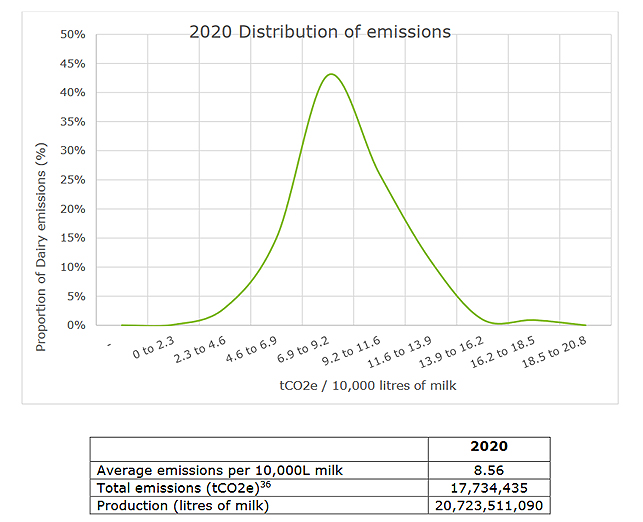
And actually, as of when I wrote my proposal, about 14 per cent of farmers are already below the rate that we want to achieve by 2030. And so, it’s a move to try to move towards achieving our target, which is about 10 per cent reduction in methane emissions by 2030.
What it would look like is about half the farmers in the sector activating quite strongly so we move from about 14 per cent below that threshold to about a third of farmers, definitely below their threshold with a heavier tail kind of moving more into the mid-range. And I think that’s entirely achievable.
When the Biological Emissions Reference Group reported in 2018 they said that based on a lot of the technologies and practices we already have in terms of best practice for how to run a farm they believed it was possible to get that 10% reduction even if we don’t see some of the technological breakthroughs that we’re hoping to see in the next 10 to 20 years. So, even if a methane inhibitor or a vaccine is not developed, we can still definitely get to our 10% target reduction. But the reason I think we need to invest in innovation now is because that’s what’s going to give us the ability to unlock our success towards 2050 on a longer timeframe.
TB
And these are long run investment projects, to be quite frank. You mentioned the work the Tax Working Group did in outlining a framework we need to work on. What other environmental taxes do you think we could be seeing coming along following that framework?
John Lohrentz
That’s a great question. The Tax Working Group’s looked at obviously emissions as we’ve already talked about. And that was both from the perspective of a potential tax, but also the emissions trading scheme. They also looked at some of the existing environmental taxes we have, which are around solid waste such as the waste disposal levy. They looked at water abstraction and water pollution and then they also looked at congestion taxes. Then they started to foray a little bit into more novel taxes. There was some discussion around this idea of an environmental footprint tax or a natural capital enhancement tax. Leaving those last two aside, I do think that there is some potential work to be done in that space of taxes on water abstraction/pollution, solid waste and congestion as well.
These are all really interesting issues. But at the same time there is a confluence of potential environmental impacts, financial impacts and also social impacts from all of the decisions we make around that. And one of the things I appreciated about how the Tax Working Group approached this question of environmental taxes is that they were very clear that our goals in the short and medium term should be quite different from our goals in the long term.
Looking long term, what we need to be focussed on is actually how do we build up a new framework of environmental taxation that could be a stronger base for our economy and that could potentially take some of the pressure off other areas like, for example, income tax.
And that’s going to take some serious work because we don’t just need a framework. We need a whole new way of thinking of how we structure the design for how we do this well to ensure that it has equity both in the temporal sense and also a distributional sense. I think that’s the big work to be done. And we can definitely start that now. But it’s going to take time to build that framework out in the shorter term.
How the Tax Working Group thought about environmental taxation largely focussed on this idea of internalizing negative externalities. I think that there’s definitely some work to be done there to ensure that where potential environmental damage is occurring through pollution or water abstraction or other avenues, that there is more focus put on ensuring that people who are doing that are paying for that.
However, I think we need to move quite slowly and also recognize that our thinking on what natural capital is and how to best protect that is just evolving. There’s more work to be done to actually develop that theoretical base for how we approach this. We shouldn’t just kind of gung-ho go ahead into establishing all these new taxes. I mean, the reality is, is right now environmental taxation revenue is about 6.2% of the Government’s budget. And I definitely think that can go up. But the way in which we do that and think about the kind of counterbalancing that we do at the same time is very, very important.
TB
On environmental tax the OECD recently released a report on taxation of energy, which in fact was highly critical of just about every country for their approach to taxing energy and the inefficiencies from that. What’s your thoughts on the OECD approach?
John Lohrentz
Obviously energy is really central to our progression towards a low emissions economy. The idea of where do we actually get our energy from matters because everything we do uses energy in different forms. I think we’re doing quite well in New Zealand with at least 80% or 85% renewable for a lot of our sources, especially around Wellington where I think it’s close to 100% renewable now.
I think some of the challenges that are going to be really central for us over the coming couple of decades are going to be first of all focussed around different industries. I’ve chosen to focus on agriculture because I think it merits the time to spend a lot of our energy thinking about how the sector engages. I think also transport is going to be very interesting and I think forestry will be the element where there’s some real important conversations we need to have around what role forestry plays in our transition.
TB
Yeah, you mentioned forestry in your proposal, because just to pick up a point you mentioned earlier, one of risks about the ETS is we could be busily reforesting areas because that gives a good initial short term answer in terms of meeting emissions targets. But longer term that may not be the most efficient use of the land.
John Lohrentz
This is also coming from the Parliamentary Commissioner for the Environment’s report where there are some really interesting discussion going on about the expectations we have around the usefulness of tree planting. And the key thing that the Commissioner said essentially was we don’t want to get to a point in 2050 where essentially what we’ve done is scored a net accounting victory. We’ve got to near zero, but we actually haven’t done that really hard work to really decarbonise the emissions in our economy.
And just to be clear, I’m a gardener, I love gardening. I love things that grow. And from that, I have a very strong preference for this idea that we should be planting. We should be going for it. Native trees everywhere, just plant, plant, grow, let things reforest and go for it. I think the bigger challenge is looking at the whole picture and saying we can’t just pay for our sins and carry on committing them.
There’s this need for all of us to be responsible for playing our part, whether at the business level, economic level or personal level to reducing some of those emissions.
TB
I couldn’t agree more. And what I liked about your proposal is it encourages change, encourages focus on the issue. It encourages innovation, which for an agricultural economy like New Zealand represents a huge opportunity. This is a classic case of looking at an issue and turning the telescope around to say, “OK, there’s an opportunity here for us. How do we manage that transition?” I commend John’s paper to you all.
I think that’s a really good place to leave it there. John, thank you for joining us.
John Lohrentz
Fantastic, thanks for the opportunity to have a discussion. I’m looking forward to more in the future.
TB
Me, too. This will no doubt be the first of many environmental discussions that we’ll be having over the coming decade.
Well, that’s it for the week in tax. I’m Terry Baucher and you can find this podcast on my website www.baucher.tax or wherever you get your podcasts. Please send me your feedback and tell your friends and clients. Until next time have a great week. Ka kite āno.
28 Jan, 2020 | The Week in Tax
- What will be the big tax issues over the next decade?
- Inland Revenue cracks down on Student Loan debtors
- Is CGT really dead?
Transcript
This decade is only a few weeks old, but I consider the likely major tax themes for the years ahead are already becoming very clear. Over the holidays, the news has been dominated by the apocalyptic visions of the Australian bushfires, and our thoughts and condolences go out to everyone affected by those fires particularly the families of those who’ve lost their lives.
Leaving aside the politics of climate change, which seem particularly toxic in Australia, New Zealand has signed up to reduce its emissions by 2050 and last year, the Zero Carbon Act became law. And in my view, over the next decade, the role of environmental taxes as one of the tools in meeting our emissions targets will become ever more important. So that is the first big theme I think we can see emerging.
Yesterday, the French government agreed to suspend collection of its digital services taxed until the end of the year.
Now, this was done in order to avoid increased tariffs with the United States government. You may recall that last year when France introduced its digital services tax America retaliated with tariffs. Now, in return for the French suspending collection, the US has now agreed to continue participating in the OECD talks aimed at achieving a generally agreed reform of the international tax system.
Therefore, the second and fairly obvious continuing theme for the next decade will be the issue of reform of international taxation, particularly for how it affects the tech giants such as Amazon, Google and Facebook. This is something that they hope to resolve this year, but I anticipate it could take longer than that. But whatever is determined it’s going to change the shape of international tax for years to come.
The third theme is wealth inequality. This has been talked about for some time. And what I think you will see coming forward is a question of how we address that. Wealth disparities have been reportedly rising over the past decade or so and various taxes are being mooted as a means of addressing that matter.
Housing affordability is one of those issues where wealth inequality plays out. And earlier this week, the annual Demographia report on housing affordability said that New Zealand’s eight major markets were completely unaffordable.
So, addressing housing affordability is one part of the equation which ties in with wealth inequality. And we’ll see across the coming decade stumbling attempts to try and address the issues coming from that. That’s a global trend as well.
Last week the news emerged that Inland Revenue had arrested a person at the border in relation to owing student debt. A woman had just returned to the country to visit a sick mother and she was arrested at Auckland Airport while about to fly to the United States. This is part of a law change that was made in 2014, which gave Inland Revenue the powers to arrest student loan defaulters leaving the country.
There are about 100,000 borrowers living offshore, and many of these have overdue debt. Actually, some of the numbers related to student loan debt are quite astonishing. There’s more than $16 billion dollars of total debt due and more than 700,000 currently have outstanding debt with 100,000 having overdue debt. And many of those are overseas and apparently outside the reach of Inland Revenue. So, it’s not surprising. Inland Revenue has given itself powers to arrest people. It does shake the tree quite dramatically and has produced some results.
Although it’s a very dramatic move the number of people that have been arrested for this has been actually quite low. It was three in 2016, one in 2017, two in both of 2018 and 2019 and one so far this year.
Now, this is a bit of an intergenerational matter because older people will take the view “Pay your debts” or “We’ve paid our student loans, so why shouldn’t you?”. And one response will be “You didn’t have student debt” and generally the issue dissolves into name-calling on both sides.
But leaving that aside, there are two things that concern me about this. Firstly, I think it’s another example where the current approach to penalties and interest just doesn’t work. If you’re going to charge penalties and interest, you’d hope that that actually does encourage payment. But apparently it doesn’t seem to do that.
The top 10 outstanding borrowers collectively owe $4.28 million dollars, at which point they’re going to give up. This is what I see in our business. They just simply going to give up. It then moves from being their problem to being our collective problem, because that’s now a debt that’s probably irrecoverable.
Secondly, why don’t we see people being arrested at the border for outstanding PAYE and GST? Time and again, I encounter situations where businesses have not paid their PAYE. In some cases, deliberately not doing so and filtering the cash away for their own purposes. Yes, Inland Revenue catches up with them eventually, and in some cases those people go to jail.
But I can’t help but think why don’t we have such a draconian policy towards arresting people who owe PAYE and GST? Particularly in the case of PAYE because that affects the livelihoods of many people. It’s not just a case of a debt between and individual student loan debtor and the Government. In the case of someone who’s defaulting on their PAYE and maybe also on the employer KiwiSaver contributions, their employees are missing out.
So, it seems to me that if we’re going to have such a dramatically fierce tool, which admittedly, is not used extensively, why are we not applying it more often to debts where arguably the social impact is greater?
And finally, I recently raised the question about whether, in fact, capital gains tax was killed off as supposedly happened last year when the Government did not follow through on the Tax Working Group’s recommendation for a general capital gains tax.
In my article, I took the view that the issue isn’t going to go away, in part because it’s tied into the wealth and housing affordability issues that I mentioned earlier. Also, what we’re seeing is that Inland Revenue will be applying the existing rules, which are often open to interpretation about intent, much more stringently.
And I’ve already come across examples where Inland Revenue is seeking to tax transactions which would have been subject to the bright line test if the bright line test had been in place at the time of those transactions.
Now Inland Revenue has been through their Property Compliance Programme, looking at this issue for almost 10 years now. But what was interesting to note about this particular set of transactions is that many of them date back to beyond what we call the time bar limit, usually for four or five years. And in fact, one of them was a 2012 transaction. So, it’s nearly eight years old now.
What seems to be happening is two things. Firstly, Inland Revenue is applying its enhanced capability through its Business Transformation program to review transactions. But secondly, and this is a critical point if you do not include a source of income in your tax return, which you should have included, then the time bar rules don’t apply.
Generally speaking, Inland Revenue can’t go back more than four or five years after a tax return has been filed, unless there’s been fraud or willful evasion. But if the income is never included in the first place, then it can go back as far as it likes. And Inland Revenue is now making use of this tool.
So what that means is that for all those people out there who may have had a quick turnaround on a property transaction, for whatever reason, you may find that even though you think that may be beyond the time limit for Inland Revenue to look at it, don’t make that assumption. They have more tools in there to do so now. And they’re now very keen to apply those tools to investigate older transactions. So, I expect to see quite a few more cases involving transactions eight, ten years, maybe even older as the as the Inland Revenue decides to crack down on this whole question of property transactions.
Next week, picking up the theme of the big tax issues for the coming decade, I’ll be joined by 2019 Tax Policy Charitable Trust Scholarship runner up John Lohrentz. We will be discussing his fascinating proposal for a progressive tax on bio-genomic methane emissions in the agricultural sector. We’ll also be discussing the future role of environmental taxes.

21 Jan, 2020 | Tax News
ANALYSIS: Who killed the capital gains tax proposal and why? What did that decision cost us? And is it really dead or just resting?
Tax is inherently political, so when looking at who killed the capital gains tax (CGT), the answer is straightforward: it was New Zealand First in the Beehive with its veto. Firmly slapping down Simon Bridges’ attempts to claim credit for the decision, Winston Peters declared: “We’ve heard, listened, and acted: No Capital Gains Tax.”
Curiously, one of Peters’ justifications for NZ First’s veto was that a CGT would unfairly penalise those who had been “forced” to invest in property following the stock market crash in 1987. It’s worth remembering that even if a CGT had been introduced those historic gains would not have been taxed. (This crucial fact was often rather conveniently overlooked during the debate.)
New Zealand First’s decision had the backing of a number of transparently self-interested groups such as the NZ Property Investors Federation but also many smaller businesses who were concerned about the potential impact.
The wider business concerns were a reason why three members of the Tax Working Group (TWG) — Joanne Hodge, Kirk Hope and Robin Oliver — disagreed with the group’s recommendation of a comprehensive CGT. The three considered any potential benefits would be outweighed by increased efficiency, compliance and administrative costs.
However, the TWG was unanimous that there was a “clear case” for greater taxation of residential rental investment properties.
Robin Oliver, a former Inland Revenue deputy commissioner, presented some interesting insights into the failure of the CGT when he and fellow TWG member Geof Nightingale spoke at the Chartered Accountants Australia & New Zealand (Caanz) tax conference last November.
Oliver commented on the visible lack of political support for a CGT, which was in marked contrast to how Roger Douglas and Trevor de Cleene had promoted the introduction of a goods and services tax (GST) in 1985.
Oliver also noted the proposed design was probably too uncompromisingly pure. In his view the politics were always going to be difficult and compromises would be needed to cross those hurdles.
Incorporating some form of inflation adjustment was another potential compromise. This is common in jurisdictions with a CGT. Australia, Canada, South Africa and the United States all do not tax the full amount of a gain. Instead, the gross gain is reduced by between 40 per cent and 50 per cent, with the net amount then taxed as if it was income.
The United Kingdom does tax the full amount of the gain but applies a different tax rate linked to the taxpayer’s total income. Interestingly, that tax rate can be higher if the gain relates to property.
Neither of these compromises were ever floated and so the CGT was effectively left to wither and die.
WHAT WAS THE COST?
What did the decision to shelve the CGT cost? For starters, the TWG modelled four revenue-neutral scenarios for redistributing the $8.3 billion a CGT was projected to raise over the first five years.
All four scenarios included personal income tax reductions of at least $3.8b over the five-year period, with the most generous scenario suggesting income tax reductions of $6.8b.
For many people, the decision not to adopt a general CGT meant they lose out on lower income taxes. However, a cynic might say that for residential rental investment property owners the continuing benefit of untaxed gains far outweighs any such benefit.
The decision not to adopt a general CGT does nothing to break New Zealand’s long-running pattern of over-investment in residential property.
The decision also does nothing to break New Zealand’s long-running pattern of over-investment in residential property, which means little real progress can be made on addressing housing affordability. There is therefore likely to be an ongoing cost for those Millennials and Generation Zers wanting to own their own property.
There’s a wider concern that funds which could be used for productive investment will be increasingly diverted into residential property, particularly in the wake of the increased capital holding requirements for banks.
DING DONG THE WITCH IS DEAD – OR IS IT?
New Zealand therefore remains an outlier in world tax terms in not having a generally applicable CGT. But it is not as if no capital gains are currently taxed. The tax system has nearly 30 separate provisions taxing some form of capital gain.
This includes a general provision which will tax any gains made from disposals of personal property if the property was acquired “for the purpose of disposing of it”. Critics of a CGT also ignored that it would have brought a certainty of treatment to all transactions.
In the absence of that certainty, taxpayers cannot always be certain that a property sale will be non-taxable. Tighter enforcement of the existing rules by Inland Revenue is very likely.
As a sign of this, I have recently become aware Inland Revenue is reviewing property transactions from as far back as 2012. Although these disposals pre-date the introduction of the bright-line test in October 2015, it appears they would have been taxable if the test had existed at the time of sale. The spectre of CGT therefore remains.
Robin Oliver concluded his comments at the Caanz tax conference by noting that although he remained opposed to a general CGT, he did not consider the present under-taxation of residential rental investment properties was sustainable in the long run.
Nightingale supported that assessment. Both were undecided as to whether a CGT was the best means of addressing the issue of under-taxation. An alternative might be to apply the deemed return approach used to tax overseas shares in the foreign investment fund regime.
It’s therefore wise to assume that CGT is not dead but merely resting. My expectation is that the debate will emerge in force towards the end of this decade as the rising cost of superannuation and health costs for the elderly puts increasing pressure on government finances.
By then inter-generational frustration with housing affordability may mean voters are ready to back change. We shall see.
This article was first published on Stuff.