Inland Revenue regularly releases Technical Decision Summaries (TDS). These are summaries from its Adjudication Unit in relation to dispute cases of interest between Inland Revenue and taxpayers. These give a good indication of Inland Revenue thinking around particular topics and how it might react to a transaction.
TDS 22/21 released last week is particularly interesting. It involves a two-lot subdivision carried out on a property by a taxpayer. He had initially purchased the property when working offshore for the purpose of renovating and extending it to live in with their extended family. Once the property was purchased, the extended family moved into the dwelling and the taxpayer joined them later on his return to New Zealand.
He then started planning to extend the property, but it emerged that there were problems with drainage and asbestos. Instead, it was suggested that the taxpayer should subdivide the property into two lots, constructing a new dwelling on each lot. And that’s what happened, during which time he was working overseas and visiting intermittently. Once one of the new properties was constructed, he occupied it for eight months. Shortly after the subdivision was completed one property was sold and the taxpayer and his extended family continued to live in the other property for a further five years.
Inland Revenue argued that the taxpayer had entered into an undertaking or scheme with the dominant purpose of making a profit under section CB 3 of the Income Tax Act. This provision is outside the normal land tax provisions, which is slightly unusual. Inland Revenue also ran the argument that the property was acquired for the purpose of intentionally disposing of it under CB 6, which is within the land taxing provisions. The question arose whether there was relief available because it was a main home. And finally, Inland Revenue also raised the question whether the sale of the subdivided lot and the property was subject to GST.
It seems part of the issue here may have been Inland Revenue just didn’t believe what they were being told. The Technical Decision Summary reasons for the decision opens with a reminder that the onus of proof is on the taxpayer to prove that an assessment is wrong, why it is wrong and by how much it is wrong.
This case turned out to have a good outcome for the taxpayer, because the Adjudication Unit ruled that the taxpayer did not enter into an undertaking or scheme for the dominant purpose of making a profit. Therefore, the gain wasn’t taxable under section CB 3. The Adjudication Unit ruled the taxpayer acquired the property for the sole purpose and with the sole intention of creating a home for themselves and their extended family. Therefore, the sale of the second lot was not taxable under section CB 6. It followed that as the property had been occupied mainly as residential land prior to subdivision, an exclusion applied. Finally, the taxpayer did not carry out a taxable activity for the purposes of the Goods and Services Tax Act, so no GST applied to the transaction.
The taxpayer won on all points. But there are several interesting points here. First is that Inland Revenue even took the case and the arguments it ran. This transaction appears to have happened before the Bright-line test was introduced, the TDS isn’t clear about the timing. The attempt to apply section CB 3 is unusual.
Secondly it highlights that Inland Revenue is paying attention to just about any property transaction and it’s prepared to use all provisions that are available to it. The case is a reminder to keep good records. I think the taxpayer struggled initially because not enough evidence was available, but they were eventually able to persuade the Adjudication Unit of what had happened.
Tax professionals vote for a Capital Gains Tax
Moving on, the Technical Decision Summary does point to an ongoing strain within the tax system around the taxation of capital gains. In many jurisdictions that have capital gains taxes the issue we’ve just been discussing would be not on whether or not the transaction was taxable, which is an all-or-nothing proposition, but what proportion might be taxable.
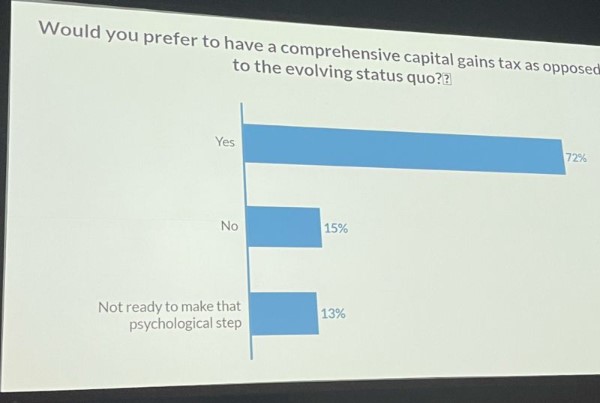
It’s therefore interesting to see that at the Chartered Accountants of Australia and New Zealand’s National Tax Conference recently, a poll was conducted on the introduction of a capital comprehensive capital gains tax. The question was put would you prefer to have a comprehensive capital gains tax as proposed to the evolving status quo, which is actually a very generous description of the evolving state, still, to be frank.
(Photo by Richard McGill of PwC)
I wasn’t at the conference. I would have voted yes, although plenty of caveats around how we might go about it. It’s also tempting to respond, “Well, that is a lot of self-interest by accountants voting for such a measure.” I know that I’ve seen similar comments pointing out when I raise the issue that of course I would support it because I get extra work out of that. I find it ironic to be accused of acting out of self-interest when the flipside of it equally applies people who don’t want a capital gains tax would also be saying so out of self-interest. Self-interest arguments cut both ways, in my view.
I do happen to think that self-interest is a problem in the tax system around this whole area. It’s very difficult to see how parliamentarians owning substantial capital assets are going to ever going to vote for something which is directly against their own self-interests.
The feedback from the CAANZ conference was that it’s necessary to keep our tax system comprehensive and robust. And it would actually simplify quite a lot of measures that we see right now. For example, if you had a capital gains tax, you wouldn’t have to work through the bright line test and its various iterations. You could remove the foreign investment fund rules, another set of rules which are complex and not well understood. And you would also probably remove, or certainly reduce the need for measures such as restricting interest deductions. This has been introduced partly as a response to the absence of a capital gains tax.
In my view, there’s a lot of distortions in the tax system because we don’t tax capital gains, and we are seeing more and more of that. At last year’s International Fiscal Association’s annual conference many of the issues we were debating really revolved around the strains on the edges of the tax system produced by not taxing capital gains.
A CGT is not going to be popular with politicians or for those who would be affected. But the rest of the world manages these strains. So, to pretend that we can get by without a CGT and continue the current incoherent approach to taxing capital gains, is a position that just simply isn’t sustainable in the long term.
Updates on global tax coordination
Now, moving on, in international tax news the OECD released its latest corporate tax statistics. There’s a lot to consider here which I’ll discuss next week.
The OECD also released data relating to the latest Mutual Agreement Procedure statistics covering 127 jurisdictions and practically all the mutual assistance cases worldwide. These Mutual Agreement Procedure cases arise when two or more tax jurisdictions want to resolve the tax treatment of a transaction or entity where each jurisdiction thinks they have priority. Transfer pricing issues are often involved.
According to the OECD, approximately 13% more Mutual Agreement Procedure cases were closed in 2021 than in 2020. But fewer new cases started this year, which is a small, unusual trend given the internationalisation of the global economy. But these Mutual Agreement Procedure cases do take some time to resolve, on average, about the 32 months for transfer pricing cases and 21 months for other cases.
But amidst all this, there’s some good news, including an award for Inland Revenue which together with Ireland was awarded the prize for the most effective caseload management. The most improved jurisdiction was Germany, which closed an additional 144 cases with positive outcomes – that is, the matter was fully resolved.
These awards seem a bit of fun, but actually it’s a pretty important matter because with the Base Erosion and Profit Shifting and the hopefully soon introduction of the Two-Pillar international tax agreement, the role of Mutual Agreement Procedures in resolving disputes is going to be important. It’s encouraging to see jurisdictions are making progress and cooperating better
Paying tax and the right to vote
And finally this week, the Make it 16 win in the Supreme Court over the potential voting rights of under 18 caused quite a stir. David Seymour of ACT jumped in with a rather ill thought out comment “We don’t want 120,000 more voters who pay no tax voting for lots more spending.”
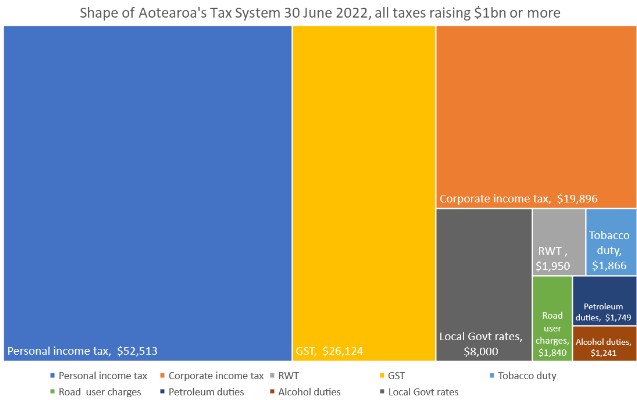
From the first time a child uses their pocket money to buy an ice cream and dairy, they’re paying tax. It’s called GST, which at over $26 billion is a quarter of the Government’s tax revenue. And as I pointed out on Twitter, lots and lots and lots of under-18s pay GST.
(The total of local government rates is an estimate. It appears the true figure is just over $7.3 billion)
The Make It 16 group made an Official Information Act request to Inland Revenue about how much tax 16- and 17-year-olds pay. And according to Inland Revenue over 94,600 16 -and 17-year olds paid a total of $82 million in income tax during the year ended 31 March 2022. That’s not an insubstantial amount of money (and doesn’t take into consideration the GST they also paid).
Given that 16 is the age of consent and 16 year-olds may drive, I don’t see much logic in saying that’s too young to vote. The kids are all right in my book.
Until next time kia pai te wiki, have a great week!
The Budget information document release on Thursday caused a bit of a stir and some excitable commentary. A few points stood out for me, particularly in relation to the ongoing controversy over the cost-of-living payment and its delivery by Inland Revenue.
We already knew Inland Revenue was less than happy to be involved in it, but some of the further documents released shed further light on it. Treasury’s recommendation was,
“…if you wish to progress with the payment along the lines of the commission[sic], the Treasury recommends that Inland Revenue be the delivery agency, given they are the agency best placed to deliver such a broad payment in the short term.”
Inland Revenue, on the other hand, didn’t want to be involved because,
“…delivering this payment, which is estimated to require around 1,000 staff at its peak for around two months, would have critical operational impacts on Inland Revenue while delivering the current COVID 19 economic supports. The addition of this payment to the portfolio of services that Inland Revenue already delivers would severely compromise Inland Revenue’s already stretched workforce.”
That’s quite an admission from Inland Revenue. I guess some of the controversy about accidental overpayments of the cost-of-living payment to ineligible recipients is an assumption that Inland Revenue is highly efficient. In reality once humans are involved then on the precept of “garbage in, garbage out” there were always going to be a few errors involved.
What concerns me about Inland Revenue’s admission, though, is it does seem to point to perhaps the organisation is a little bit too lean and mean after its staff has been cut quite substantially by over 20%. We know it makes extensive use of contractors which as we discussed last year, led to an Employment Court case, which it won, by the way. On the other hand the admission that basically it needs to increase its staff by about 20% to manage something like this points to perhaps Inland Revenue being more stretched than it ought to be in staffing levels.
And that also indirectly does raise some questions about Inland Revenue’s enhanced capability following completion of its Business Transformation project. It is perhaps too simplistic to think that a couple of pushes of buttons is all that was needed to enable the cost-of-living payments to be made. But it does strike me as surprising that Inland Revenue has to devote a thousand staff and additional resources to deliver the payment.
Now, one of the other criticisms that emerged has been made about the payment is that only 1.3 million people have received it so far of the estimated 2.1 million. But in reality, it was known beforehand that all 2.1 million estimated eligible people would not receive a payment straight away. One of the papers notes,
“around 25% of potentially eligible recipients, around 500,000 individuals, will not receive this payment during the proposed August to October window because their assessment for the 2020 122 tax year is not complete”.
The paper goes on to explain that based on tax filing information for the year ended 31st March 2020,
“…around 38% of people who submitted an IR3 did so by the end of July, and 53% by the end of September 2020. Assuming the same pattern for the 2021/22 tax year, Inland Revenue expects there will be a long tail of IR3 filers who would not receive their cost-of-living payment during the proposed payment window.”
The paper notes this will mean Inland Revenue will have “increased contacts” as people will be asking why they haven’t received a payment. This will then “have an impact on other services for taxpayers” such as Working for Families.
This is quite a reasonable point. But, of course, politics has intervened. And when you’re beating a dog, any old stick will do. So, the Government is copping it for what was obviously something that would have happened in the first place.
The other point that comes across is a wider one around the future sustainability of the tax system. Treasury was pouring a lot of cold water on Ministers’ various spending plans and pointing out the unsustainability of what was being asked for. Treasury warned
“Meeting these new targets consistently will require you to maintain a balance between revenue and expenditure. Over the medium term this would require significantly constraining spending growth, unless your revenue strategy is adjusted to maintain a higher level of tax revenue-to-GDP in later years.”
As the Herald noted, that would mean finding new taxes to leave spending as a share of the economy higher over the long term.
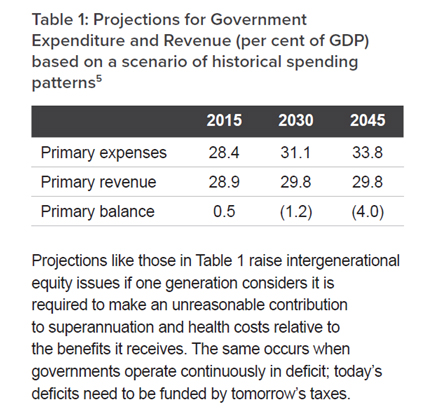
Now, one of the reasons the Tax Working Group recommended a capital gains tax was it had considered the long-term fiscal sustainability of the tax system based on the then current spending trends. Its Submissions Background Paper in March 2018 pointed out that based on then current projections, the Government’s primary expenses would rise steadily to reach 31.1% of GDP by 2030 and would actually mean that there would be a deficit of. 1.2% of GDP by then. The TWG recommended steps were needed to widen the tax base.
Those issues have not gone away and in fact will have been exacerbated because of the increase in borrowings that the Government incurred as a result of the COVID 19 pandemic.
We are not really having a discussion around how are we going to fund an ageing population, the increased demands on health and, as I pointed out last week, adapting to climate change. Every government seems to be stuck around keeping tax limited to 30% of GDP, Bernard Hickey has a long series of very interesting commentary on this.
The Budget documents don’t really address that issue in my mind, and it’s something that, as I’ve said beforehand, we’re going to need a serious discussion around how we expand our tax base and manage these pressures. Superannuation, remember, is now the second single biggest item of Government expenditure. This discussion isn’t going to go away and inevitably it’ll come back to the question of taxation of capital. We probably see the politicians fence around it during next year’s election. But those pressures will remain.
Pressure derails OECD deal?
Now, speaking of politicians under pressure, President Biden had been struggling to get his Inflation Reduction Act through Congress. But this week he managed to do so after a few recalcitrant senators finally came on board.
There’s a couple of interesting implications about this. Firstly, it appears to move forward the possibility of America coming on board with the OECD’s global tax deal. And in particular, the Pillar Two proposal for a minimum corporate tax rate of 15%.
However, it’s emerged that the Biden administration’s changes to the bill in order to get it passed appear to be at odds with how the minimum 15% corporate tax rate % is going to work. The details are a bit complicated, inevitably, but the corporate minimum tax of 15% will apparently only apply to the book income, that is income reported in financial statements of companies with revenue over US $1 billion. It will also only apply on a group level rather than at a country-by-country basis, which is contrary to the intention of the OECD tax deal, of eliminating the practise of setting up subsidiaries in tax havens.
Some international tax experts are saying the Biden deal may not now actually be compliant with the global tax deal. That possibly opens it up for other jurisdictions to say “Hang on, we’re not going to have that”. But ironically, it appears that US multinationals may in fact be keen to get the OECD Pillar Two deal passed through, because otherwise they may be exposed to additional taxes. So, watch this space. The point is, the Inflation Reduction Act is progress even if there are ructions still going on in Europe with Hungary now putting a spanner in the EU’s need for unanimity to agree the deal.
The other quite interesting thing that emerged is that the US Internal Revenue Service, the IRS, got US$80 billion of extra funding. And there’s a story from the Washington Post which explained why it needed that funding.
It includes an absolutely extraordinary photograph of the cafeteria in an IRS office in Austin, Texas. All that is visible is boxes and boxes of paper files, because the IRS had, as of the end of July, a backlog of 10.2 million unprocessed individual returns.
To give you an idea just how archaic the IRS’s system is, paper tax returns aren’t scanned into computers. Instead, IRS employees manually keystroke the numbers from each document into its system, (this is what Inland Revenue previously had to do until its Business Transformation programme).
It is absolutely extraordinary what’s going on with the IRS. I suggest every time you feel that Inland Revenue has dropped the ball and is hopelessly inefficient, thank God you’re not dealing with the IRS. We had a situation where we sent the IRS a letter in January 2020 and we did not get a reply until August 2021, and we were possibly one of the lucky ones.
Giant jump in tax writeoffs
And finally, a little snippet emerged about how much use of money interest the Inland Revenue has written off in relation to the COVID pandemic funding. National MP Andrew Bayly asked the Minister of Revenue how much tax interest and penalties have been written off for the last three financial years. The response was in the year to June 2020, it was $17.8 million, in the year to June 2021, $22.5 million, and in the year to June 2022, $26.8 million. Quite reasonably substantial amounts.
But what was also revealed was how Inland Revenue had applied its increased discretion to write off use of money interest as a result of the COVID 19 pandemic. The total amount remitted between 10th June 2020 and 4th of July 2020 was $104 million, which is way above what I would have ever estimated. This amount probably relates to well over $1 billion of debt, possibly as much as $2 billion. It gives an idea of the fiscal impact COVID 19 has had and will probably continue to have.
Well, that’s all for this week. I’m Terry Baucher and you can find this podcast on my website www.baucher.tax or wherever you get your podcasts. Thank you for listening and please send me your feedback and tell your friends and clients.
Until next time kia pai te wiki, have a great week!
Last Saturday, the ACT party leader David Seymour appeared on Newshub Nation and suggested that Inland Revenue be used to deal with the gangs.
He believed the powers currently being used by Inland Revenue as part of its high wealth individual research project could equally be applied to deal with the gangs. It did make for some entertaining viewing, as interviewer Rebecca Wright was more than a little incredulous at the suggestion that gang members wearing patches would happily submit to filling out questionnaires. On the other hand, the notorious mobster Al Capone, was ultimately jailed for tax evasion so the use of Inland Revenue against organised crime is not that unreasonable a suggestion.
Mr. Seymour does seem to have misunderstood the nature of the powers currently being used by Inland Revenue as part of its high wealth individual research project. Those powers have been deliberately limited so that the information gathered is solely for research purchase purposes. They are therefore more prescribed than the general powers available to Inland Revenue. I also think Mr. Seymour was overstating how much of a sanction non-compliance with the high worth individual research project would be.
Now Inland Revenue does indeed have some extensive powers of information request and where appropriate, search and seizure. And if you want an example of how it can apply those rules that can be found in the case of Tauber v Commissioner Inland Revenue.
In this case, Inland Revenue was investigating a former accountant who it believed was suppressing income. After its initial information requests were not satisfactorily answered in its view, Inland Revenue then decided to use the powers available to it under Section 16 of the Tax Administration Act. It carried out simultaneous search and seizure operations at six separate locations, including a boat shed.
Mr Tauber responded by making an application for judicial review, claiming that the various Section 16 warrants were too widely drawn and not specific enough. The application also questioned whether the searches were necessary for carrying out the Commissioner’s functions and if the searches were carried out in an unreasonable manner. Unfortunately for Mr Tauber and the other claimants the courts upheld Inland Revenue’s use of its powers.
The case illustrates the extensive powers available to Inland Revenue. However, what it also illustrates is that applying those powers is a very intensive operation requiring a considerable number of resources. If you’re raiding six properties simultaneously with teams of investigators, you’re talking about an operation which may have involved somewhere between 40 and 50 people. Now if you think about dealing with gang members Inland Revenue would also want to be raiding several premises simultaneously. Therefore, that would require considerable resources from it and no doubt police officers to be available in case matters escalated.
It’s therefore questionable whether Inland Revenue would actually have the resources to carry out major investigations into gangs. And although tax evasion is a criminal offence, Inland Revenue would probably be of the view that the powers available to police and other authorities under the anti-money laundering legislation, which have been strengthened this week, mean those agencies are more appropriately deployed to deal with organised crime.
This isn’t to say that Inland Revenue wouldn’t pass up the opportunity to investigate tax evasion involving gangs if it felt considerable sums were involved. But as the Tauber case shows, using its full range of investigatory powers requires considerable resources, which ultimately, I think, Inland Revenue might feel better used elsewhere. In other words, “Nice idea, but yeah nah.”
Update on OECD tax reform
Moving on, the OECD delivered its latest update on the status of the international tax reform agreement to G20 finance ministers and central bank governors a couple of weeks ago. This included a progress report on the status of Pillar One, which is the proposal to ensure that market jurisdictions can tax profits from some of the largest multinational enterprises.
The OECD Secretary-General presented a comprehensive draft of what these proposed technical model rules will be for Pillar One. These are now going to go out for public consultation between now and mid-August. The intention then is to finalise a new Multilateral Convention by mid-2023 for entry into force in 2024.
In addition to updating the status of the Multilateral Convention to implement Pillar One, the Secretary-General’s Tax Report also gave an update on how an implementation of the OECD transparency agenda (the Common Reporting Standards on The Automatic Exchange of Information). And the latest update is that information on at least 111 million financial accounts worldwide covering total assets of nearly €11 trillion was exchanged automatically between tax administrations in 2021. And later this year, the OECD will finalise a new crypto-assets reporting framework, which will be included as part of the Common Reporting Standards. So things are moving ahead even if they’re going more slowly than people had expected.
In relation to the Pillar Two work, which introduces a 15% global minimum global minimum corporate tax rate, the technical work on that is largely complete and an implementation framework is to be released later this year to facilitate the implementation and coordination between tax administrations and taxpayers. All G7 countries, the European Union and several other G20 countries, along with several other economies, have scheduled plans to introduce the global minimum tax rules. New Zealand hasn’t reached that stage but consultation on the matter has just ended, so we may see something later this year.
IRELAND’S TAX RISKS
Now one of the ideas behind the Pillar Two global minimum corporate tax rate is to try and stop tax competition driving corporate tax rates lower. Now, one of the poster child’s for lower corporate tax rates is Ireland. And last week I mentioned Ireland’s strong GDP per capita growth in recent years. This appears in part to be a by-product of multinational and multinational investment in Ireland, attracted by Ireland’s low corporate tax rate of 12.5%.
Now tax is always full of unintended consequences and this week the Irish Finance Ministry highlighted a potentially huge downside of this policy for Ireland.
Apparently just ten multinational firms pay over half of Ireland’s corporate tax receipts. These are expected to be between €18 and €19 billion this year, up from an estimated €16.9 billion forecast just three months ago. And by the way, that’s nearly a five-fold increase in the last decade.
Now, on the face of it that all sounds good. But John McCarthy, the Irish finance ministry’s economist, warned that the fact that just ten multinational firms pay more than half of honest corporate tax, represents “an incredible level of vulnerability” for the Irish economy, as a shock, which impacted on the multinational sector would have severe fiscal implications for Ireland. I understand something like one in nine Irish employees are employed by multinationals such as Facebook, Google and Pfizer. Therefore, the fallout from a shock in this sector could be huge for Ireland.
Mr. McCarthy told reporters the level of concentration in such a small number of firms is something he has never seen in any other economy. He was therefore more worried about the overreliance on these types of firms than the impact of the global overhaul of corporate tax regimes could have on Ireland’s position as a hub for multinational investment. Ireland power. The same report estimates that Ireland’s tax take would be affected negatively by about €2 billion over the medium term.
Irish Finance Minister Paschal Donohoe then chipped in saying he has long shared the concerns McCarthy outlined. He said the best way to manage the risk was to return to the pre-pandemic position where corporate tax receipts are not used to fund permanent spending. This seems an incredible admission that a low corporate tax rate is actually not sustainable over the long term. So that’s something to pause to think about when you hear talk about corporate tax cuts.
By the way, these concerns of the Irish finance minister and the Finance Ministry might explain why Ireland didn’t oppose the proposed 15% global minimum tax rate. I suspect that on the quiet this represents an opportunity for Ireland to raise its corporate tax rate without too much fuss. It would be interesting to know the level of concentration here in New Zealand. I guess the big four Australian banks and the New Zealand Superannuation Fund would represent at least 20% of the corporate income tax take.
IRD BACK LIQUIDATING DEFAULTERS
Moving on, a quick follow up from last week’s items about Inland Revenue’s enforcement and collection activity increasing. As of 30th June 2021, 140,000 taxpayers had arrangements with Inland Revenue covering $3.7 billion of tax. Now, Inland Revenue would be keen to ensure those numbers don’t continue to grow. Historically, what it’s done is taken strong enforcement action including initiating liquidations. Apparently about 70% of all high court liquidations were initiated by Inland Revenue. However, during the pandemic, as part of its more sympathetic response, that number fell to just under 30%.
However, I’ve been informed that since April that there’s been a huge escalation in Inland Revenue activity in the High Court and liquidation proceedings. So that’s the clearest sign of Inland Revenue’s increased focus on debt collection and a clear warning to all those out there that if you if you’re in trouble you need to front up and try and make arrangements with the Inland Revenue before they take it further to the liquidator.
AWARDS FINALISTS
And finally, this week, the Tax Policy Charitable Trust has just announced its four finalists in this year’s Tax Policy Scholarship competition.
This competition is designed to support tax policy, research and thinking. Entrance is limited to those under the age of 35, and the intention is that people are asked to give ideas of proposals for reforms to our current tax system, to address potential weaknesses and unintended consequences of existing laws. Now there are three topics in this year’s competition: environmental taxation, tax, administration generally, or the powers granted to the Commissioner of Inland Revenue and to investigate for research policy purposes. (These are the powers that Mr. Seymour was referring to in his interview about tackling the gangs).
The four finalists are Daniel Doughty, a senior consultant with EY in Wellington. He’s proposing a small business consolidated reporting regime to simplify tax reporting for small companies. I think this is an excellent suggestion, so look forward to finding more about this. Our tax system expects a lot of administration from small businesses without really trying to adjust the compliance burden to help them with those processes.
The second finalist is Mitchell Fraser, a tax solicitor with Mayne Wetherell in Auckland. Mitchell is worried that the new powers granted to Inland Revenue for tax policy purposes may have unintended consequences. He’s suggesting alternative means to collect the information that’s wanted, including through Statistics New Zealand.
The third finalist is Vivien Lei, a group tax advisor with Fisher Paykel Healthcare. Vivien has got another interesting proposal to change New Zealand’s environmental practises by introducing an impact weighted tax regime. Under this model, organisations will be taxed on a net positive or negative impact on the environment. Now this is an area I’m very interested in and previous readers or listeners of the podcast will know that John Lohrentz, one of the runners up in the last competition, proposed a progressive tax on bio genetic biogenic and methane emissions in the agriculture sector. It’s therefore good to see there’s plenty of focus on this area.
And finally, there’s Jordan Yates, a senior tax consultant with ASB in Auckland, and he believes the tax policy landscape has been fractured and suffocated by political roadblocks. I don’t think he’s wrong there. Jordan’s proposing an independent statutory authority that would be responsible for the independent management of fiscal policy as it relates to the tax base. It’s an idea I’ve heard floated in other places and another one I look forward to hearing more about. This fracture is one reason why the Minister of Revenue, David Parker, has proposed his Tax Principles Act.
The finalists have all been asked to develop a 5,000-word submission on their proposal. They’ll then make a final presentation and answer questions at a function later this year in October, after which the winner will be announced.
This is a great initiative by the Tax Policy, Charitable Trust, and I look forward to hearing more about these proposals. And as we did with Nigel Jemson, the winner of the last competition and runner-up John Lohrentz we will hopefully have the prize winners on the podcast.
Well, that’s all for this week. I’m Terry Baucher and you can find this podcast on my website www.baucher.tax or wherever you get your podcasts. Thank you for listening and please send me your feedback and tell your friends and clients.
Until next time kia pai te wiki, have a great week!
Inland Revenue has begun taking more action on outstanding tax debt. It dialed back how hard it was pushing on overdue tax debt during last year in the wake of Covid-19. But in recent weeks, its activity has stepped up, and those involved with corporate reconstructions are seeing much more activity with Inland Revenue pursuing tax debt.
There are some reports that it’s particularly targeting the housing and construction sector, but that’s not necessarily the case, as I understand it. But the housing and construction industry has a record of nonpayment. Inland Revenue is particularly concerned about those companies or individuals not keeping up to date in relation to their GST and PAYE obligations. Inland Revenue’s longstanding view is that such receipts are held on trust (because they’re being withheld from the payees) and therefore the companies have no right to the payments and need to pass them straight through to Inland Revenue.
An Inland Revenue spokesperson confirmed they were taking more action adding “We give high priority to any business that has failed to pay employee deductions when due.” In the past Inland Revenue sometimes seemed quite extraordinarily slow in taking action with overdue PAYE. But if it’s boosted its efforts in this space that’s all well and good because following Gresham’s law, bad money drives out the good. And those conscientious employees and businesses that follow the rules and make the payments as required are being undercut by more unscrupulous operators.
In that context, what I’ve been told is that Inland Revenue is also upping its efforts in relation to developers who are claiming GST on land purchases, but then failing to declare the GST when they make the subsequent sales of the properties. In some cases, you also have what they call “Phoenix companies” where there’s a pattern of developers establishing companies which then fall over leaving unpaid tax debts. Inland Revenue got itself extra powers to try and deal with those matters. And I would expect that with its enhanced capabilities following completion of the Business Transformation programme, Inland Revenue should be on top of that situation.
As always with tax debt the key thing to do if you run into trouble, is talk to Inland Revenue. It is actually surprising how little tax debt can soon become unmanageable for people. Inland Revenue’s own research suggests that break point is as little as $10,000. This ties in anecdotally what I’ve seen.
The key thing is, if you get in front of Inland Revenue early, tell them that you have hit difficulties and want to arrange an instalment plan, they will be cooperative. Where they won’t be cooperative, and in fact they may look to take action and prosecute, is where someone persistently fails to meet their obligations in relation to paying over PAYE and GST and then tries to evade any responsibility by attempting to liquidate the company. Such scenarios increasingly will lead to prosecutions by Inland Revenue.
People will be surprised at how reasonable Inland Revenue can be. But to do so you have to be front up early, put all your cards on the table and you can then hope to get a reasonable hearing. Sometimes it doesn’t work out, but you would be surprised at how often these issues can be resolved.
And this also takes the stress away from people, employers and business owners who get into tax trouble quite naturally stress about the matter and often put their heads in the sand. It’s remarkable how much of a difference to stress levels it makes once you’ve spoken to Inland Revenue, and you find is this they are prepared to come to some form of arrangement. That’s dependent on a number of factors, the key factor being willing very early on to deal with the issue.
GST for directors’ fees
Moving on and still talking about GST, Inland Revenue has released some draft guidance for consultation on the treatment of GST for directors’ fees and board members’ fees. This covers a number of draft public rulings and is accompanied as well by a very useful fact sheet. I’m liking how Inland Revenue is sending out a lot of these fact sheets alongside the longer papers with detailed consultation, because the fact sheets of what you can put in front of clients as they are a good summary of the issues.
The rulings will cover directors of companies, board members not appointed by the Governor-General and board members appointed by the Governor-General or the Governor-General in Council. Basically, what the rulings say is board members or directors must charge GST on the supply of services where the director or board member is registered or liable to be registered for a taxable activity that they undertake, and the director or board member accepts a directorship or membership of a board in carrying on that tax taxable activity. Remember, liable to be registered means they are carrying out taxable supplies which over a 12-month period would exceed $60,000.
And the director or board member cannot charge GST on the supply of services where they are engaged as the director or board member in their capacity as an employee of their employer or they’re engaged in in that capacity as a partner in a partnership, or they do not accept the office as part of carrying on a taxable activity.
As I said, these draft rulings are accompanied by a fact sheet, which includes a very handy flowchart, these flow charts and fact sheets makes life a lot easier and more understandable for those affected. The proposed rulings are reissues of previous rulings on the matter. They’re fairly uncontroversial as they generally are simply restating the law, updating the statutory references and setting it out in a clearer and more understandable format for the general public.
Tax take up strongly
Now, this week, the Treasury released the government’s financial statements for the 11-month period ended 31st May 2022. And it all looks a lot better than what was being forecast in May’s Budget. Core tax revenue is $2.9 billion ahead of forecast just at just under at $98.9 billion. Now, the main reason it’s ahead of forecast is a higher than expected corporate income tax take which is $1.6 billion ahead of forecast. There’s also more tax from individuals which is $700 million ahead of forecast and PAYE collections are another $600 million ahead of the Budget forecasts.
The corporate income tax take for the 11 months of the year to date is just under $17.9 billion compared with a forecast $16.2 billion. Just for comparison, in the year ended 30th June 2021, the total corporate income tax take was $15.7 billion. So corporate profits look strong, and I think one or two economists might be pointing to whether that might be feeding inflation. But whatever its role is, I’m sure the Government will be grateful for the continued strong growth in the corporate income tax take. By the way, that increased corporate income tax take will also reflect the fact that the New Zealand Superannuation Fund will be paying substantially less tax this year than in 2021 because of the volatility in the financial markets.
Favourable winds for windfall taxes
Elsewhere in the world President Macron in France is under pressure to consider a windfall tax on some parts of the corporate sector where high energy prices have resulted in higher profits. Britain, you may recall, imposed a windfall tax on some oil companies, although it’s come with a potential subsidy which may dilute the impact of that. Windfall taxes have no real history in New Zealand, so are unlikely to happen here. But it is to see how other jurisdictions are reacting to questions of what they perceive as excessive profiteering.
Housing’s tax-free advantage
And finally, this week the Reserve Bank of New Zealand issued an Analytical Note on how the New Zealand housing market looks in the international context. What it does is compares facets of the housing market in New Zealand with those in 12 other developed countries[1] over the 30-year period from 1991 to 2021.
And it notes that several other economies, Australia is one, have experienced increasing house prices in recent years, but the rate of increase has been the highest here. Interestingly we have also seen the steepest decline in mortgage rates since the Global Financial Crisis and then almost the strongest increase in population. Apparently, although we’ve been ramping up construction quite dramatically in the past few years, the number of dwellings per inhabitant remains low and below the average for the OECD.
There was some mostly passing commentary in the note about the impact of tax. The paper does touch on the absence of a general capital gains tax commenting:
“Another feature of the New Zealand economy that may support higher housing demand is the absence of a comprehensive capital gains tax. New Zealand is unique in that aspect in the sample of countries we consider, fiscal authorities in other countries tax capital gains from asset sales at or close to the personal income tax rate.”
Being an analytical note, it doesn’t make any recommendations as to whether there should be increased taxes on housing, although the OECD has been for a long time pushing that point. It’s always interesting to consider the role of tax in our housing market and also whether the absence of the fact that housing is treated so generously for tax purposes means that investment is driven into that rather than into more productive sectors.
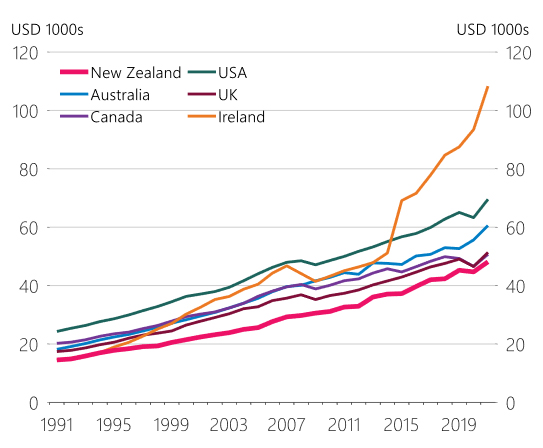
On that point, there’s a very interesting graph illustrating the surge in Irish GDP per capita over the last ten years or so, it’s really quite marked. The note comments that this surge
“was supported by high-performing multinational companies that relocated their intellectual property assets to Ireland attracted by lower corporate tax rates [12.5%] as well as Brexit-related uncertainty in the United Kingdom.”
Figure 4: per capita GDP in US dollars at current PPP
This Reserve Bank note reinforces my long held view that our favourable tax treatment of housing does divert funds away from productive investment and we need to change that treatment. As previously stated, my preference is for the Fair Economic Return approach Susan St John and I have proposed. .
Well, that’s all for this week. I’m Terry Baucher and you can find this podcast on my website www.baucher.tax or wherever you get your podcasts. Thank you for listening and please send me your feedback and tell your friends and clients.
Until next time kia pai te wiki, have a great week.
It’s good to see Inland Revenue have stepped up the focus in this area because we deal with quite number of clients in this space around their international tax obligations and there is a sometimes-surprising lack of knowledge. The main guide is the form IR1246 on Offshore tax transparency. It’s relatively short at 28 pages, including a glossary and as I said, is aimed clearly at the general public.
It begins with a little section at the start about “What your taxes pay for”. I think we’ll see more and more of this as Inland Revenue rolls out various publications as part of its compliance programmes. It’s a reminder of how much tax revenue is raised and where does it go. In case you’re interested Social Security and Welfare is the biggest single amount at $36.8 billion in the year to June 2021 with Health coming in second at $22.8 billion and education third at $16 billion.
This is adopted from similar initiatives we’ve seen in other tax authorities around the world, emphasising your taxes are for the common good and here’s where your taxes are spent and here’s how they may benefit you. So that’s a deliberate policy aimed at reminding people that tax is part of the price we pay for a civilised society.
The guide explains Inland Revenue’s role within New Zealand and then works its way through the various international obligations and standards. Some of this is pretty boilerplate and well known to tax agents and advisors but possibly isn’t so well known to the general public.
And the key point that Inland Revenue is really stressing is that it has access to a number of international exchange or information exchange programmes such as an exchange of information on request through one of the various double tax agreements or international exchange agreements New Zealand is a signatory to.
Then there’s a section which would make anyone with property overseas sit up and pay attention:
We annually exchange land data with many of our treaty partners. The data we exchange is a combination of this information we obtained from the land transfer tax statements, received land information in New Zealand and our own internal tax data. We also receive similar information from some of our treaty partners, which serves as good initial intelligence with an option to follow up with further exchange of information requests during the course of more in-depth compliance work.
We actually experienced this with one client when Inland Revenue requested whether we had disclosed income from property in the United States as they had received information from the US regarding the property. We had, but it was still illuminating to see how much Inland Revenue knew.
And then there are the spontaneous exchanges of information under FATCA (the Foreign Account Tax Compliance Act), and the Common Reporting Standard on the Automatic Exchange of Information. Incidentally, the next exchange under the Common Reporting Standard is happening in September. There are the collection assistance agreements under several double tax agreements. This is something I don’t think people are really aware of Inland Revenue’s ability to ask overseas jurisdictions to go hunting for delinquent taxpayers and outstanding tax.
And then there’s the foreign trust regime’s reporting requirements. An interesting point here is that any information collected during the registration and annual return process of a New Zealand foreign trust is shared with the Department of Internal Affairs as the supervisor of trust and company service providers and the Financial Intelligence Unit of New Zealand Police. This information is shared because of their regulatory role in relation to anti-money laundering and countering the finance of terrorism.
The guide then runs through the various types of overseas income, and you can find more details in the Foreign Income Guide. This also includes taxpayers working remotely in New Zealand for overseas employers. This appears to be part of a new initiative.
One page in the guide has the header “Offshore is no longer off limits” and the guide explains Inland Revenue is involved with other international collaboration outside those agreements have already mentioned. These include the Joint International Taskforce on Shared Intelligence and Collaboration which apparently includes 35 of the world’s national tax administrations. There’s also the Study Group on Asia-Pacific Tax Administration and Research. I was not previously aware of these two organisations. So, you learn something every day.
Overall, this is a welcome and important initiative from Inland Revenue. People are now able to access easily understandable guidance as to their overseas income obligations. There’s an interesting comment that as a result of an initiative under the Common Reporting Standards, it received over 900 voluntary disclosures from people after they were advised Inland Revenue had received information regarding their overseas income. Voluntary disclosures happen regularly once people realise they have not complied with their obligations they come forward to rectify their errors.
“Leaving on a jet plane…”
Now, with the borders reopening and international travel resuming, Inland Revenue has decided to release for consultation a draft “Questions we’ve been asked” (QWBA) in relation to the deductibility of overseas expenses. This publication was actually delayed because of the pandemic as Inland Revenue thought it and we advisors might be busy elsewhere and really nobody was travelling.
This draft consultation covers the issue as to what extent can income tax deductions be claim for overseas travel costs other than meal costs? And basically, the answer is they can only to the extent they have a connection with deriving assessable income or carrying on a business. No deductions can be claimed for any part of the costs that are of a private or domestic nature or incurred in deriving exempt income. Now where the costs need to be impulse apportioned between deductible and deductible, then this must be done on a basis that is reasonable.
The draft QWBA doesn’t consider two issues: the treatment of a companion’s travelling costs which is covered by QB 13/05. And secondly, the deductibility of meal costs which is dealt with in Interpretation Statement IS 21/06.
This draft QWBA is a short document, 14 pages. It sets out the legislation, considers some of the current case law and then includes four practical examples covering various scenarios. The first is where there’s a both business and private purpose for travelling overseas. The second where there’s a business trip involving incidental private expenditure. Example three deals with someone is travelling overseas privately, but then realises on arrival there’s actually some business opportunities.
The final example deals with cancellation costs, which have not been refunded, something no doubt quite a few businesses experienced because of COVID 19. The example suggests that the cancellation fees are deductible because the costs were incurred in the course of, carrying on a business.
This is more useful guidance on a day-to-day issue which businesses and advisors are going to be encountering regularly now. It’s particularly opportune with borders reopening now, and international travel resuming.
Big Tech’s transfer pricing strategies
Now, last week I covered Google New Zealand’s December 2021 results. The same day Facebook also released its December 2021 results. These are the first results it’s released since December 2014. This is because Facebook has changed its model to now report on a country-by-country basis.
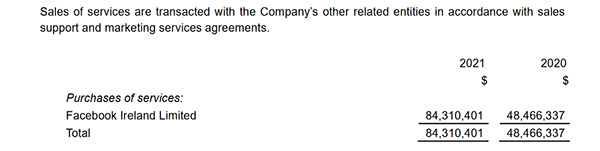
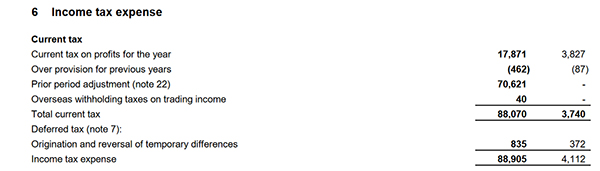
It’s interesting to see what’s gone on in the interim. Back in in 2014, Facebook paid $43,000 of tax on $1.2 million of revenue. This year, it’s reporting $6.5 million in revenue with a tax charge of $605,000. But the detail that’s of interest is what’s going on with its related party transactions as these give you a clue to the level of activity actually going on.
Facebook ‘s gross advertising income for the year to December 2021 was $88 million, which I have to say surprised me a bit as I thought it was higher than that. But anyway, these are the first concrete numbers we’ve seen for a while now.
$84 million was paid to Facebook Ireland for purchases of services.
Coincidentally, Facebook Ireland’s corporate tax rate just is 12.5%. So, you can work out yourself the potential saving that could represent for Facebook.
As I said in relation to Google’s results last week, it’s possible Inland Revenue is looking at this. We know there’s a lot of review activity going on in this space. Transfer pricing, audits and investigations do take some time and we got a clue as to how long and how they might play out result when British American Tobacco released its December 2021 results.
Included in these was a note that it had been engaged in an Advance Pricing Agreement (APA) process with Inland Revenue and the UK’s H.M. Revenue and Customs. This has been going on since March 2016 and it related to the combustible tobacco operations of the British American Tobacco Group. Agreement on the APA was finally reached in July 2021.
As a result, British American Tobacco New Zealand’s 2021 financial statements included a profit adjustment for prior years resulting in $70.6 million of additional tax payable for those prior years.
Now, the effect also of this agreement is that the tax payable for the December 2021 year rose from $3.8 million in the previous year to over $17.8 million. This increase illustrates the impact of the reduction in what overseas associates can charge. The turnover for New Zealand was roughly similar for both 2020 and 2021 at $247 million and $251 million respectively.
A win therefore for Inland Revenue and a little bit of a windfall as well for the Government. The case does show how long it takes to reach agreement on these issues.
Funding the road network
And finally, back in New Zealand, back in March the Government cut the fuel excise duty as a cost-of-living countermeasure. That was initially for a three-month period but is now being extended for a further two months until mid-August.
And this prompted David Chaston to take a look at the fiscal impact of this.
The National Land Transport Fund (NLTF) uses the funds from fuel excise duty and road user charges for the maintenance of country’s highway network.
The NLTF has some fairly big numbers going through it: in the year to June 2020, the total amount of fuel excise duty and road user charges amounted to just over $3.7 billion. In the June 2021 year, that total rose to just under $4.2 billion. However, as of April 2022, the total expected income from fuel excise duty and road user charges was about $23 million short of target. And obviously the longer the government keeps the fuel excise duty cut in place, the lower the income for the NLFT is going to be.
David therefore raised the issue about how are we going to fund the NLTF in the future? Remember that electric vehicles are currently exempt from those user charges, but thanks in part to the government’s clean car discount and the growing availability of electric vehicles, the number of EVs is rising. When does this exemption end? Longer term as the proportion of electric vehicles in the fleet rises, the amount of fuel excise duty will fall. This has to be an accelerating trend in order for the country to meet its emissions targets.
So, how is the NLTF to be funded in the future in order to maintain the highways? It seems to me there’s only two possible answers to that; firstly, increase road user charges, which means the exemption for electric vehicles must end, probably very soon. And secondly, and this is part of a wider decarbonisation issue, shift heavier traffic which increases wear and tear on highways to other modes of transport like local shipping and rail.
So that’s an interesting dilemma for any future government to be considering. I think any sort of environmental taxation moves in this space, are really more like behavioural taxes and therefore as the behaviour you are trying to discourage, the use of internal combustion engine vehicles declines, your revenue declines.
So longer term, some thinking has to go into how are we going to fund the maintenance of our highways? And it seems to me ultimately general taxation will need to become part of the mix. Rather than being specifically funded out of the National Land Transport Fund, the taxpayer will be paying a different way through contributions from the general tax pool.
That’s it for this week. I’m Terry Baucher and you can find this podcast on my website www.baucher.tax or wherever you get your podcasts. Thank you for listening and please send me your feedback and tell your friends and clients.
Until next time. Ka pai te wiki, have a great week.